Episode #
99
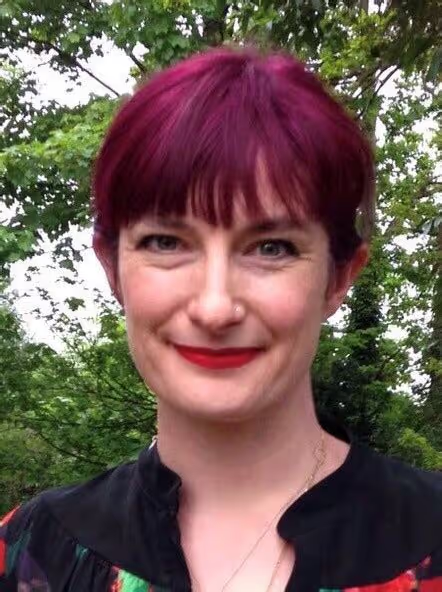
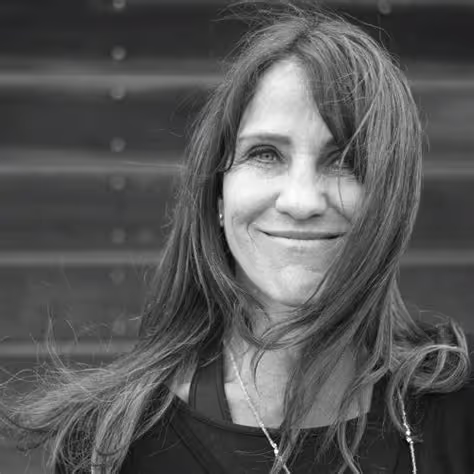
Chrissy Levett
Episode Summary
Q1: Place
If we could do a flypast on any part of the world that is significant to you, which place, city or country would it be and why?
The coastline of the UK
Q2: Life
Give us a glimpse into your life story so far with an emphasis on what you are doing currently?
Came out of art school, and worked freelance in the design industry as a job in graphic designer. I trained actually as an illustrator and printmaker, but then went to the Royal College of Art and did graphics there. I was passionate about seeing the world partly because I couldn't read so I learned through seeing things and hearing things and ended up during that time working for a number of different NGOs in different countries. Had two children and also had a massive midlife crisis in my 40s and then out of that midlife crisis came this idea of building a creative platform that would encourage the creative industry, the design industry to use its talents for social and environmental impact. That was the start of Creative Conscience
Q3: Reset
Where on earth is your place or reset or re-charge?
The Ocean. "I'm scared of it and in awe of it"
Q4: Wonder
What wonder of the natural world excites you the most?
The desert of Namibia
Q5: Hopefulness
What is your story of hopefulness (not your own) about a person, business or non-profit who are doing amazing things for the world?
Archie Moore who is a young designer and a graduate from Falmouth, School of Art. He created a project called Extra Bold. It was beautifully designed and it was really, really clever.
Q6: Insight
As we prepare to re-enter, what insight, wisdom or question would you like to share with us?
Out of despair comes great learnings'. I feel like the world and our society and political systems and everything that's going on is in a place of despair. However, from that place of despair can come the learnings that we need to change things.

Transcript
intro:
Orbiting 250 miles above, the space station provides us with the ultimate view of planet Earth. From this perspective, we ask our guests to engage with six questions that orbit around wonder and stories of hopefulness. For the next few minutes, this is our wonder space.
Steve:
Welcome to the ninety ninth episode of the wonder space podcast, which is an expression of a family trust called Panapur. My name is Steve Cole. And since September 2020, I have asked the same six questions to over 90 people from around the world. People like chef Ivor Peters, who in episode 26 talked about a life changing trip to Chennai, which inspired the creation of his Indian food business, Urban Raja, and also highlighted the issue of millions of people who are caught up in human slavery around the world. We are thrilled to be drawing from the wonder of Ask Nature, who are a project of the Biomimicry Institute.
Steve:
Their work looks to nature for inspiration to solve design problems in a regenerative way. Here is another moment to help us re wonder.
Ask Nature:
Life in the desert faces many challenges, including being periodically sandblasted by racing winds. For those creatures who wear their skeletons on the outside, that powerful scouring could mean deadly levels of erosion. But life finds a way. The desert scorpion meets this challenge with microscopic texturing across its outer surface. Thin grooves catch the air as it moves across the scorpion's body and spin it in the opposite direction, creating a turbulent cushion.
Ask Nature:
That cushion of air deflects some of the incoming wind and sand without them ever touching the scorpion. The grains of sand that make it through are still slowed by the reverse flow of the cushion and hit the exoskeleton with reduced force, a graceful interplay of physics and biology at just one of the infinite scales at which living creatures must interact with their surroundings.
Steve:
This week on WonderSpace, we orbit with Chrissy Levett, who is the founder and creative director of Creative Conscience, global platform that encourages, trains, and rewards creative thinking for social justice and sustainability. Krissy believes that design and creative thinking should be used to solve global challenges and as a form of positive activism. With this expansive overview of Earth, I start by asking Chrissy, if we could do a fly past on any part of the world that is significant to you, which place, city, or country would it be, and why?
Chrissy:
Wow. Well, this might sound really a bit dull, but it would be The UK. And it would be anywhere in The UK, which is by the sea, like staring out at the sea. Because I love, I love the sea. I feel slightly ashamed to say that I've visited and worked and travelled in some probably about a 120 countries, which is I feel bit ashamed around that because now with what we know around the climate crisis and moving around the planet and stuff.
Chrissy:
But I love this country so much. I love the greenness of it. I love the diversity of it. The tolerance, its culture, the landscape. It's so varied.
Chrissy:
Know, you could be in Scotland in the hills or you could be in Devon. It's like, I don't know. I just I just really love this land. And I love the darkness of British humor humor and kind of even our sort of sarcasm. I don't know.
Chrissy:
I just I love it.
Steve:
Chrissy, give us a glimpse into your life story so far with an emphasis on what you are doing currently.
Chrissy:
So in a nutshell, very quick, British born, the youngest of six kids, grew up in a quite a strange, how would I describe, like a sect, if you like. Something called the Plymouth Brethren that really not many people know about. It's quite a strange, dark upbringing, I'd say. And I couldn't get out of there fast enough and I escaped to art school. Basically because I couldn't really read and write but I could just draw and invent and was just a bit of an utter.
Chrissy:
So I went to art school. Had a brilliant time, loved it, came out of art school, and just worked kind of freelance in the what we call, I suppose, the design industry as a job in graphic designer. I trained actually as a illustrator and printmaker, but then went to the Royal College of Art and did graphics there. And so it just became this kind of job in freelance designer because when I left college, there was a big recession and there weren't no one was giving anyone any work. And then during that time, I would I was passionate about seeing the world partly because I couldn't read.
Chrissy:
I learned through seeing things and hearing things and it was kind of pre phones and podcasts. So I would just travel almost in order to learn and and ended up during that time working for a number of different NGOs in different countries. And then I would come back and work freelance and then go back to work in different places for sort of charities and stuff like that. And then that was my kind of life really. Until I had a couple of kids and then I couldn't really go to war torn countries anymore.
Chrissy:
They wouldn't let me when I didn't want to take my kids there. And then I had massive midlife crisis in my forties. And then out of that midlife crisis came this idea of building a creative platform that would encourage the creative industry, the design industry to use its talents for social and environmental impact. And that was ten years ago. And so I gradually let go of my old design life which was basically building products and brands that were really actively destroying our futures and moving towards using creativity to build better.
Chrissy:
And so that's what I kind of do full time now is help with a community of people run this thing called creative conscience. And that I would describe as a a kind of global platform, empowering and rewarding and training creative thinkers to use their talent for social environmental impact. And so we've had to date thousands and thousands of of projects from all over the world, mostly from young people, where they've taken a situation that might have been negative in their lives, and through that negative situation they've used their talent and skills then to build a positive solution. And we've got a lot, many many examples, but there are few that really spring to mind in terms of the impact that they had. So there was a young girl, she was Romanian actually, she was studying in The UK here, illustration and animation.
Chrissy:
And she created a project on teenage suicide and bullying. She built this beautiful, it was just stunning graphic novel. It was 166 pages, all digitally drawn around this issue of bullying. And she'd won an award with us and it was published on an anti bullying network site. And the project reached millions and millions of people.
Chrissy:
She had messages and emails from people from all over the world telling her that the project had saved lives, it had stopped negative behaviours like self harm. And I think what's so interesting about this, and we see it over and over again, is that it has come from her own personal experience of being bullied as a young girl. And I think sometimes it's easy for us when we are a bit older and we are set into an industry, we think that we should be giving young people the problem and saying, this is the problem, here is the brief, you sort it out. But actually when you let people come to the table with their own personal experience, whatever that experience may be, when it's personal to them, and then they mash it together with something that they love, that they're really good at, that's where magic happens. And so for us, it's all about empowering people to take those negative experiences and building on that and then bringing them together and showcasing them and celebrating them.
Steve:
Where on earth is your place of reset or recharge?
Chrissy:
It's when I meditate, which I do every morning without fail. But the place where I reset is in nature, and that is by the sea. The ocean, I just, I mean water generally, but there's something about the ocean that is, it just changes every day and it, it, it's so powerful, and it makes me feel really humble. I'm slightly scared of it, but I'm in awe of it.
Steve:
What wonder of the natural world excites you the most?
Chrissy:
I love the desert. Again, it's really frightening, but it's so beautiful. A number of years ago, I was privileged enough to travel from I've got family in South Africa, I travel from South Africa to Namibia, you know, overland. And I traveled through Namibia, and it was just a beautiful, beautiful country and the desert there was just mind blowing. And then you know having the opportunity to meet with the bushmen there and the way they live their life.
Chrissy:
They have an expression that if you have more that you can carry, you're greedy. And that really moved me. But again, you know, you were just dumped in the desert, you would very quickly die. So it has this sort of element to it that's really powerful, frightening, and beautiful.
Steve:
Chrissy, what is your story of hopefulness that's not your own about a person, business, or nonprofit who are doing amazing things for the world?
Chrissy:
I'm gonna choose one young man from my recent past and a guy called Archie Moore, who is a young designer who is a graduate from Belmont School of Art. And Archie created a project about it was a typographic project. And you think, well, how can typography affect and change the world? Because it's just a bunch of letters. Right?
Chrissy:
And I think this is a brilliant example how anything that we do can positively change the world. And so Archie created this project called Extra Bold and I think you can find it actually if you search for it. And it's an open source platform that has designs, typographic letters and alphabets and designs to help activists communicate better with sort of clear, relevant typography for their marches and for their work. And I just loved this because it was a completely selfless thing to put out in the world. It's really really powerful.
Chrissy:
The power of words and typography and clear messaging is really really important in in movements and in organizations. And it was just beautifully designed and it was really, really clever. So that's who I'd like to give a massive shout out to, and that's to Archie Moore.
Steve:
Finally, as we prepare to reenter the Earth's atmosphere, what insight, wisdom, or question would you like to leave with us?
Chrissy:
So there's a little bit of a story attached to this, and I won't go too deep into it but some years ago I found myself in a group, an Al Anon group meeting. It's like AA but it's for people who have lived with alcoholics or something like that. So it's a sort of it's a community group. And I found myself in this meeting and I took a book away from that meeting and there was one sentence in that book that has become a mentor for me personally. And I believe it's kind of relevant to where we find the world that we're in right now.
Chrissy:
And the sentence that I read in this tiny little book that I took was, out of despair comes great learnings. And I feel like the world and our society and political systems and everything that's going on is kind of in a really, in a place of despair. However, from that place of despair can come the learnings that we need to change things. And so that would be my little mantra that I would leave with you, Steve. Out of despair comes great learnings.
Steve:
You can find out more about Creative Conscience at creative-conscience.org.uk. In her story of hopefulness, Chrissy spoke about Archie Moore, and you can find his project at extraboldfoundry.com. What is your story of hopefulness that's not your own? About a person, business, or nonprofit who are doing amazing things for the world. We would love you to consider recording yourself in under thirty seconds, sharing your story on your phone through your video or the voice memo or recorder app.
Steve:
You can then simply upload the recording to the link on our website, ourwonder.space, and we will look to include them in future episodes. I want to thank Chrissy for joining us on Wonder Space. Let's continue to share our stories of hopefulness that makes a name for someone else. We need them like never before. Thanks for listening.