
Episode #
48
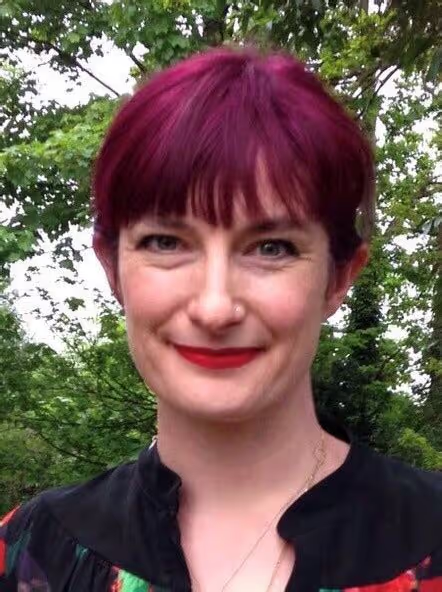
Tina Wetshi
Episode Summary
Q1: Place
If we could do a flypast on any part of the world that is significant to you, which place, city or country would it be and why?
The Democratic Republic of Congo
Q2: Life
Give us a glimpse into your life story so far with an emphasis on what you are doing currently?
Born and raised in London, Tina studied History and Politics and has a masters in Culture, Criticism and Curation. Co-founded Colechi, a fashion research agency and collective to reposition the broken fashion industry through collaborative practise and research. Tina also works in PR working with fashion brands and campaigns which is also working towards remodelling and reimagining the fashion space.
Q3: Reset
Where on earth is your place or reset or re-charge?
Anywhere with water such as the Docklands in London
Q4: Wonder
What wonder of the natural world excites you the most?
Victoria Falls
Q5: Hopefulness
What is your story of hopefulness (not your own) about a person, business or non-profit who are doing amazing things for the world?
PEM (People Empowering People) It forms a bridge with the council, institutions and charities; enabling local residents the opportunity to showcase the wealth of talent that exists within the community, and creating opportunities for local people to initiate and develop solutions to local issues.
Q6: Insight
As we prepare to re-enter, what insight, wisdom or question would you like to share with us?
Hold your space and seek the thing you most believe in

Transcript
Steve (host):
Welcome to episode 47 of Wonderspace. It's great to have you on board. My name is Steve Cole and over the past year I have been asking the same 6 questions to amazing people from around the world. The questions orbit around wonder and hopefulness and the setting for each journey is a shared window on the space station, 250 miles above Earth, from where we see everything from a different perspective. Before we introduce our guest, our friends at AskNature.org are going to help us to re-wonder.
Ask Nature:
What gives the hummingbird its hum? It's not in how it sings, it's all in the wings. Most birds flap vertically, with the downstroke creating a pressure wave in the air that we hear as a whoosh. Hummingbirds tilt their wings at an angle to the ground and then flap in a horizontal figure 8 pattern. This pushes air down during both parts of each stroke, allowing for dexterous flight maneuvering and creating 2 pressure waves that interact and produce the characteristic harmonics that give these birds their musical English name.
Ask Nature:
The hummingbird, what a fascinating creature.
Steve (host):
Our orbit this week will take us over the UK and Scandinavia and to experience these views with us in this ultimate window seat we welcome Tina Wechee. Tina is a cultural strategist and creative director and is the co-founder at Kalechi which is a co-learning and research space for independent fashion creatives. Kalechi were nominated by our eighth guests on Wonderspace Kate Fletcher and Matilda Tam who collaborated on an important fashion research plan called Earth Logic. With a panoramic view of Earth I start by asking Tina if we could do a flypast on any part of the world that is significant to you. Which place, city or country would it be and why?
Tina:
So for me it would definitely have to be Congo, the Democratic Republic of Congo. So that's where my family's from, that's home. I've never personally visited and you know I have to and it's just the 1 place that I need to go and whether it's flying past it or actually visiting I think in any shape or form that would be kind of I guess life changing.
Steve (host):
Tina give us a glimpse into your life story so far with an emphasis on what you are doing currently.
Tina:
Born, raised in London, I guess. I don't think I come out of London enough. So I mean, I think it's so interesting kind of coming from such an urban city, I guess an industrial space, where it's just kind of work, work, work from the go. I remember being young and 1 of our teachers saying that our school uniform is almost like called little business people and we're just kind of prepared for that world already. And yes, my parents migrated here from Congo, so they came here.
Tina:
I studied in London as well, so I studied history and politics, and then I did a masters in culture criticism curation. And that's where I was kind of really rooted into kind of history, politics, and all of these kind of ideologies, theories and things like that. And then thinking about how do we kind of show that to people, how do we create different ways for people to understand new ideas or to kind of see a reflection of the position that we're in. And I think from being someone who's always been in this 1 space, you always just have to use your imagination of what else can it look like. And going on to Kalechi, so Kalechi is a fashion research agency and collective, so we're all about kind of using collaboration and community in order to kind of think about how can we innovate the fashion space, how can it be kind of independent facing, How can it be people, planet and earth facing?
Tina:
And those ideas actually kind of started whilst I was studying and it's interesting because it's kind of an intersection of both of my interests from thinking about society and the world and then also fashion. Fashion is such a great space because it is culture, like it has the frivolousness and the art of just kind of you see it and you embrace it and it means so much to you in terms of your identity and everything, but then equally it's so reflective of us as people and reflective of culture, reflective of what our society looks like now. And I think being able to talk about all of the different things in the world, how we live in the world through fashion is such an interesting thing. And Kelechi really is just about thinking about how we can reposition the industry specifically. So it is kind of looking about fashion because it is such a broken industry and how it works, you know, there's so much hierarchy, there's so much kind of old systems, but then equally there's just not enough research.
Tina:
It's so rooted in kind of colonialism as well in terms of materials, in terms of how we think about how we're sourcing our relationship with the Western world and the global South. So there's just so much discussion and conversation, so many things that are rooted in how we've come to the society that we are now. And there's so much to deconstruct from it. And it's what Kellett is trying to do in terms of doing that extensive research to think about how we're in the place that we are now, but then how we can move and shift it. And then working with people who are doing that within their own practice.
Tina:
So just independent people who have kind of formulated their own craft, whether that comes from their studies, whether that comes from their heritage, their background, or they've just kind of done it themselves. And it's really about kind of coming together and thinking about how we can reposition the industry in that sense. So that's kind of a lot about my work now. And then I guess just my wider work is still rooted in fashion in terms of PR, so working with different brands and campaigns. So I'm just still on a journey of learning to be able to understand how we can remodel, how we can shift, how we can I guess reimagine our world and our space?
Steve (host):
Where on earth is your place of reset or recharge?
Tina:
My place of Reset is anywhere with water. Specifically now I would just say kind of like the Docklands, the River Thames, because that's where I live, but whether it's like a beach anywhere else I just think water is so humbling, it reminds us of our position within this ecosystem. Us as people are made of water, like 75%. When I think about my faith as well, it kind of links to that in terms of water as an element and thinking about the 3 different variants of it. And I think anytime I need to reset, I need to kind of be humbled and also reminded of my position in this world and the wider spectrum and just the wider concept of everything and I think just kind of being in that space it's encapsulating but it just brings me back to that kind of grounding.
Steve (host):
What wonder of the natural world excites you the most?
Tina:
The wonder of the natural world that excites me the most would be Victoria Falls. I would love to just kind of experience it and be immersed in it and equally I think the fact that it is in Africa, it's just such a land that is amazing to me and that I want to experience so I think yeah.
Steve (host):
Tina, what is your story of hopefulness that's not your own about a person, business or non-profit who are doing amazing things for the world.
Tina:
So my story of Hopefulness is PEM People, People Empowering People, which is a non-profit organization that works with local residents, community organizations, in order to kind of like bridge this gap between the council, institution, charities and give local people I guess the agency and the opportunity to be able to showcase their talents and to be able to exist within their local space. So we collectively we met Nicholas last year so we were told to speak to him because he was someone who was driving change within the area, so we're rooted in Southwark as well. And, You know, he's really working on a level with the council, which is a space that not a lot of people want to go into. Not a lot of people are represented in terms of thinking about black people are being a voice for us within these councils, within, you know, council meetings and discussions and government and where spending and funding goes. And he's really kind of spearheading Southwark as an agenda, young people within Southwark especially, to be able to have that ability to take space and to have space within all the regeneration that is happening and all of the changes.
Tina:
So, you know, arts and culture wants to be at the forefront of a lot of boroughs that have been neglected for a long time. And then people are really about kind of giving young people, especially agency, and not just young people, just local people who have the ability to do so much, but don't have that recognition. So they do this, they give a platform, they have some studio spaces in Olkent Road where they can give people kind of like training and they give people the ability to start their practice or what they need to do. There shouldn't really be an issue where people should have to move out we should be able to kind of have the agency and the ability to do what we do in terms of arts or culture or whatever within our areas. So in order to just kind of bring local wealth into Southwark and give people agency to be able to tap into the wealth within their own community and then to be able to be the faces of that.
Tina:
PEM people are doing that and that's something that is so powerful and so important and I think all of us should be supporting.
Steve (host):
Finally as we prepare to re-enter what insight wisdom or question would you like to share with us?
Tina:
Someone said this to me last year and then she just said hold your space which it doesn't mean much when you kind of say it but when I kind of like I guess unraveled it it was really just about kind of whatever you believe in that's what you need to seek and that's the only thing that you need to seek and it's as simple as that in the sense of there's it doesn't have to be so complicated and I think I'm someone who overthinks and sometimes wants to tap into many different things at the same time but you realize that whatever you're doing is always rooted in 1 thing. And whether that's something that's spiritual, whether that's something that's just something that you believe in or that you're passionate about, it always is just 1 thing. And I think it's about identifying that and then seeking that as a thing. And being able to hold your space is such an important thing to do because that, everyone has a place to be and it kind of goes back to what I was saying about humbling myself and being positioned somewhere in the world. And it's like if every single person has that responsibility of whatever that they're doing and they're constantly doing it then we work in unison and that's what it's all about.
Steve (host):
More Information and links to the work of Kelechi together with links to the previous 47 Wonderspace episodes can be found at ourwonder.space. I want to thank Tina for joining us on this Wonderspace and I hope you can join us next week for more wonders and stories of hopefulness.