Episode #
49
My Changing Planet
Episode Summary
Q1: Place
If we could do a flypast on any part of the world that is significant to you, which place, city or country would it be and why?
St Kilda in the Hebrides Isles in Scotland
Q2: Life
Give us a glimpse into your life story so far with an emphasis on what you are doing currently?
Seeking to reconnect with a childhood love and curiosity around nature. Frustrated and jaded by academia and a clinical life firefighting problems that are preventable. This sailing adventure to COP is about reconnection but also about listening to the oceans and challenging leaders to take a more holistic view of the oceans.
Q3: Reset
Where on earth is your place or reset or re-charge?
Nature - Where we find a sense of peace but also where we find answers
Q4: Wonder
What wonder of the natural world excites you the most?
Manx Shearwater marine birds comes onto land to breed. It then leaves the chicks in the nest and flies from the UK to the Antarctic. The chicks soon follow behind.
Q5: Hopefulness
What is your story of hopefulness (not your own) about a person, business or non-profit who are doing amazing things for the world?
Health and Harmony in West Borneo have set up clinics and livelihood programs leading to forests growing back and communities living more sustainable and healthy lives. Heal Rewilding is another project engaging with diverse and young communities to help give nature a chance to heal itself.
Q6: Insight
As we prepare to re-enter, what insight, wisdom or question would you like to share with us?
Through listening to the oceans and taking underwater recordings, this trip has been a reminder of how interconnected we all are. We need to collectively engage with politics and hold our leaders to account, vote with knowledge and put our leaders under pressure to listen deeply.

Transcript
Steve (host):
Welcome to episode 49 of Wonderspace. It's great to have you on board. My name is Steve Cole and over the past year I have been asking the same 6 questions to amazing people from around the world. The questions orbit around wonder and stories of hopefulness and the setting for each journey is a shared window on the space station 250 miles above earth from where we see everything from a different perspective. Before we introduce our guest our friends at asknature.org are going to help us to rewonder.
Ask Nature:
When food is scarce many animals lose weight but marine iguanas go further they lose length up to 20% of it. Since soft tissues only account for about 10% of their overall body length, it appears some of that shrinking is in the bones themselves. Then, when the food supply increases again, the iguanas build right back up to their full size. How do they manage such a large scale change to such a fundamental aspect of their makeup? That remains a mystery.
Steve (host):
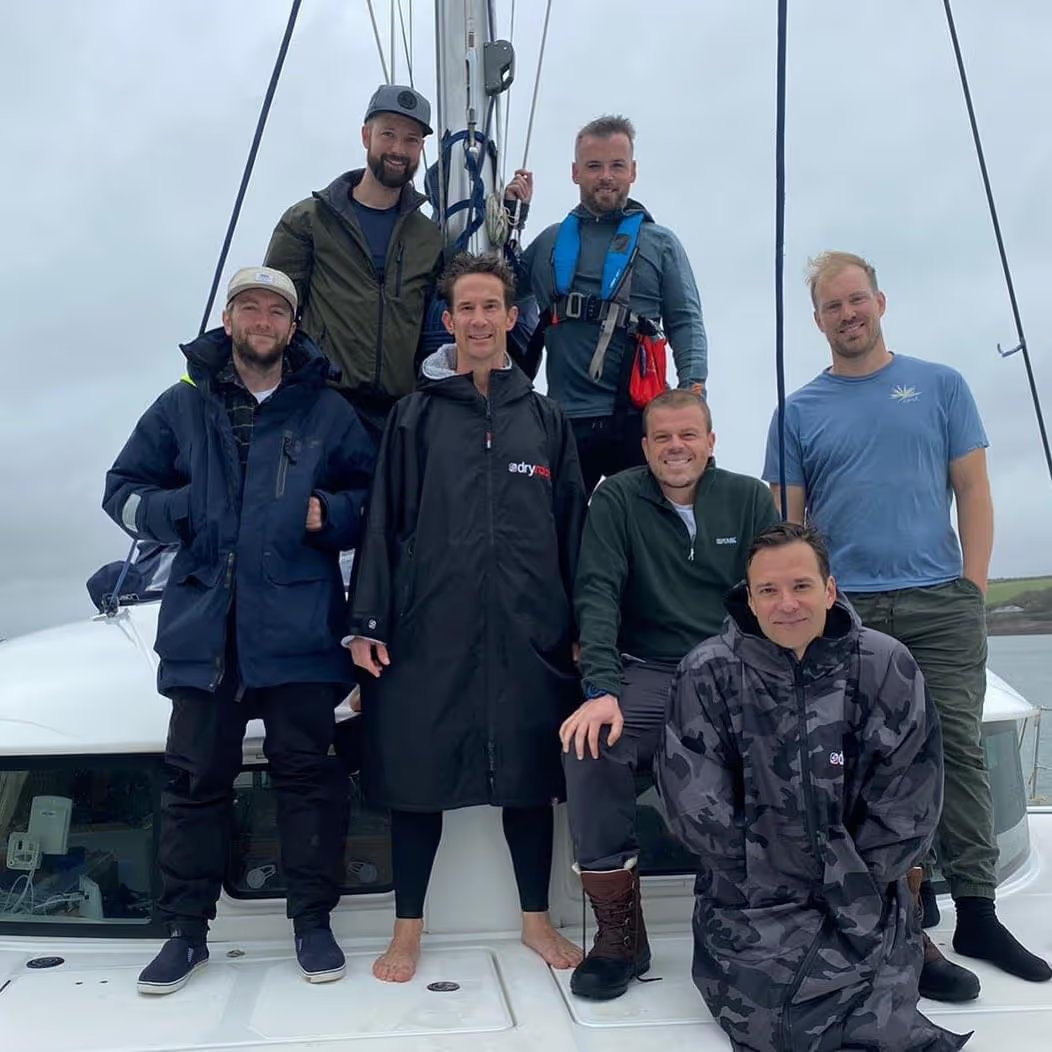
This Wonderspace episode coincides with the start of the United Nations Climate Change Conference in Glasgow. For this special edition of Wonderspace, we are going to quickly descend from the elevated views on the space station and join a different kind of crew of wildlife experts, adventurers and filmmakers, who over the past month have sailed from Cornwall to the COP26 summit in Glasgow. Dave Erasmus is 1 of the crew on board and is going to ask the 6 wonder space questions. But before diving into the questions, Dave briefly tells us about My Changing Planet and introduces the crew on board.
Dave:
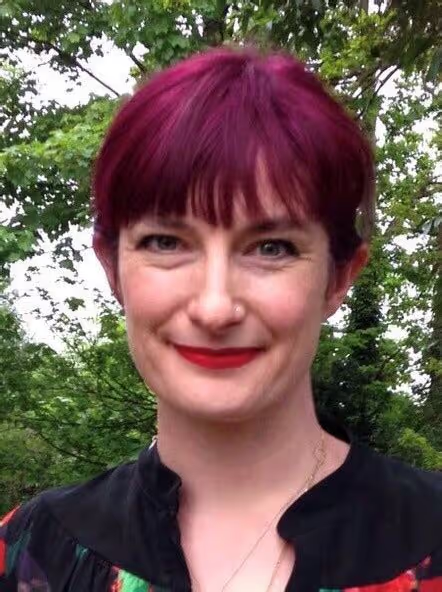
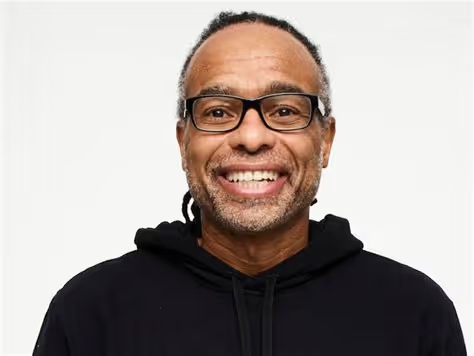
My Changing Planet is a total adventure into the unknown. A sailing trip from Padstow to Glasgow via Britain's wildest spaces, ending up at COP26, the environmental conference in Glasgow, at the beginning of November. On board, we've got 2 vets, 2 amateur adventurers, 2 filmmakers, none of which had any sailing experience less than a year ago. But what brings us together is some common desire to want to adventure, to belong, to find connection, find some kind of transformational experience that we can film and share with our audience and hopefully bring some organic value direct into the corridors of power at COP26. At the helm we have Andy Lindzell, prolific amateur adventurer, master strategist and passage planner.
Dave:
We have Paul Ramos, a dreamer who came up with this idea and started pulling the troops together. Jackson Kingsley, the director who has the whole film story pieced together in his mind. Sean McCormack our British nature specialist and chef supreme. And Jack Fisher not only the man who can get you any shot you want from the sky, but also with the eaglest of eyes to spot any buoy in the waters at about 500 meters ahead. My name's David Rasmus, crew member, dishwasher, and general connector, trying to make this whole thing flow.
Dave:
We hope you enjoy listening to this recording that we made on the choppy waters between Lismore Island and the Isle of Mull in the Scottish Hebrides. So the first question, if we could do a fly pass on any part of the world that is significant to you, which place, city or country would it be and why?
crew:
Well, we could talk about why St. Kilda was the place we're aiming for now, right? Yeah. Why it's significant
Crew:
and... Yeah, let's do it. I mean, yeah, so St. Kilda is kind of this group of islands past the Outer Hebrides, out towards, as they call it, the edge of the world. And the reason why it's significant is, on many levels, Culturally, their people have been there for thousands of years.
Crew:
Up until around the 1930s when all of a sudden 1 day everybody left and they all had gotten boats and they all came back to the mainland and never returned. So there's evidence of prehistoric and modern peoples there that still remain. It's also a place of, I guess, ecological significance as well. You know, being at the outside the outer Hebrides, we were hoping that it was going to be, I guess, an area that we don't see plastic pollution, that we didn't hear noise pollution and that there were still healthy colonies of birds and marine mammals. But yeah, that was the reason why we wanted to go.
Crew:
We wanted to see for ourselves just how wild it still is.
crew:
Yeah, and also it's been so isolated from the rest of the British Isles for so long. It's got its own endemic wildlife, like subspecies of wildlife that have become genetically distinct from their ancestors because they've been cut off from the rest of the land for so long. So really, really unique kind of place.
Crew:
In a way, I guess it kind of represents what we would like to find a world that isn't so influenced by what we're doing to the world we're living in. Really.
Crew:
Maybe we should just point out that the alarm and all the background noise, we're sailing through the fog at the moment and the little beeping noise is the AIS, which means that we're gonna have an impact at some point in the near future with another vessel or land or something else.
crew:
Approaching solid object.
Dave:
Number 2, give us a glimpse into your life story so far. I guess with how it really connects with what brings you here.
Crew:
I'm kind of coming full circle background to what I did as a child, how I was as a child. I always had my head down to the ground, looking under rocks, looking under logs, and kind of also by myself in that world. And it was, there was something just very magical. Even the closer you get to the earth, when you look in moss or in grass, that world, that microscopic world to a kid, There was something really magical about that, that I kind of lost touch with, I suppose, as I entered my teenage years, and tried to fit into, you know, as a growing adult, to the human world. And a good 15, maybe even 20 years has passed that I've been trying to reconnect with that, but I've become too economic by studying and getting degrees.
Crew:
But now I find by just having an adventure like this, I'm finally, for me it's about finding that magic again. And I've realized that The only way to do that is to get close again to the ground. Essentially, I think what we do as children reflects who we really are, and I think it's really important that
crew:
we listen to that. I'd add to what Paula said, we have a lot of similarities. I grew up looking under stones and logs and looking into ponds and seeing that like natural world as something that was like wondrous and awesome and you know in the true sense of the world like absolutely amazed by the complexity of life and nature. I think myself and Paul being vets, kind of, I would speak for both of us I think when I say like a little bit jaded of the clinical life picture of being in a vet surgery and just like putting band-aids on problems and firefighting problems that are totally preventable. Paul put it in a very good way when we first spoke about this project saying, you know, we shouldn't be looking at like the animal, the sick animal right in front of us, we should be looking at the holistic view of the animal's environment and it's the exact same with our planet health.
crew:
It's like looking at the little things actually we miss the bigger picture. I think 1 of the reasons I wanted to do this project is to say to government leaders look at the bigger picture, look at ocean health, look at like joined up thinking on a planet basis, on a global basis, rather than kind of trying to firefight and fix the little problems we're facing.
Dave:
Sweet. Question 3, Where on earth is your place of reset or recharge? Where do you go to reconnect I guess?
Crew:
Sometimes when when things get to me too much I take a walk anywhere in nature. For me right now, that's in the woods. And just walking and moving in nature. Sometimes I also talk to myself out loud and I speak back to myself out loud but being in nature at ground level is where I find most peace and where I look for answers when I need to pause and really think about it. The other month I was out with my 12 year old and I know that 1 day I'm gonna be gone and I told him, I took him to a tree and I said, I put my hand in the tree and I said, I just break some hearts because I know no 1 I'm gonna be gone in on his life.
Crew:
But I said, if you're ever having problems in life, you can go to any tree or Like the sea and I'll be there So that he has some somebody to talk to in nature so that he can go into nature and connect and Maybe can do that in the sense that he feels that I'm there listening that's that's how I feel yeah sorry when you have kids you cry a lot about
Dave:
kids it's good it's good yeah for me it's just the lone in nature I often like like you're demonstrating but for me often when I get alone in nature, some emotions hit me that I was like, I could cope without engaging with that. I didn't even know they
crew:
were there. You know,
Dave:
it's only once I get truly alone and I don't have to worry about anybody else, then all of a sudden I just get hit with this catharsis for like 10 minutes often. It's just out of nowhere. I wasn't even feeling down or anything. It's time to
crew:
think, isn't it? When you actively take that time away from the normal kind of stress, the normal routine, the normal commitments, like take 10 minutes or 2 days out of that time, stuff comes to light.
Dave:
Cool. Really good. So number 4, What wonder of the natural world excites you the most?
crew:
None of you seem to be interested in birds.
Crew:
And I'm there with my brother
crew:
and I'm just going, look guys, it's a canna, it's a kilomite, it's a this, it's a that. And I'm always a pain to say to people, I'm not like a bird watcher or a twitcher, but I just find birds absolutely fascinating because they're so different from us in many ways. And I think their ability to fly and to fly wherever they want and to like far flung places is just incredible. Like 1 of the species we were going to see on this trip, Banks Shearwater, little marine bird comes in to land at night, goes into tunnels, it's very rarely on land just to breed, and then it takes off once it's had its chicks and leaves them in the nest and flies from Britain to the Antarctic and South America in the space of a couple of weeks. And the chicks follow it later and go on instinct, on looking at the night skies, on magnetic fields, who knows how they do it, but they manage to just make their own way to South America and back.
crew:
And I just think the freedom of birds is just something that absolutely inspires me. You see lots of spectacles, natural spectacles, you see, you know, in wintertime starlings murmurating. We talked about them as an emblem of this trip. How do they fly around in this crazy form, like all looking out for each other and not colliding with each other and moving as 1 big unit. I think there's so much we don't understand about them but also so much that's like complex about their lives and different and when people are like oh I'm not really interested in birds just the big you know enigmatic wildlife or charismatic wildlife There's a lot more to discover so that's like wonder for me is looking at birds because they're all around us they're visible.
Dave:
What is your story of hopefulness not your own about a person or business or not profit
Crew:
that are doing amazing things for the world. I like this group called Health and Harmony there in West Borneo and what they've done is they, I think they took like a thousand, they did a thousand hours of just listening to communities to ask you know what do you need to make your life better and because they knew the problems ecologically in terms of palm oil and deforestation but at a local level the real level how can you curb that but by working with these communities they found out what they most want are livelihoods. They don't want to cut down the rainforest, but they need a way to feed their families. They also want good health care. Their expected life is shorter.
Crew:
They experience all sorts of preventable diseases, even deaths and birth, maternal deaths occur as well. And so since they've started, malaria has gone from a very, very common thing to die from to non-existent. They've set up an entire clinic, and they've trained Indonesian doctors to take care of the communities and also set up livelihood programs so that the forests are growing back, people have turned in their chainsaws and are finding another way to live that's more sustainable and that they have a sense of more self-empowerment as well in say. So yeah, that's a program that I admire.
Dave:
It's cool.
crew:
I'd probably mention a group called Heal Rewilding. So rewilding is like this movement away from traditional labor intensive conservation and such to actually give back parts of land to nature to heal itself. And what they stand for is obviously that, it's like giving nature a chance to recover and to help our planet and sequester carbon and all of those usual things that we talk about in rewilding. But they're very, very inclusive and at their core is being accessible to everyone. Rewilding can be seen as quite a game for people with money and land to dabble in but they are a charity, they're raising funds to do it as a collective, they are very much trying to engage young people, people from diverse ethnicities and backgrounds and demographic groups so it just seems like a kind of a breath of fresh air on the rewilding scene and they're currently fundraising for buying land and creating the flagship first project.
Dave:
And Andy's 1 was Regenerate in Roehampton, working with young people in the estates, giving them opportunities to thrive really, connecting them to opportunities and... 30 knots. 30 knots of wind. And that's why he can't talk about it, because he's dealing with the helm of 30 knots of wind as we rattle towards Mull. Final question if you're up for it guys is, so as we prepare to re-enter what insight, wisdom or question would you like to share with the audience, with us?
Crew:
That goes back to where this all began for me and as Sean alluded to before, our work is very much reactive and we're sick of it. We want preventative medicine for the earth. We want to put our energies into preventing problems rather than dealing with them and managing and mitigating them. So The problems that we're facing now, a lot of them, are because we are not acknowledging our connectedness with nature, with this world that we live in. And as a result, It's very expensive, both in terms of life and pain and economically.
Crew:
So what I'd like to do is share, just share how truly connected we are to the world. And that's the start of it. Just to acknowledge that and to plant that seed. That's what I want.
crew:
I think like our destination here is COP26. It's a political, global climate change conference. Our global leaders are coming together to talk. And for me, there's been periods in my life where I've been disengaged from politics and feeling like it was a bit futile or feeling a bit pessimistic about actually anyone doing any good rather than just talking the talk. But I think for everyone at this point in time, you know, if we're not getting the results, if we're not getting the actual action rather than just words from our global leaders, our politicians, local and global level, we all need to collectively actually engage with politics and hold our leaders to task and say like the time for words and promises and pledges is over.
crew:
We're on this precipice where you know ecosystems are collapsing all around us. 1 in 3 species of plant and animal are ready to go extinct in the next 50 years if we don't tackle this now. And I think it's for everyone to actually say, yeah, I might not be that engaged, I might not be that knowledgeable, but actually to vote properly and to put our leaders under pressure to do the right thing.
Crew:
I don't know what my answer is really, but it's something to do with listening. I think we all know listening is important, but I think there's a new type or idea around listening that's evolving from this project, and it's really about listening, In our case right now it's listening to the oceans, but I guess the bigger picture is listening to the earth and paying attention to what's there and It's so easy to be completely oblivious to it when it's right in front of you But I think through this project is definitely opening our eyes and opening our ears to a whole new world that has been right next to us but we just not paid any attention to. I think maybe we're quite privileged to be able to go out here and do this and experience all of this but I think it's something that everyone can do in some capacity and they can start just putting a little more energy into listening to what's already there. I think further on to that I think what we're doing with these underwater recordings I think it's interesting that there's often multiple layers, the surface level. For instance, recordings we're getting at the moment, there's 1 thing we're all hearing but there's another level you know once you dive deeper into it and I think that can be applied into other other parts of your life.
Steve (host):
Footage from this trip can be seen on the video of this episode which you will find on the Wonderspace episode page online. More information about My Changing Planet together with links to all their socials can be found at mychangingplanet.org. Films of the trip can also be found on the YouTube channel of Dave Erasmus. Next week's Wonderspace will be our 50th episode and will also be the second week of COP26 in Glasgow. To mark these milestones we will be asking our 6 questions to John Elkington who is a prolific author and a world authority in sustainable development.
Steve (host):
To engage with the previous 48 Wonderspace episodes go to ourwonder.space I want to thank Dave, Andy, Jack, Paul, Jackson and Sean for joining us on this Wonderspace And I hope you can join us next week for more wonders and stories of hopefulness.