Episode #
54
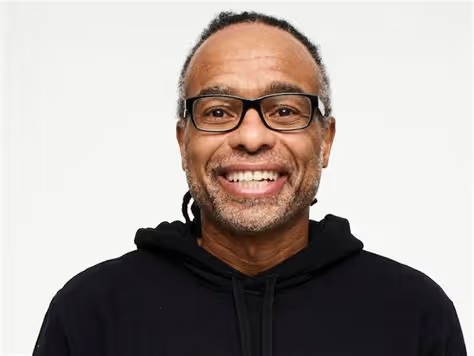
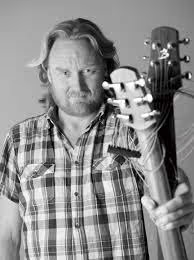
Jason Carter
Episode Summary
Q1: Place
If we could do a flypast on any part of the world that is significant to you, which place, city or country would it be and why?
North Korea
Q2: Life
Give us a glimpse into your life story so far with an emphasis on what you are doing currently?
Jason picked up the guitar aged nine. A career turning point came after a concert in Bahrain and a conversation with the Minister of Culture. His advice led to opportunities to work alongside The British Council and Unesco and perform in over 100 countries. Jason branched out into filmmaking and speaks about Directing and Producing the film, Grain of Sand.
Q3: Reset
Where on earth is your place or reset or re-charge?
Sauve in the South of France
Q4: Wonder
What wonder of the natural world excites you the most?
The Niagra Falls
Q5: Hopefulness
What is your story of hopefulness (not your own) about a person, business or non-profit who are doing amazing things for the world?
The quiet, peacebuilding work of former Finnish President Martti Ahtisaari
Q6: Insight
As we prepare to re-enter, what insight, wisdom or question would you like to share with us?
When we engage with creativity we have the potential to touch the profound.

Transcript
Speaker 0:
Welcome to episode 54 of the Wonderspace podcast, it's great to have you on board. My name is Steve Cole and over the past year I have been asking the same 6 questions to amazing people from around the world. The questions orbit around wonder and hope from us and the setting for each journey is a shared window on the space station from where we see everything from a different perspective. Our orbit this week will take us over Europe towards the Arabian Peninsula and to experience these views with us in this ultimate window seat we welcome Jason Carter. Before Jason responds to our questions he is going to help us to rewonder with the ending of a piece performed on the harp guitar called Different Worlds.
Speaker 0:
Jason has spent 25 years of his life touring to over 100 countries as a classical guitarist. Working alongside the British Council and UNESCO, his creative piece building and intercultural work has taken him to countries such as North Korea, Afghanistan, Pakistan, Uzbekistan, Russia and China. Jason is also a filmmaker and is best known for his film, Grains of Sand, which he speaks about as part of his story. With a panoramic view of Earth, I start by asking Jason, if we could do a flypast on any part of the world that is significant to you. Which place, city or country would it be and why?
Speaker 1:
Yeah, it was a difficult 1 trying to think about where I'd like to hover over or travel over, because I have traveled quite a bit as a musician and met some extraordinary people in extraordinary places. And I think I've chosen North Korea because I was there in 2007 giving concerts. I gave 5 concerts in the Opera House over a period of 5 days to the general public and whilst North Korea it was it was such an extraordinary experience because on 1 level I was so restricted in my movements and who I could speak to on a daily basis and yet When I sat on stage in front of those people I was for a moment free Not that I could talk to people it wasn't allowed but I could sit and play music to them and that was such an incredible privilege. And so we live in a day and age where instantaneous contact with people is normal. We meet someone at a concert or we meet someone at a restaurant and we can exchange contact details and suddenly we're on WhatsApp or we're on email.
Speaker 1:
And it's so normal these days to be in contact with the world and yet after leaving North Korea in 2007, I have no idea what those people that I met are doing and how they are. And I became very closely acquainted with my guide and my translator because they were with me, not 24-7 of course, but they were with me from the moment I woke up until the moment I went to sleep. Which was quite stressful mostly because you know you're followed everywhere however inevitably the human contact and that relationship did develop and when I said goodbye to them at the airport it was quite almost a teary event which is very bizarre And so I'd like to hover above North Korea, recounting my time there and giving a thought for those people that I met and wondering how they are.
Speaker 0:
Jason, give us a glimpse into your life story so far with an emphasis on what you're doing currently.
Speaker 1:
I spent 25 years as a touring classical guitarist and you know I've been playing the guitar since the age of 9 and never put it down really But it comes to a point where you think, well, how do I do this professionally? How do I, you know, what do I do? And a job, I was unemployed living in London and a job came up in Dubai playing the guitar at the Hilton in Dubai in 93. So I thought, wow, get to go get to go to the Middle East for the first time and I get to play for money. So I went with about 5 days notice.
Speaker 1:
I got on the plane and I remember, I had no idea where Dubai was. I remember knowing it was in the Middle East, thinking it was in Saudi Arabia, like everyone thought in those days because Dubai wasn't on the map as such as it is now and I remember just following the map of the plane thinking. Oh, it's there, you know and You know the job was boring. I mean I was playing 5 hours a day You know 6 days a week in the lobby of a hotel it was summer so it was incredibly hot and yet I got a taste of of the United Arab Emirates at a time when it was still really quiet and dusty. I remember you could even walk into palaces and meet the sheikhs, you could walk into people's houses, Dubai was covered in dust it was really dead you know but And so I was so grateful to experience the golf at that time when it was still pretty much unknown to be honest.
Speaker 1:
And I spent 3 years in and out of the Emirates doing those kind of gigs. And after 3 years, I should have had enough. You know, it was kind of not the place. The place is amazing. It's just that I wanted to be a performer, wanted to tell stories through music.
Speaker 1:
And so I came back to London and I basically started selling myself as a concert guitarist. I'd had 3 years playing the guitar every single day pretty much for 5 hours a day. I had a cracking good technique and I was ready to play my stuff. And so I went on tour in Ireland. I phoned venues and arranged a concert tour.
Speaker 1:
I did 20 concerts in about 6 weeks in Northern Ireland. And from there, it just spiraled really. And I just, you know, I've always been good at self-promotion, so I kept on that. But in 1999 came a turning point. I was back in Bahrain, and I was playing a concert with the Bahraini Pearl Divers and amazing experience these old guys were there sort of the sort of key holders to these songs that have now disappeared and to share the stage with these with these old men was just a magical experience very generous and After the concert the Minister of Culture came to me.
Speaker 1:
He said, he's so excited. He said, Jason, you have no idea what happened tonight. And I said, well, what do you mean? And he said, well, tonight you've played a concert to a mixture of Sunni and Shia. Now we have had a lot of issues in Bahrain with tensions between these groups for a long time.
Speaker 1:
And I think you need to really think more about why you do what you do and would there be possibilities of you doing this more? And I thought, wow, that's amazing. I didn't think about it. And I remember sitting in my hotel room at the Ramada that night and I think it was July in 1999 and I got on the computer and I started emailing the British Council you know because I suddenly thought this is exciting So I emailed the British Council in various countries and to cut a long story short, I ended up doing a lot of work with them in places such as North Korea and Afghanistan and Mozambique and Estonia and Saudi and Pakistan and Uzbekistan. And I became increasingly addicted to that moment when you know that what you are doing is Affecting people's lives in a very profound way.
Speaker 1:
You know, I'm an instrumentalist and so there's no words which in fact opens up many more doors for me And especially when you collaborate with musicians from those places. I remember in Afghanistan, you know we're sitting on stage and at that time the British Army were there and and the British weren't well respected but as the musician it gives you a different kind of passport and the respect and brotherhood that I shared with those Afghan people, those guys on stage for those concerts was amazing. And so I became really driven by story, by stories of change and stories of hope through music. And also I've had a passion for filmmaking. I've made films for a long time for fun and a lot of abstract music videos and so on.
Speaker 1:
And I decided because of my close connection to the Middle East and my watching the way that Abu Dhabi and Dubai were developing at such a fast pace and literally these stories and poems and songs were being buried in the sand under those buildings that were being built. And I thought to myself, I have to do something about this. I have to do something in terms of a story. So I decided to make a film called Grain of Sand, which was just that. It was a story of a question really about is this important?
Speaker 1:
Are these stories important? Where we come from? How much does it affect where we're going. And the film had a great impact as we were making it and also of course when it was made. And through that process I was approached by other people who were interested in culture and heritage themes to make films for them.
Speaker 1:
And So I became a filmmaker and I didn't intend to. I mean, of course, if someone had asked me years ago, would you like to do that? I would have said yes, but I was a musician. And yet because of my desire to tell stories, I had to adapt and learn a new craft basically. And that is telling stories through narrative.
Speaker 1:
So that was exciting. And for the last 5 years, we've been living in Bahrain and I've been making film for people. We've been working with the royal family and just various people. And now we find ourselves back in Europe and we are again, trying to tell stories that initiate change and challenge people's thinking with as much creativity and humility and integrity as we can.
Speaker 0:
Where on earth is your place of reset or recharge?
Speaker 1:
My place of reset or place of recharge has to be a little village in the south of France called Sauve. And Sauve in French means safety. Now I've been living in France since 2009, and I've always felt at home in the south of France, in this particular region of the Gare, which is in the center south near Montpellier. And I walked into this village in 2015, not knowing it at all, And it's full of artists, it's full of musicians, it's full of painters, it's full of actors, and full of people who are oozing creativity and just doing amazing things on a daily basis. And to cut a long story short once more, I bought a house there, and we live most of the year in France and whilst it's my home and of course when you live in a place you know you are you know you engage in the daily routines of life but still this place has something special so to be able to live in a place where you can reset but also live I think is a privilege and very rare so I'd say yes my place of reset is Sauve in the south of France.
Speaker 1:
What
Speaker 0:
wonder of the natural world excites you the most?
Speaker 1:
Having travelled extensively in unusual and exotic places the place that I would choose is not I would say considered to be the most exotic. However for me Niagara Falls in Canada is immense. Now I first went there, I was taken there whilst I was on tour a few years ago and I thought oh that's nice yeah see a waterfall that'd be cool you know nice day out. I got there and the first thing I saw was this mist which was enormous over of course this huge ravine and that was 1 thing but you can actually stand next to the falls and you can literally put your hand over it almost and touch them the noise is deafening it's terrifying and When you stand there you are well aware that that water has been flowing over those rocks Forever and it will keep going forever And yet you stand there and you know that if you jump in there, you are not going to survive. And yet you can stand so close to it and respect the awesomeness and the powerful nature of how this water flows.
Speaker 1:
So for me, it has to be Niagara Falls. And whenever I've gone back to Canada, I've made a point of going there every single time because it's something that takes you outside of yourself for a moment and it's so powerful. You know, any concerns you have, any, all the stuff that we live on a daily basis just disappears because of the awesomeness of what I'm standing next to.
Speaker 0:
Jason, what is your story of hopefulness that's not your own about a person, business or non-profit who are doing amazing things for the world?
Speaker 1:
My story of hopefulness regarding a person or organisation has to be, after much thought and deliberation, was Marty Atesari. He was a Finnish president and I lived in Finland for 7 years and I feel I do have a good grasp of what Finnish people are like especially the men they're very quiet and I've met a lot of people who do things quietly and they initiate enormous change quietly and Marty Atasari is 1 of those people. Now he, inevitably, if you see certain situations in Iraq or Acha, which is 1 of his big successes in terms of peace deals, Mahdi's organization would often inevitably be behind those things. And what I love about what he does is that he's a good listener. So he will go in and not tell people what to think or to do, but he will go in and listen.
Speaker 1:
He listens to their stories and finds a way to bring those stories together in a very profound beautiful way and I think that's the key thing for any peace builder to be able to listen quietly and join people together through their stories, that's the key. And so my hero of the moment I think would be him because of his humility and his passion for people. So yeah, Marty Atasari is the man.
Speaker 0:
Finally, as we prepare to re-enter, what insight, wisdom or question would you like to share with us?
Speaker 1:
The wisdom I'd like to share is about playful creativity. Picasso said, every child is an artist. The problem is how to remain an artist once he or she grows up. Now as children we know children play normally they're playful they explore they're curious and yet if we're not careful the world tends to tone down those things. And I think the education system is partly responsible for that.
Speaker 1:
Now we've been living in a very strange time the last 18 months due to various lockdowns. And a lot of artists have lost incomes and that has affected us all enormously financially but also psychologically. However in times of strife and difficulty especially as we've been experiencing recently, creativity and that playful creativity which inevitably brings joy is so important. Now for myself, I was in Bahrain during lockdown and it was not quite as bad as it was necessarily as it was in the UK or other places, but still we had no work. And for a couple of weeks I watched the news and I was all terrible and oh my gosh, and the world's coming to an end.
Speaker 1:
I had to stop and think. I thought to myself, this is not the truth. And so I personally began engaging in that playful creativity. And in fact, I think I'd missed out on that for quite a few months before lockdown. And what it brought personally to me was that joyful sense of living again.
Speaker 1:
And I think all of us, we're all creative, we're all made to be creative and some of us are in a position as professional creators, musicians, you know, actors or whatever. But I think all of us are creative. And when we engage in creativity, I think we touch on the profound. And so my wisdom in this moment would be a challenge to people, regardless of your status as a creative person, whether you're a professional or not, take that step. And creativity is always a step at a time it's never here's a film I made which lasts an hour and ta-da it's ready.
Speaker 1:
The steps to doing small or big things are always 1 foot in front of the other. So it's about, I have an idea. The first step is this, write it down. Then, and so on, and everyone has their own process. And I think when we are under stress, it's more difficult to engage in those things.
Speaker 1:
So I think learning how to put 1 foot in front of the other to remain creative and therefore invoke a joyful sense of creativity is so important. And it doesn't have to end up in a project. It doesn't have to end up as a film or an album or whatever But I think sometimes when we engage in creativity those things come so You know you might have an idea and you just with the guitar player and suddenly there's a chord progression and suddenly Oh, there's a piece there, you know, so but not just that for the people who are Around us and with if we're performers the musicians The impact of that joyful creativity is so profound and it inspires others to be the same and to do the same and so I think engaging in creativity no matter what is my moment of truth for me. More
Speaker 0:
information about Jason together with links to his music, film and a brilliant interview about his trip to North Korea can be found at jasoncarter.net. To engage with the previous 53 Wonderspace episodes go to our website ourwonder.space. I want to thank Jason for joining us on this week's Wonderspace and I hope
Speaker 1:
you