Episode #
98
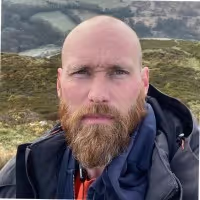
Olly Armstrong
Episode Summary
Q1: Place
If we could do a flypast on any part of the world that is significant to you, which place, city or country would it be and why?
The River Tyne
Q2: Life
Give us a glimpse into your life story so far with an emphasis on what you are doing currently?
I grew up in the northeast of England with an intent to stand up for those who were oppressed, help those who are vulnerable and to speak up and push back against power when it hurts people. I grew up in those spaces, and started studying music in my teens and then realised that I could run music workshops for people who were struggling. That lent itself to community politics which enabled a body of work, speaking up and challenging power. I pulled all those things together about five or six years ago to put all my energy into climate justice for the working class and in collaboration with others built the non-profit Breathe.
Q3: Reset
Where on earth is your place or reset or re-charge?
I've just started six northeast spiritual walks, but they also incorporate industrial action around mines and steel works...
Q4: Wonder
What wonder of the natural world excites you the most?
I love the metaphor of tides especially with mental health and well being.
Q5: Hopefulness
What is your story of hopefulness (not your own) about a person, business or non-profit who are doing amazing things for the world?
My good friend, Nadia Shaikh from Right to Roam who are doing incredible work around land justice. Fighting for the right to roam.
Q6: Insight
As we prepare to re-enter, what insight, wisdom or question would you like to share with us?
My learning that I'd like to share with others, is try and find a way to apply the kindness and care that you teach others to yourself

Transcript
Intro:
Orbiting 250 miles above, the space station provides us with the ultimate view of planet Earth. From this perspective, we ask our guests to engage with six questions that orbit around wonder and stories of hopefulness. For the next few minutes, this is our wonder space.
Steve:
Welcome to the ninety eighth episode of the wonder space podcast, which is a creative expression of a family trust called Panipur. My name is Steve Cole. And since September 2020, I have asked the same six questions to over 90 people from around the world. People like Marina Cantacasino in episode 29, who founded the forgiveness project that works around the world using people's stories to promote reconciliation, forgiveness, empathy, and compassion. Stories that heal, rehumanize, and offer hope.
Steve:
For our third year, we are thrilled once again to be collaborating with Ask Nature, who are a project of the Biomiricry Institute. Their work looks to nature for inspiration to solve design problems in a regenerative way. Here is another moment to help us re wonder.
Ask Nature:
The tide comes in and the tide goes out, and a purple sea star warps between two lives in parallel universes. In one, cold water surrounds its body and it moves freely, eager to make its way toward a muscle bed for a good meal. In the other, it lies immobile, baking in the heat of the sun. But the sea star need not fear the exposure that low tide brings. While it can't control its body temperature directly as warm blooded creatures like humans can, it has a clever trick up its sleeve, or rather up its five arms.
Ask Nature:
On hot days, as the cool water begins to recede, the sea star prepares for the extreme heat to come by drawing a relatively vast amount of that frigid water directly into its body cavity. Being so full of water, the sea star can then barely move, but it successfully avoids dangerously overheating in the direct sun. Researchers suspect the value in the trade off is that this allows the slow moving invertebrate to remain close to its favorite food source instead of racing back and forth with the ever changing tide. For humans, the value is in demonstrating that even for something as fundamental as regulating body temperature, life explores and discovers many paths to success.
Steve:
This week on Wonder Space, we orbit with Ollie Armstrong from North Shields in the Northeast Of England. Ollie is the co founder and director of Breathe, which is community organizing for solidarity, resistance, and change. It's led by a diverse team of activists, performers, and event producers dedicated to spotlighting and supporting work with those closest to the pain of climate breakdown. With this expansive overview of Earth, I start by asking Ollie, if we could do a fly past on any part of the world that is significant to you, which place, city, or country would it be, and why?
Olly:
Yes. It was it was nice when you sent these questions in advance to reflect on these things. And for me, it would be it would be the River tine. So it would be where the tine cuts around the coast and hits the sea and then moves further north. So that's a section of the world where I grew up until I was, like, nineteen twenty before I moved to college in a sec a place where I moved back to a year ago.
Olly:
And I was talking to a church pastor that I know really well yesterday, who's recently moved back to the Northeast just about how that area where the Tyne hugs the coast and the sea hugs the coastline of the Northeast is like a really healing place, safe and healing. So, yeah, that's where I would happily show anyone and and talk about.
Steve:
Ollie, give us a glimpse into your life story so far with an emphasis on what you're doing currently.
Olly:
So I'm gonna start now and then loop backward and then come back to where we are and tell you about my work and then what got me here. So I'm one of the two directors of Breathe, which is climate justice community organizing or community organizing for climate justice, as well as directing the team. I I'm the lead organizer on Tynesite in the North Of England. And the reason I got here is I grew up in the Northeast Of England. I was part of a community church.
Olly:
My dad was a pastor. So I grew up with an Intense to stand up for those who were oppressed and help those who are vulnerable and I guess to speak up and push back against power when it when it when it's allowed to hurt people. I grew up in those spaces, and I started studying music in my teens, and then realized that could run music workshops for people who were struggling, kind of impact their lives, pull them together, uplift them, and then that work kind of lent itself into into community politics. And so I kind of grew a body of work speaking up and challenging power, and then I kind of pulled all those things together about five or six years ago, and like a lot of people realized with a fracturing planet with climate collapse with them. With an impact on a world that's driven by the richest making terrible repeat terrible decisions.
Olly:
I needed to put all my energy into climate justice for the working class, and so I kind of pulled together all my learning from working communities, all my learning on on helping them make people safe and putting power in the hands of in the people's hands themselves, and put together all of that with a group of other people to build Breathe. Yeah. And looking forward, what we want Breathe to do and to be is simply that community organizers is in some key areas across England and Scotland, areas we call closest to the pain or our call, you know, either working class or under the poverty line or the most oppressed. We wanna learn from all those old techniques of community organizing, whether it's civil rights, whether it's the recent push to to win political seats in America, whether it's the work various faith groups have done for decades and centuries in The UK. We wanna take that learning and apply it in our communities across across England and Scotland.
Olly:
We want our communities to respond to climate breakdown by making sure political and power decisions and economic decisions are made by foreign with them as as communities rather than done to. And in practical terms, that means we want our teams in Birmingham, Newcastle, Stoke, and Glasgow to thrive in the coming twelve months. We wanna put more organizers across The UK. And for me, I think a key passion for me is to work hand in hand with other organizations who are doing climate justice work too. There needs to be more joined up work, more in unison work, more work where we lift each other up rather than pull each other down.
Steve:
Where on earth is your place of reset or recharge?
Olly:
Yes. So my place of reset and recharge, I think, is the same as my first answer, but the place where I'd show people. So walking along the River Tyne where I grew up, so along the banks of the Tyne, which is still quite industrial. There's lots of fishing boats come in. There's old factories that have long shut down, you know, the shipbuilding factories, all intersecting with the load of other new businesses.
Olly:
So I love to walk along that coastline that that resets my heart. Another thing I used to reset who I am is I've just started six Northeast spiritual walks, so they're the old walks of the saints, but they also incorporate industrial action, so the mines and steel works. So the six of them, so I've done the first one, doing the next one next week, and you walk two or three days from the Northeast, and you see all these places and reflect on them. And then the third place is somewhere I've not been yet, and it's the West Highland Way in Scotland, and it sounds weird to see I have a reset space I've not yet visited, but people keep telling me about this beautiful long seven day spiritual walk through the West Of Scotland. So that's that's a reset I'm I'm imagining for my next steps.
Steve:
What wonder of the natural world excites you the most?
Olly:
So I'll give two answers to this, and one one's the same as the one I've already given, which is the coastline. So for me, I love I love the sea when it crashes into the shore. I love the metaphor of waves. I love the metaphor of tides as to how I think especially with mental health and well-being, how sometimes we think we should always move forward all the time, but you don't. It's human to move like a tide, but hope that you're always progressing up the shore.
Olly:
Some days going back, some days going forward. So I love the I love the sea. But I also love nature through the eyes of my youngest son who loves animals. He's really smart and switched on with understanding a whole range of animals. So I have a kind of secondary love of nature through by my youngest child.
Steve:
Ollie, what is your story of hopefulness that's not your own about a person, business, or nonprofit who are doing amazing things for the world?
Olly:
Yeah. The person who's inspiring most at the minute is my is my good friend Nadia Sheikh from Right to Rome. Right to Rome are doing incredible work around essentially land justice. So they're fighting for the right to Rome, so access to land. But really, Nadia understands that deeper sense that it's that it's bigger than that.
Olly:
It's about the right to access of land, and who owns that land, and the money in that land, and how the richest hoard it. And it's not just about land. It's the metaphor for all things. So Nadia's work with right to roam, which we saw just this last week have huge press around Dartmoor, where they've they've blocked the last wild camping space in England. Very rich landowners blocked it.
Olly:
Nadia is holding the space for the right to roam group to gather hundreds if not thousands of people to fight back to say this is our land, the land of the people, and I'm hopeful they will head switch into where this is also about money and finance and space and ownership, and how it should be in the hands of the people, not just the richest. So Nadia is great. She's my story of hope.
Steve:
Finally, as we prepare to reenter the Earth's atmosphere, what insight, wisdom, or question would you like to leave with us?
Olly:
Yeah. This is a big one. I know that I try and keep these things simple. Right? What's a simple advice that would change your life?
Olly:
So two people this last week have said to me, it's okay to not be okay, but that's not my advice. It's true, but it that's not my advice. What's interesting about that is that's the kind of thing I say to my team and to my friends all the time. What I realized is lots of us who work in these spaces of kind of transformation and kindness and care have got really good at looking after other people, but are still quite terrible at looking after ourselves. So my learning that I'd like to share with others is try and find a way to apply the kindness and care that you teach others to yourself.
Olly:
For me, that's hearing that it's okay to not be okay. For me, it's hearing that it's okay to slow down. For me, it's about hearing that it's okay to turn down meetings or to not do everything because they're all bits of advice I give the people I have responsibility for. But they're all the things I failed after twenty years myself because I don't apply kindness, love, and grace to me the way I do to others. So this year, I'm gonna be kind to me.
Steve:
You can find out more about Breathe at breathe.build. In his story of hopefulness, Ollie promotes the work of Nadia Sheikh and Right to Rome, which you can find at righttoroam.org.uk. What is your story of hopefulness that's not your own about a person, business, or nonprofit who are doing amazing things for the world? We would love you to consider recording yourself in under thirty seconds, sharing your story on your phone through your video or the voice memo or recorder app. You can then simply upload the recording to the link on our website, ourwonder.space, and we will look to include them in future episodes.
Steve:
I want to thank Ollie for joining us on Wonder Space. Let's continue to share our stories of hopefulness that makes a name for someone else. We need them like never before. Thanks for listening.