Episode #
96
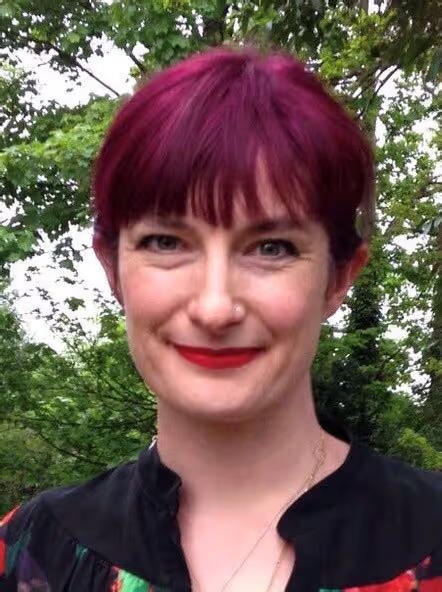
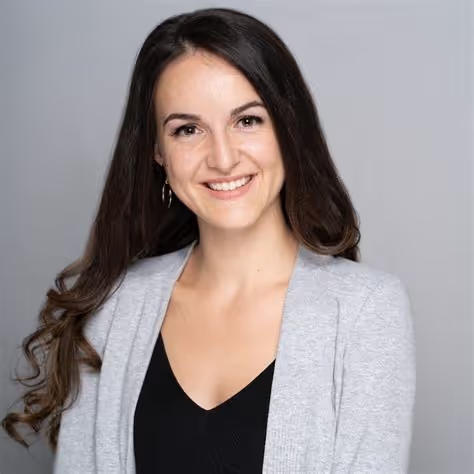
Iva Gumnishka
Episode Summary
Q1: Place
If we could do a flypast on any part of the world that is significant to you, which place, city or country would it be and why?
Granada in Spain
Q2: Life
Give us a glimpse into your life story so far with an emphasis on what you are doing currently?
Graduated from New York and felt a really big urge to go back to my home country, Bulgaria, in order to participate in the response to the Syrian refugee crisis that was happening at the time. I saw that what better place to work on social impact than your own home. This led me to founding my current organisation Humans in the loop and for the past five years we've been working on helping refugees build up their skills, secure their livelihoods through remote digital work and really access the job market in a way that suits their needs.
Q3: Reset
Where on earth is your place or reset or re-charge?
Velingrad in Bulgaria
Q4: Wonder
What wonder of the natural world excites you the most?
The deserts of Morocco
Q5: Hopefulness
What is your story of hopefulness (not your own) about a person, business or non-profit who are doing amazing things for the world?
Three women who are super passionate about social entrepreneurship. All of them have their families, their children, and they're juggling all of that and they're showing me that it's possible to do it and to be a successful woman in business and to have a strong social mission and to take care of your family.
Q6: Insight
As we prepare to re-enter, what insight, wisdom or question would you like to share with us?
A big question is what is impact? I'm in the social impact field and I've been working on this for five years. But I think that we have a lot of work to do in measuring impact and ensuring that we're doing something good for people's lives.

Transcript
Intro:
Orbiting 250 miles above, the space station provides us with the ultimate view of planet Earth. From this perspective, we ask our guests to engage with six questions that orbit around wonder and stories of hopefulness. For the next few minutes, this is our wonder space.
Steve:
Welcome to the ninety sixth episode of the wonder space podcast, which is a creative expression of a family trust called Panapur. My name is Steve Cole. And since September 2020, I have asked the same six questions to over 90 people from around the world. People like photographer, Giles Dooley, who in episode 41 talked about the moment he stepped on a landmine in Afghanistan, losing both legs and an arm. After a year in hospital, he returned to Afghanistan, not just to tell the stories of people who have been injured by wars, but also to be their advocate.
Steve:
For our third year, we are thrilled once again to be collaborating with Ask Nature, who are a project of the Biomimicry Institute. Their work looks to nature for inspiration to solve design problems in a regenerative way. Here is another moment to help us re wonder.
Ask Nature:
While they are the biggest bears alive, polar bears have relatively smaller paw pads than their Ursine cousins. Cousins. Presumably that's to decrease the amount of their skin that comes in contact with the frozen ground. There's just one problem: less skin gripping the ground should mean a greater chance of slipping and sliding, wasting energy while walking, and losing precious fractions of a second when lunging to make an attack. Polar bears avoid these dangers with a relatively simple solution.
Ask Nature:
The microscopic bumps on their paw pads are 1.5 times taller than those on other bear species. That gives the paw pads a greater total surface area and greater friction with the icy ground. It was a desire to find new ways to increase the grip of tires in icy and snowy conditions that drove this research. The polar bear paw model may help there, or in the design of all kinds of better gripping surfaces, such as roadways and pedestrian walkways, flooring, or even recreational gear, like rock climbing footwear. Cool developments indeed.
Steve:
This week on Wonderspace, we orbit with Eva Gomniska in Bulgaria. Eva is the founder and CEO of Humans in the Loop, a social enterprise which supplies diverse and high quality human
Iva:
world.
Steve:
With this expansive overview of Earth, I start by asking Eva, if we could do a fly past on any part of the world that is significant to you, which place, city, or country would it be, and why?
Iva:
I would say the most significant city would be Granada. It's this, really, really beautiful historical city that has a lot of Andalusian heritage in it, and it's also a student city where you can find a lot of young people, a lot of hippies, people who are living very like non standard lifestyles, and because when I went to Spain, I spent one year there, before that I was living in New York, and it's kind of the complete opposite. It's very hectic, very mercantile, and focused a lot on getting things done and going forward and high speed and everyone's so busy, and Granada was the opposite. It was kind of like so relaxed, chill. You have a lot of time to dedicate to your hobbies, to arts, to just like strolling around the city and thinking and having nice conversations.
Iva:
It was great.
Steve:
Eva, give us a glimpse into your life story so far with an emphasis on what you're doing currently.
Iva:
So maybe we can start back in Spain since this is where we started our story, and of course, York. So I was doing my bachelor's degree there, and my undergrad. And then as soon as I graduated, I felt a really big urge to go back to my home country, Bulgaria, in order to participate in the response to the Syrian refugee crisis that was happening at the time, 2016, 'seventeen. So I had never thought of going back home. I always thought that I would be traveling around and exploring different places and working abroad, but then, because that was happening in my home country, was like, okay, I need to go back, I need to participate in the civil society response because the country and the government was not handling the situation very well.
Iva:
So I really wanted to contribute and I thought that what better place to work on social impacts than your own home and starting close to home instead of going to different places around the world and trying to fix people's lives and fix people's problems. So that's what led me to create my current organization, Humans in the Loop. And for the past five years, we've been working on helping refugees build up their skills, secure their livelihoods through remote digital work, and really access the job market in a way that suits their needs. We started the first couple of years in Bulgaria, but then quickly we saw that there is a big demand from people from different countries, specifically even conflict affected countries. They're frequently the source of refugee waves.
Iva:
There is a lot of need for employment opportunities in these locations because of sanctions, because of conflict, because of difficulties with accessing jobs locally. So we scaled very quickly to a lot of countries in The Middle East, including Syria, Iraq, Afghanistan, Lebanon, Yemen. Now we've also started scaling to Eastern Europe in order to support with the Ukrainian crisis response, we've done a pilot in Ukraine, now we're starting to do more work, we're soon doing a pilot in Moldova as well, as well as working with Ukrainians in Bulgaria. And in total over the past five years, we've worked with more than 1,000 people from these different locations and we've provided them with $1,000,000 in revenue for their jobs. So this is this big, big milestone that we hit recently.
Iva:
We've recently done a pilot with War Child in the Democratic Republic Of Congo, we have a pilot coming up in Rwanda. We're looking at major locations of conflict affected populations and refugee communities as well. We're looking at Latin America as well, Southeast Asia. So we're really trying to expand more globally, but we're also looking into creating more opportunities for these people to participate in the digital economy through more advanced services. Right now what we're doing is actually we're providing services for artificial intelligence companies and computer vision companies.
Iva:
We're preparing their datasets and what I want to do is to create opportunities for people to continuously work together with systems in order to monitor them, supervise them, audit them, see how they're performing and so on. So this is a really up and coming opportunity and field for people, and I think that it would be amazing if we can become the leaders in this type of work. And that's why we're called humans in the loop because this is kind of our our model and our vision for the future. Now we're getting closer and closer to it. More and more companies are interested in this, so it's really exciting.
Steve:
Where on earth is your place of reset or recharge?
Iva:
I would say it's somewhere close to home. Again, my husband and I have been traveling a lot around Bulgaria and just exploring some nice corners in the country, here in the mountains or close to the seaside. And we've actually been spending some time in Viningrad, which is the city high up in the mountains where my grandma lives and they really love like going out and running around there in the forest and it's a really nice place and it's super close to where I live. But I think I like the fact that it's underrated and underappreciated because it's almost empty, know, there aren't that many people. So that's the best part of it.
Steve:
What wonder of the natural world excites you the most?
Iva:
I recently spent some time in Morocco, which is where my husband is from. So we traveled around in the desert and that was amazing. It was a great, great experience. You know, this really wide sky with all the stars that were so bright, and we were just like riding on a camel caravan in order to reach a Bedouin camp in the middle of the desert. So it was this really, really beautiful scenery of going with a slow pace on the camelback and just wondering when it's gonna end because it was such a long trip.
Iva:
So I really felt connected not only to nature and the natural world, but also to people in the past who've also enjoyed these views and felt that sensation. It was a really special experience.
Steve:
Eva, what is your story of hopefulness that's not your own about a person, business or nonprofit who is doing amazing things for the world?
Iva:
So I have a couple of different role models that are all women. They're all in the same space working around me here in Bulgaria. And it feels great to have such a community close to me that I can refer to, I can, you know, spend time with, I can share my challenges with, and there are a bunch of really, really amazing women. Two of them are working on sustainability startup called Lamon which produces sustainable laminating foil for magazines and other types of packaging and so that the paper can be recycled because if you I'm not sure if you know, but a lot of this, like, glossy paper can not be recycled because it has, you know, this type of, like, glue which is nonrecyclable. So that's an amazing startup that they're working on, and they're really cool people, and they're super friendly and down to earth.
Iva:
I also have another friend who's working on a health tech startup, and we've traveled together, recently, and she's also amazing. I also have another role model here that I really look up to who's a financial guru, and she's actually helping me out with our financials, but she has her own VC fund, and she's also super passionate about social entrepreneurship, And all of them have their families, their children, and they're juggling all of that, and they're showing me that it's possible to do it and to be a successful woman in business and to have strong social mission and to take care of your family and your kids and so on. So right now, as I'm planning on what my steps forward on a personal level would be, I think it's great to have these people as a reference around me.
Steve:
Finally, as we prepare to reenter the Earth's atmosphere, what insight, wisdom, or question would you like to share with us?
Iva:
A big question that I currently have a lot and that's been on my mind, is what is impact, because I'm in the social impact field and I've been working on this for five years, but I think that still we have a lot of work to do until we reach a really reliable model where we know that we're doing something good for people's lives. Because impact is something very subjective, there may be so many unintended consequences of your work on people's lives, and whether or not what you're doing for them is actually beneficial is a big question, and it should not be taken for granted. Just because you have good intentions, it doesn't mean that the results of your work are actually good on a personal level for people and in general for the community that you're working with. So this is something that I've been thinking about a lot in terms of how can we adapt our model in order to serve more people. Should we aim for breadth and just, like, impacting as many people as possible, or should we aim for depth and impacting fewer people, but in a really substantial and meaningful way?
Iva:
So these are questions that I guess everyone working on a social impact startup has, but it's a big question for me and I'd love to leave it out there for people to think about as well.
Steve:
You can find out more about Eva on her website, evagamnishka.com, which also provides a link to her TEDx talk where she talks about the role of humans in AI systems. Humans in the Loop website is humansintheloop.org. What is your story of hopefulness that's not your own, about a person, business, or nonprofit who are doing amazing things for the world? We would love you to consider recording yourself in under thirty seconds, sharing your story on your phone through your video or the voice memo or recorder app. You can then simply upload the recording to the link on our website, ourwonder.space, and we will look to include them in future episodes.
Steve:
I want to thank Eva for joining us on Wonder Space this week. Let's continue to share our stories of hopefulness that makes a name for someone else. We need them like never before. Thanks for listening.