Episode #
94
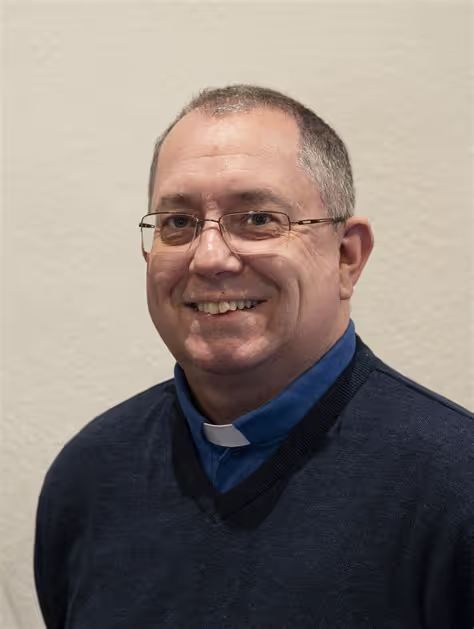
Andy Thompson
Episode Summary
Q1: Place
If we could do a flypast on any part of the world that is significant to you, which place, city or country would it be and why?
Abu Dhabi in the UAE
Q2: Life
Give us a glimpse into your life story so far with an emphasis on what you are doing currently?
As leader of the Christian Union at Birmingham University became very good friends with the leader of the Islamic union and after 9/11 there was a real sense of a calling to be a bridge builder. Spent over 15 years leading churches in the middle east and invested so much time building connection with scholars and leaders of other faiths. This experience led to the writing of various books and today the interfaith work continues alongside the work as a vicar in North London.
Q3: Reset
Where on earth is your place or reset or re-charge?
The great Cathedrals. Their beauty and the dedication of the people who built them.
Q4: Wonder
What wonder of the natural world excites you the most?
The deserts around Abu Dhabi
Q5: Hopefulness
What is your story of hopefulness (not your own) about a person, business or non-profit who are doing amazing things for the world?
Islamic Scholar Shaykh Abdullah bin Bayah who is bringing together people from all over the world to agree that our religions and law systems should make space for equality for all.
Q6: Insight
As we prepare to re-enter, what insight, wisdom or question would you like to share with us?
The desert has much to teach us, its a place that is seen as lifeless and yet it is teeming with life and a place where God often gets our attention.

Transcript
intro:
Orbiting 250 miles above, the space station provides us with the ultimate view of planet Earth. From this perspective, we ask our guests to engage with six questions that orbit around wonder and stories of hopefulness. For the next few minutes, this is our wonder space.
Steve:
Welcome to the ninety fourth episode of the Wonder Space podcast, which is a creative expression of a family trust called Panapur. My name is Steve Cole, and since September 2020, I have asked the same six questions to over 90 people from around the world. This will be our last episode for this year before we take a break for Christmas, and I wanna take this opportunity of thanking our 40 guests who were featured on Wonder Space this year. Thanks also to over a 100 people who shared their story of hopefulness at Boardroom twenty thirty, fixing the future, blue earth, and anthropy. I also want to thank Andrew Howley and the team at ask a nature for producing 40 moments of magic over this past year.
Steve:
Here is their last re wonder moment of this year.
Ask Nature:
There is a group of plants native to Southern Africa, the large ripened fruit of which resembles gnarled brown claws that point in all directions. They go by several colorful common names, including grapple plant and devil's claw. They are found in drier habitats such as overgrazed plains and fossil dunes. If seedlings were to grow near their parents, they would be in direct competition for scarce resources and space for their roots to grow. So it's to the grapple plants' benefit that their seeds be carried as far away as possible.
Ask Nature:
And so, grapple plants enlist some unwitting help. Their fruit is perfectly structured to be stepped on, wedged into the creases of the sole of a giant foot, or snagged on long tufts of hair and dragged long distances without damaging the seeds inside. This seemingly simple trick reveals an intimate partnership between ground hugging plants and some of the largest animals on land today, and shows that even in extreme and empty seeming landscapes, diverse communities of living things are working together to create the conditions that support life for all.
Steve:
Orbiting around our six Wonder Space questions this week, we welcome Canon Andrew Thompson, who was nominated by our fifty fourth guest on WonderSpace, musician and filmmaker, Jason Carter.
Jason Carter:
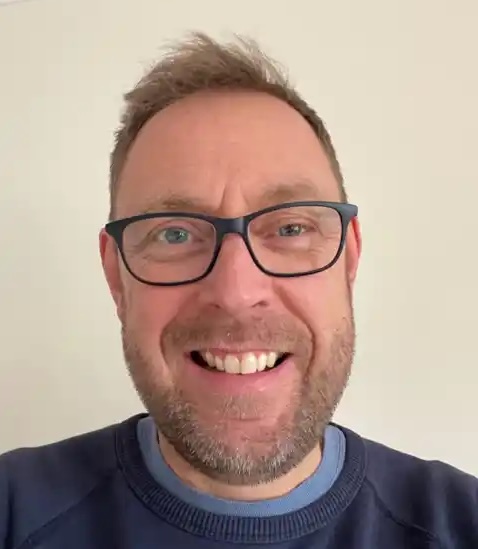
I nominated Andrew Thompson because in the thirty years that I've known him, I've seen him walk into spaces, rooms, palaces. And just by being himself, he has been able to change culture, to challenge norms, and to initiate change, and I've always found that immensely inspiring.
Steve:
Andrew is an author and a vicar of a church in North London, and before that, spent most of his working life in The Middle East, where he has been honored for his services to human rights and promoting interfaith dialogue between Christians and Muslims. With this expansive overview of Earth, I start by asking Andrew, if we could do a fly past on any part of the world that is significant to you, which place, city, or country would it be, and why?
Andrew:
Well, I would settle for The United Arab Emirates as a country. It's been my home for, twenty plus years. And in particular, would focus on the city of Abu Dhabi, which is in the heart of the Islamic world. And the reason I would choose that is because when we think of Islam and when we think of the Middle East, we often are bombarded with negative media images. But in Abu Dhabi, as you fly over, you will see a massacre surrounded by churches which belonged to the ruling family of the Abu Dhabi crew.
Andrew:
They changed the name of the mosque to Mary, mother of Jesus' mosque as a symbol of solidarity with the churches around them. And if you sort of fly a little bit further along the Abu Dhabi Coast Road, you will see an amazing development. There's a big garden there next to another amazing building called the Louvre Museum Abu Dhabi, which is an astonishing work of art. It's a building itself. There is a big garden there, and in that garden they are building or about to complete a mosque, a church and a synagogue of the first of its kind in the entire region.
Andrew:
Again, it's a symbol that the House of Abraham is united by commonalities which are often put aside to focus on differences. And so The United Arab Emirates for me is a really special country. It's trying so hard to push back against the narrative that different religions and different cultures have to be in conflict with one another. Unless I know, we're not letting our narrative be defined by conflict. We want it to be defined by tolerance.
Steve:
Andy, give us a glimpse into your life story so far with an emphasis on what you're doing currently.
Andrew:
Well, I went to college in Birmingham where I eventually became the leader of a Christian union there for students. And I became very good friends with the leader of the Islamic Students' Union. And here and I very quickly became I can only describe it as frenemies. We were friends and we were enemies at the same time. And we had at the time these rather juvenile debates about my god is better than your god, etcetera, etcetera.
Andrew:
But I was actually very challenged by Abdullah, his name was. I've not really set the tone for my life journey in terms of my ministry as a Christian. So I've got to know his culture. I've got to learn a lot about Islam through him. And I think a key turning point was, 09/11 when the Twin Towers were attacked.
Andrew:
I remember exactly where I was. I was in an English parish in Derbyshire and realising at that moment when I saw the towers fall in New York that the world was entering into a new history, a new such a moment where there was going to be unrivalled hatred towards Islam. This would be seen as a war between the Christian West and the Islamic front. And because of people like Abdullah, I know that's such an awful way to portray an entire region that is full of people of hate. So I committed myself around then to become a grid builder.
Andrew:
Grid building between Islam in particular and Christianity has been very much a defining motive of my ministry. So when I went to The United Arab Emirates and indeed in Kuwait, often I would spend time sitting in the mosques, talking with the imams, meeting Muslims. I've had some extraordinary, wonderful times where I would go and visit some of the top religious leaders in the nation. And you're in a room with, you know, up to a 100 imams, and they say, hey, Andy. Tell us what you preached about in church last week.
Andrew:
And they were curious too. So I have preached my sermons not only in church, but to some amazing Islamic scholars. I wrote a book called Jesus of Arabia, which again sort of looked at the commonalities of the gospel culture with modern Islamic culture and how so much of what Jesus said and what he did would make so much sense to an Islamic audience in The Middle East, even to this very day. I also wrote a book called Celebrating Tolerance, which was a story of The United Arab Emirates liberation of all religions under Islamic law, including the Jewish community. I was privileged to see the beginning of the Abrahamic Accords.
Andrew:
I was invited to the reception actually when the first plane landed from Tel Aviv in Abu Dhabi And I was just amazed because after twenty odd years in The Middle East, I was surrounded by people speaking Hebrew in an Islamic Gulf country. It's extraordinary. I was there when Pope Francis came to Abu Dhabi. We saw the biggest ever Christian celebration in the history of our side of the Arabian Gulf, all of it. I took part in a Mass with 180,000 worshipers there in a football stadium hosted by the President of The United Arab Emirates.
Andrew:
Through it all, being an ordinary vicar, you know, preaching most Sundays, celebrating communion, doing weddings and funerals, all the things that vicars do. But I was right next door to the mosque, which was called Mary, Mother of Jesus mosque. And there discovered a whole new level of diplomacy, where every religious festival we would give each other chocolates. To be honest, it became a bit of a competition to who could give the biggest chocolate box. But I can't tell you how much goodwill that generated when the Imam would share chocolate with his congregation from the church.
Andrew:
And I would often stand at the door after a church service handing out the chocolate which he's gifted to us on events like Christmas and Easter and so on. So all the church members would get a chocolate from the Imam. You know, those are some of the memories I have from that time. But now I'm in the Duchess of London, a vicar in the Palace Of Actbridge, which is where Boris Johnson is our local MP. Hooray.
Andrew:
As a side note, actually, Boris Johnson's last act as a prime minister was in my church in that village where we introduced him to a number of Ukrainian refugees. And his very last act would allow himself to be he did selfies, basically, with all these Ukrainian refugee families, and they loved it. And what was really moving was they were sending me photographs to the men on the front line. So since I've been in London, I've got myself into the same routine as I did in Abu Dhabi, getting to know the religious leaders of not just the Christian churches around me, but I'm also getting to know the local religious leaders from other communities.
Steve:
Where on earth is your place of reset or recharge?
Andrew:
This was the hardest question I had to wrestle with. Because on the one hand, I would say nature, I love connecting with God walking along a beach next to the sea or in a beautiful forest surrounded by tall trees. But I am aware of that when I really feel I need to centre myself and reconnect with God. I really love going into the big old cathedrals in our cities. I was ordained in Derby Cathedral and every time I go to Derby City, that's the place where it was really special to me.
Andrew:
I would sit there and I would just rest and again, just being reminded by God of my calling to serve him and to serve on this particular expression of the Church of England. So there's something about cathedrals, the history, the space, the beauty, the dedication of the people who who built it, and and, of course, the presence of god always seemed to be very real to me in most places. So that's where I go.
Steve:
What wonder of the natural world excites you the most?
Andrew:
The desert. That's one thing The United Arab Emirates has a lot of. It's got amazing doom desert. In fact, some amazing movies have been shot there. The Star Wars movies were shot there, the recent ones.
Andrew:
All set in the highest sand dunes in the world. And what was really surprising about the desert is you look around and you think nothing can survive here. But when you camp in the desert and you wake up in the morning, there's all these tracks in the sand outside your tent where there's lots of insects, camel spiders, scorpions, there's snakes running around, there's lizard tracks, and suddenly you realise you thought you were sleeping and this lifeless violent place is teeming with life, which you just don't see at all. So the desert is a pretty autumn place.
Steve:
Andy, what is your story of hopefulness that's not your own, about a person, business, or nonprofit who are doing amazing things for the world?
Andrew:
Well, the man that come to my mind is is a little shrunken 80 year old man called Jacob Dollabinbaher. He's about as high as my nipple. But he is a giant in what he's trying to do. He is an Islamic scholar who's bringing together people from all over the world, politicians, lawyers, religious leaders, and he's basically trying to bring them together to agree one thing: that our religions and our law system should make space for equality for all. He is very conscious as an Islamic leader that in Islamic countries, for example, Christians are often occupying a second class citizen base, and they're saying that's not Islamic.
Andrew:
So, he is completely redefining or reclaiming, rather, he would say, classical Islam. He argues that Prophet Muhammad had very good relationships with Christians and Jews on the Medina stage. And so he is, in effect, reinterpreting the Quran for the modern age. And he is pulling into his wake some remarkable partners to the enterprise. And so I listen to him and I look at him and I think, this man is amazing.
Andrew:
He is well, I must say he's touching 90 he still is energised and bringing people together on that mission to try and push back against the forces of distraction and hatred. And he's he's he's doing some incredible things.
Steve:
Finally, as we prepare to reenter the Earth's atmosphere, what insight, wisdom, or question would you like to leave with us?
Andrew:
I think the desert had much to teach us. The desert has been hugely significant for the world community in that it wasn't the desert that Moses encountered God. It wasn't the desert that Jesus was empowered by the Holy Spirit to begin his mission. And that it was on the desert where prophet Muhammad, peace be upon him, began his ministry. The desert is a place which brings the promise of hope for the future.
Andrew:
And I suppose if I made that analogy for life, if you feel you're in a place which feels like a desert, then just know that if there's life around you, it's a place where God often gets our attention, and it's a place where promises hope once we come out of it. Continuing the theme of the desert, just a reminder of the wise men traversed across many deserts and seeking something that would be meaningful and hopeful. And in their journey, even though they weren't Christian or they weren't Jews or they weren't Muslim, they were pagan astrologers actually, they encountered Jesus and that led them to a pivotal moment of understanding God's revelation and purpose for this world.
Steve:
What is your story of hopefulness that's not your own? About a person, business, or nonprofit who are doing amazing things for the world? We would love you to consider recording yourself in under thirty seconds, sharing your story on your phone through your video or your voice memo or recorder app. You can then simply upload the recording to our link on our website, ourwonder.space, and we will look to include them in future episodes. I want to thank Andy for joining us on Wonder Space for what will be our last episode of 02/2022.
Steve:
I hope over Christmas that you are able to reset, but also to rewonder as you once again orbit around the story of divine love and grace. On behalf of designer Dan, who got married last week to Hannah, editor Sam, the team at ask nature, and myself, happy Christmas, and thanks for listening.