Episode #
91
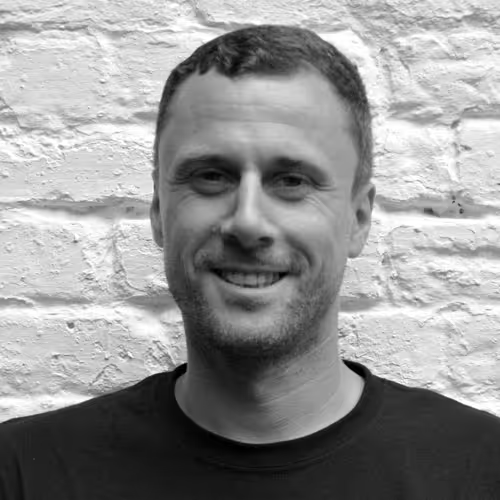
Dirk Bischof
Episode Summary
Q1: Place
If we could do a flypast on any part of the world that is significant to you, which place, city or country would it be and why?
Hokkaido which is an island of Japan
Q2: Life
Give us a glimpse into your life story so far with an emphasis on what you are doing currently?
Born in Eastern Germany, inspired to see how my father started his own business providing income for families and creating work in an area where there was no work. I got to London and I met my first social entrepreneur and 20 years ago I started my first social business. Today doing very similar things with entrepreneurs and supporting founders into business with Hatch Enterprises.
Q3: Reset
Where on earth is your place or reset or re-charge?
A small lake in Eastern Germany
Q4: Wonder
What wonder of the natural world excites you the most?
The wonder of death is something I've always used as an accelerant that makes me focus on the stuff that makes a difference and makes things meaningful.
Q5: Hopefulness
What is your story of hopefulness (not your own) about a person, business or non-profit who are doing amazing things for the world?
The Ocean Clean Up organisation that is scaling up efforts to remove all plastic from the oceans and rivers
Q6: Insight
As we prepare to re-enter, what insight, wisdom or question would you like to share with us?
To stay curious. And to keep questioning your motives

Transcript
Intro:
Orbiting 250 miles above Earth, the space station provides the ultimate view of planet Earth. From this perspective, we ask our guests to engage with six questions that orbit around wonder and stories of hopefulness. For the next few minutes, this is our wonder space.
Steve (host):
Welcome to the ninety first episode of the wonder space podcast, which is a creative expression of a family trust called Panapur. My name is Steve Cole. And since September 2020, I have asked the same six questions to over 90 people from around the world. People like creative entrepreneur Tamar Gutmann from Amsterdam, who in episode 25 talked about a hope that comes from seeing countless artists raising their voices to speak up about injustice and inequality. For our third year, we are collaborating with Ask Nature, who are a project of the Biomimicry Institute.
Steve (host):
Their work looks to nature for inspiration to solve design problems in a regenerative way. Here is another moment to help us to re wonder.
Ask Nature:
Young plants, like young animals, are particularly vulnerable to illness and injury, in part because they haven't built up their defenses against would be attackers and competitors. Bacteria and insects can be attracted to nutrients released by the plant's roots, and their appetites can be insatiable weakening, damaging or destroying the young plant. Like all of us, seedlings could use some help and they have some pretty impressive ways of getting it. Young maize sprouts, for example, just emerging from their kernels release a chemical from their roots that is toxic to bacteria, insects and other plants. But it's also attractive to a particular species of bacterium that can detoxify the natural pesticide and which don't pose a threat to the plant through their own feeding.
Ask Nature:
Once established around the ultra fine roots of the maize seedling, these beneficial bacteria can outcompete other harmful organisms for the limited nutrient supply, becoming the plant's microscopic partners and providing an underground shield that allows the plant above to soar into the sky.
Steve (host):
This week on Wonderspace, we welcome Dirk Biscoff, who is the co founder of Hatch Enterprise. Hatch is one of The UK's leading enterprise support charities that pioneered a unique approach to entrepreneurship for diverse and underrepresented founders. Since 2013, they have supported over 7,000 entrepreneurs to help them launch and grow their ventures. With this expansive overview of Earth, I start by asking Gurk if we could do a fly past on any part of the world that is significant to you, which place, city or country would it be and why?
Dirk:
I think for me it has to be Japan. I was already in love with the country before even having been there. The myths, the stories, I really kind of thrived in the whole samurai ninja culture and also nature and just the otherness and the way culture is so different in Japan. So I've done two cycle trips now through Japan. I'm doing my third one next year.
Dirk:
That's the big plan. So one I did in 2018, which was around Hokkaido. And Hokkaido is the northernmost kind of biggest island in Japan. And I just remembered cycling there by myself with tent and multiple backpacks and stuff. And both the loneliness of the Western Coast cycling through small fishing villages where the streets were so empty they were drying the seaweed on asphalt because you know there were no cars, were never any cars, so they used the street to dry the seaweed.
Dirk:
But you could see how life could have been like, you know, fifty, one hundred, two hundred years ago kind of cycling past those villages and cycling past this rugged sea of kind of Northern Japan just made me feel really connected. Think Japan is my is my my one of my favorite favorite places, really.
Steve (host):
Dirk, give us a glimpse into your life story so far, with an emphasis on what you are doing currently.
Dirk:
So looking back at my life, I was born in Eastern Germany before the wall came down basically. Once the wall came down, many businesses in East Germany were assets stripped, sold off, closed down. And the same happened to my dad's company. And he was like, well, I could either become unemployed or buy the remaining bits of machinery and land and start my own business. So he then started his own business around age 40.
Dirk:
I'm now a bit over 40. And he started a metal engineering company back in the days where there was no work, there was no jobs, there were no businesses. So he very quickly then started employing like two, three, four, five, six more people and generating both, you know, an income for those families, an income for our family, you know, creating work in an area where there was no work. That really inspired me back in the days. But it wasn't until I got to London and I met my first, I would call him social entrepreneur, who was running an organization called Quicken with Homeless Concern, when I realized you can actually be an entrepreneur, do something good, and at the same time, you know, grow an organization that would do like, you know, like really useful, helpful things in the community.
Dirk:
And that for me was when the light bulb moment came on and I was like, I want to be a social entrepreneur. And, you know, that was almost twenty years ago when I started my first social business to support more young adults into workplaces and into their own lives, so to speak. And yeah, like now, many years later, I'm doing very similar things with entrepreneurs and supporting founders into business. So when we started Hutch, you know, we were founded in Brixton, in South London. And because of the work I was doing with young adults kind of in the ten years previously, I could see that you need help and support when you're starting a business.
Dirk:
It's not easy to do it by yourself. The lack of business skills, access to networks, access to finance, all of this is really difficult. If you're coming from an underrepresented background, if you're a woman or if you're a disabled founder, all this stuff is 10 times harder, if not more. And we wanted to build an organisation that would support people where we could see the talent and the power of who they are and what they could be doing and add the business component to their lives, essentially. And we're now doing this on an annual basis with about 1,500 founders.
Dirk:
And for us, this is really powerful because all of a sudden, you're no longer just building up individuals. You're building a real community of people who help each other, work together, trade with each other, support each other. And I think that's really, really amazing. And there's one story of a young woman called Maria, and we met her very early on. She was part of our first cohort or group of young people or young adults, essentially.
Dirk:
They were in their early 20s. And she came to us and wanted to start a graphic design business. And we could see she has serious graphic design skills. So she came with her buddy at the time and we said, Okay, we'll support you. And we helped them start their business, get incorporated.
Dirk:
We helped them with some of their first clients. We became one of their clients. And now many years later, I still chat to her and she's now worked with some really prestigious, I think the UN Health Organization. She's worked with some major charities and she's still only two or three people with her team. But she's super happy because she has the freedom to do what she wants, where she wants, because it's ultimately about, you know, somebody fulfilling their life stream through work, through entrepreneurship, and that's what gets me out of bed.
Steve (host):
Where on earth is your place of reset or recharge?
Dirk:
Yeah, there's only one place really that I go to, and it's not far from my hometown in East Germany. And it's a small little lake that used to be a place where they would dig coal, you know, back like fifty or one hundred years ago and then they shut it down eventually and the little mine kind of filled up with water. And it's such a secluded place surrounded by trees and fields, but whenever I go there, there's a white beach essentially in the middle of a forest with some sandstone that you can lay on top and look over the lake. And whenever I go there, like, I come to rest. Like I go there and I chill and read a book or just sit there, do nothing.
Dirk:
And like for me this was always a place that wouldn't change. But only this year when I came back, I actually realized that even this place, unchanging as I always had it in my mind, even that place was changing as trees were growing into the rocks now and kind of breaking some of the rocks apart. And I could see that nature itself, even though I wanted it to not change that place, even that place was changing.
Steve (host):
What wonder of the natural world excites you the most?
Dirk:
That was a hard one. I had to really think about it. And I think for me, one of the things that made me who I am and made me do what I did, I think it's death. So knowing that, you know, this life, this charade essentially will come to an end at some point sooner or later, that's always been something that was a driving force behind a lot of the things that I wanted and did do in a very short space of time because I always felt I never had time. I never knew how long this thing was going to go on for.
Dirk:
So I always tried to pack as much as I could into the time available. Obviously, helped me do lots of things in a very short space of time, but at the same time it also increased kind of the pressure on having to do lots of stuff quickly. But yeah, like if I look at it now with a bit more perspective, I've always used death as an accelerant and as a thing that makes me focus on the stuff that makes things meaningful. So yeah, it has to be death for me.
Steve (host):
Dirk, what is your story of hopefulness that's not your own about a person, business or nonprofit who are doing amazing things for the world?
Dirk:
I mean, for me, I really love nature. You know, it was whether it's cycling in Japan or whether it's roaming around on beaches. And we recently went to Thailand with my partner. And one of the first things, and we were there like 10 ago, one of the first things that struck me walking on the beach was the amount of plastic that's being washed up on the beach on a daily basis. No matter how much locals were cleaning, every single day you'd have more plastic.
Dirk:
So one of the organizations that are doing something about it very practically is called the Ocean Cleanup. And when I heard about them, they're a Dutch social entrepreneur or they're a Dutch charity not for profit, when I heard about them and their crazy idea to tackle the Great Pacific Garbage Patch, which I think is, I don't know, a million square kilometers or something absolutely ridiculous, something so huge. When I thought, oh my god, they're actually going to tackle this with a machine that's going to gobble up plastic and probably put it back onto ships and then, you know, unpack the plastics, recycle it, make new plastic from it, I think that's what they're doing. But just tackling such a huge problem, even though it's not the beginning of the problem itself, it's the cleanup after the effect, so to speak. I thought this was absolutely amazing.
Dirk:
And now I think they're on their sixth or seventh interceptor, so to speak, and they're sending them to all kinds of places. The results that they're having, especially on local communities where they have seen the before and after picture after a year of them having their machine in place, where local beaches are no longer polluted by plastic, I found it quite extraordinary. When I saw what they were doing, it's like this is absolutely outrageous, like how is this ever going to get off the ground? And then little by little, you know, funding came in the first trial and then, you know, a bit more funding came and a bit more funding came. And now I think they're building so many of these to deploy them in, you know, a number of localities to really tackle, you know, the end result plastic in the ocean.
Dirk:
Yeah, it's extraordinary. And again, it's highlighting that shit can happen when you're inspired, you really see the problem, you share the problem with somebody else, you get other people excited and passionate about it, and then you just start working on a solution. I think that's the exciting bit, the entrepreneurial bit.
Steve (host):
Finally, as we prepare to enter the Earth's atmosphere, what insight, wisdom, or question would you like to leave with us?
Dirk:
I guess to stay curious and to keep questioning things, keep questioning yourself, keep questioning your your motives, and whether you're aligned to the things that you're doing and to figure out if what you're doing at the moment is doing something good in the world, is doing something good for yourself, is doing something good for your local community and, yeah, staying aligned to some kind of inner purpose. And for that, I think curiosity and keeping on questioning things versus assuming things to stay as they are and to keep as they are. Think that's the one piece. Stay curious. Keep asking questions.
Steve (host):
You can find out more about Hatch at hatchenterprise.org. Also, out the work of Ocean Cleanup at theoceancleanup.com. What is your story of hopefulness that's not your own, About a person, business, or nonprofit who are doing amazing things for the world. We would love you to consider recording yourself in under thirty seconds, sharing your story on your phone through your video or the voice memo or recorder app. You can then simply upload the recording to the link on our website, ourwonder.space, and we will look to include them in future episodes.
Steve (host):
Thanks to Dirk for joining us on Wonderspace this week. Let's continue to share wonder and stories of hopefulness that makes a name for someone else. We need them like never before. Thanks for joining us.