Episode #
88
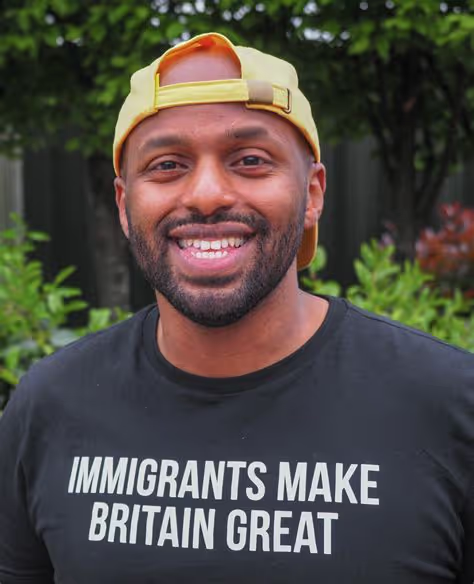
Magid Magid
Episode Summary
Q1: Place
If we could do a flypast on any part of the world that is significant to you, which place, city or country would it be and why?
Spital Hill in Sheffield
Q2: Life
Give us a glimpse into your life story so far with an emphasis on what you are doing currently?
I came to Sheffield from Somalia with my family and got involved in my local community because I could see so much injustice, which led to being elected as a local councillor. After being at the heart of local politics, I was eventually appointed as Lord Mayor of Sheffield before being elected to stand for Yorkshire and the Humber in the European Parliament. Today I run the European climate organisation called Union of justice working at the intersection between climate and race
Q3: Reset
Where on earth is your place or reset or re-charge?
A restaurant in Sheffield called Arabian kitchen
Q4: Wonder
What wonder of the natural world excites you the most?
The wildlife on my doorstep especially at night time
Q5: Hopefulness
What is your story of hopefulness (not your own) about a person, business or non-profit who are doing amazing things for the world?
Young people from different faiths coming together around the issue of Climate Change. Organisationally it would be Julie's Bicycle who support artists to use their artistic-creative skills and communication to change the narrative on the climate crisis.
Q6: Insight
As we prepare to re-enter, what insight, wisdom or question would you like to share with us?
Use your given time to try and do something that is bigger than yourself.

Transcript
Intro:
Orbiting 250 miles above, the space station provides us with the ultimate view of planet Earth. From this perspective, we ask our guests to engage with six questions that orbit around wonder and stories of hopefulness. For the next few minutes, this is our wonder space.
Steve (host):
Welcome to the eighty eighth episode of the wonder space podcast, which is a creative expression of a family trust called Panapur. My name is Steve Cole, and since September 2020, I have asked the same six questions to over 80 people from around the world. People like Sofia Amandzi Ayuga, who is a senior design director at Adidas in Germany, who in episode 18 talked about her desire to see more African designers and artisans around the global table of art and design. She also highlighted the work of pioneers such as Omiyemi Akureli from Lagos Fashion Week. For our third year, we are excited once again to be collaborating with Ask Nature, who are a project of the Biomimicry Institute.
Steve (host):
Their work looks to nature for inspiration to solve design problems in a regenerative way. Here is another moment to help us re wonder.
Ask Nature:
For creatures that spend nearly their entire lives underground, spotted salamanders have a surprisingly intimate relationship with the sun. Adult females emerge from tunnels in spring in search of seasonal pools that form on the forest floors of Eastern And Southern North America. If all looks good, they'll lay their eggs there and head back underground. But the next generation is far from alone. As the young develop and grow, they are assisted by tiny caregivers, algae that live within the salamander's eggs.
Ask Nature:
When sunlight strikes the algae, they photosynthesize producing oxygen and carbohydrates, both of which are provided directly to the developing salamander. The algae are thought to benefit from nitrogen based waste produced by the embryo's cells. Eventually the salamanders will hatch metamorphose and head underground themselves to begin the cycle again. While all animals ultimately depend on energy from the sun through the nutritional benefits of plants, salamanders and their algae have taken it to a very special level indeed.
Steve (host):
This week on Wonderspace, we welcome Majid Majid, who was a member of the European Parliament and was also the mayor of his beloved city Sheffield. Majid was named one of Time's 100 rising stars, shaping the future of the world. And today he is founder and director of Union of Justice, which is an organization dedicated to racial and climate justice. With this expansive overview of Earth, I start by asking Majid if we could do a fly past on any part of the world that is significant to you, which place, city or country would it be and why?
Magid:
I would just would want to naturally just zoom into Sheffield basically and I think just for many reasons like it's very hilly, it's very green, there's interesting characters and I guess what I yeah I would just want to zoom in but also maybe I'm being biased maybe I'm not but obviously it's one of the best places in the world Sheffield but even more even more like specific in Sheffield the area called Berngrieve Spital Hill which I think there's over like 60 languages spoken there there's great so yeah it's just I would just want to zoom into that part kind of thing really just kind of just also had the opportunity to kind of just show to the rest of the world how wonderful and amazing just not just like aesthetically but just the people also the weird and wonderful things that take place within this small kind of macrocosm of this kind of community is just yeah. It's just it's just amazing.
Steve (host):
Majida, give us a glimpse into your life story so far with an emphasis on what you're doing currently.
Magid:
I would probably refer to myself as someone who's a bit of a compassionate disruptor. I've kind of fell into things but then again like people say luck or is it is luck an opportunity to me, it's preparation but I guess I've sown I've been led by of course by compassion but also wanting to just make make things better around me kind of thing so it's I guess came to Sheffield from Somalia with my family and just coming to a new environment where realizing that rain was a default setting for this part of the world compared to Somalia, but also just honestly just a case of tired was tired of asking the wrong people to do the right thing and I was like, right, what can I do? And just through research speaking to people and one thing led to another kind of just getting involved in my local community because I was like at a time where there was just so much injustice is taking place I thought if I can at least meet in my small part of the world my Sheffield, my community that'd be better, at least me doing something and then got elected as a counsellor.
Magid:
Well first we're just trying to save the local library from closing down because as we know local libraries are more than just places where you just rent books. Arguably it's actually the only place where you can just go and sit down without being expected to pay to pay for anything basically. And then kind of just got involved and I got, like, the local councilor then mayor of my city and then member of European parliament And I guess it's always just like stories, like, because in terms of what I'm doing now at the moment, I kind of run a European climate organization called Union of Justice where we look at the intersection between climate and race, and they're kind of like very three things short stories that kind of really led me to do what I'm doing is first and foremost I hear about a school in Sheffield that actually had to close down because the air pollution was that bad. Secondly was the story of Ella Kissa Debry who was a nine year old girl from South London and who actually died of air pollution was the first account of somebody actually dying from air pollution and also stories of my mother telling me about how things were in Somalia growing up and and with loads of camels and livestock and the fact that now due to the kind of severe drought, to the climate crisis, it's all basically all going.
Magid:
So hearing those kind of stories led me to kind think okay what is it, how can I best use my talents on what I can do and then it's basically led me to work in a union of justice? It's kind of three pillars to what we do so number one is empowering those marginalized communities, those people on the forefront of the climate crisis in Europe and with the skills and the tools that they need whether that be training, capacity building or even just creating the space for change to take place. The second thing that we do is we basically as we say is we kind of influence and we don't sit on the fence and we're not a neutral organisation, I don't think we can afford to be So we basically kind of work with elected representatives, other NGOs, policymakers to kind of really just shift kind of policy to make sure that I think that the European Green Deal or just any kind of client policy is something that's driven for people and planet and not just profits. The third thing we do basically is campaign. Like, one of the things campaigns we're gonna be starting in the next couple of months is looking at Europe's role and responsibilities to the rest of the world due to its current colonial postcolonial relations.
Magid:
One of the things that kind of campaigns focus on is climate reparations but more specifically in cancellation of debts. It's because like climate reparations can mean different things to different people but as a starting off point to kind of break at least one of those extractive links is if we can kind of just cancel debts.
Steve (host):
Where on earth is your place of reset or recharge?
Magid:
I really struggled with this in the sense that there's many different reset buttons for different resetting you see. So like in terms of that I've got a place I reset which food helps. There's a specific restaurant in Sheffield called Arabian Kitchen, I definitely do a lot of resetting there. I do a lot of resetting in bed 100%, I do a lot of resetting just by praying and I guess I can be anywhere that I am kind of, preferably like a mosque. All that kind of reset and it's just genuinely being around good people, inspiring people that I just and they don't have to be anyone fancy but I'm just ordinary people that kind of inspire me in different ways that's kind of like recharges my inspiration, learning like I'm cunt like I said, we should we should all be students.
Magid:
So like, just always like picking up a book. I'm just literally watching YouTube videos, reading. That resets kind of thing. So yeah, there's like so many different ways of resetting basically.
Steve (host):
What wonder of the natural world excites you the most?
Magid:
I struggle to kind of think about this, but I I guess the thing that excites me currently this moment is where I live at the moment in Nether Edge in Sheffield, I kind of like came face to face with a badger the other day. Right? And of course, badgers are nocturnal, so it must have been about 02:00 in the morning kind of went out and it was quite funny because we both startled each other. We kind of both screwed away, but it was like there's so much badgers I always hear at nighttime. There's the amount of foxes that literally like to the point where foxes are just quite brave, like they don't even care about, you know, but it's like just seeing the foxes, like hearing badgers, the bed it's just seemed that there's so much stuff happening.
Magid:
Honestly I don't think I've you can't have a quiet night in where I live just in because of where I live there's just so much wildlife just and it's just teeming with it and that really kind of excites me kind of thing. Well in morning, evening, maybe I'm just observing too much. I don't know. I'm sure to many people it's just background noise but it's like it's just very active and very live.
Steve (host):
Majid, what is your story of hopefulness as not your own about a person, business or nonprofit who are doing amazing things for the world?
Magid:
Yeah. Again, it's quite true because of course there's so many organizations and actors and people in general I kind of really admire. But recently just something I kind of recently learned was came across was there was a group of girls and in a school in Leicester I think it was where basically they come from a Muslim background and some of the other friends come from a Christian background and they basically wanted to do something about the climate. So they kind of both went and spoke with their parents, like what can we do? And long story short, it kind of really resulted in the Friday mosque sermon, like Jummah prayer sermon, delivering an entire sermon of what they can do during the climb of Christ and also the Sunday services church was kind of linked to what it says in our bible in terms of, like, our responsibilities.
Magid:
So if any kind of this then ended up them doing joint events community, like, for example, putting up air quality, like, and air pollution monitors up, like campaigns against, like, stopping cars from idling, but also even just, like, they had they had even a joint session of how we can what does it mean to show solidarity to the global self and how do we show empathy? And that honestly was just that literally just birthed came from a group of students from the same school that had different faiths and kind of just wanted to kind of lean on their faiths to make the sit their situation live than just the planet be better. So it was just like, yeah, it was using their religion, their faith to kind of try and heal the world kind of thing and I thought that was quite beautiful. One of the organizations I kind of really find inspiring in terms of what they're doing is an organization called Julie's Bicycle. So what they're doing now, they're basically pioneering like a nonprofit mobilizing the arts and culture to kind of take action on the climate and just using arts and culture as a medium in itself is very very important.
Magid:
I think also just generally really really effective and I think something that can kind of get neglected. The work that they do actually in terms of supporting and building artists to kind of help shape the world that we live in kind of thing but also kind of use their artistic creative skills and communication to try and whether that be shift perceptions or kind of change the narrative on the climate crisis, I think is is amazing.
Steve (host):
Finally, as we prepare to reenter the Earth's atmosphere, what insight, wisdom, or question would you like to leave with us?
Magid:
Basically, just understanding that things can change and they can change for the better, I guess it kind of starts with those kind of thing. But also, it's one of the things we kind of think about change is the fact that we kind of feel like the things have to be done in a grand level kind of thing, but it's honestly just kind of just looking at your own kind of circle and understanding that we've all got our own circle of influence, whether that be. Listen, if you're if you love if you love writing, you can write. If you love baking, bake. In terms of, like, using God given time to try and do something that is bigger than yourself.
Magid:
So even if that's literally as simple as having difficult conversations with your family and friends, that is in itself kind of doing something. I just kind of just struggle to accept the kind of thing that we should be completely indifferent to everything that's happening at the moment. Like, I need to to be fair, you don't have to look as far as, like, what's happening in Bangladesh or the Solomon Islands, whatever. You just need to kind of just look at what's happening at home and even if you kind of feel like well you're only one person you can look online there's a group of people or whether you want to kind of join a community group or just find your online travel there's things that long story short there's things that we can all do basically to try and make our situation, the world situation a bit better.
Steve (host):
Links to Majid and the organizations he talks about can be found on his episode page at ourwonder.space. What is your story of hopefulness that's not your own? About a person, business, or nonprofit who are doing amazing things for the world? We would love you to consider recording yourself in under thirty seconds, sharing your story on your phone through your video or the voice memo or recorder app. You can then upload the recording to the link on our website, ourwonder.space.
Steve (host):
Thanks to Majid for joining us on Wonderspace this week. Let's continue to search for and find ways of sharing wonder and stories of hopefulness. We need them like never before. Thanks for joining us.