Episode #
85
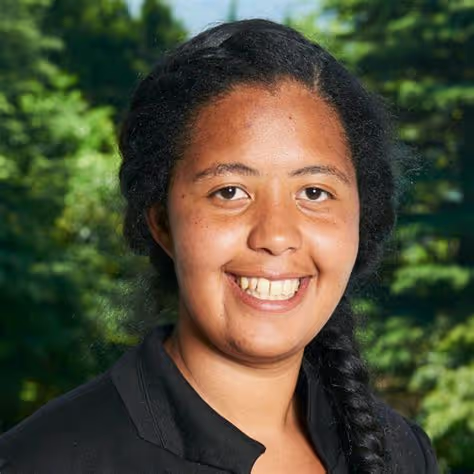
Sheena Talma
Episode Summary
Q1: Place
If we could do a flypast on any part of the world that is significant to you, which place, city or country would it be and why?
Homeland which is Seychelles
Q2: Life
Give us a glimpse into your life story so far with an emphasis on what you are doing currently?
Brought up surrounded by the ocean, but due to a bad experience in the water, didn't start diving until the age of 17. Went on to study marine biology and now work for a variety of organisations such as Save our Seas Foundation and Nekton, where we carry out deep-sea research with countries where deep-sea research isn't necessarily a priority. My current pathway is to do as much as I can for the environment, but particularly illuminating the deep sea.
Q3: Reset
Where on earth is your place or reset or re-charge?
With my extended family
Q4: Wonder
What wonder of the natural world excites you the most?
The place that mesmerises me the most is the deep waters. To even imagine what lives beneath the surface of our ocean.
Q5: Hopefulness
What is your story of hopefulness (not your own) about a person, business or non-profit who are doing amazing things for the world?
The Sustainable Ocean Alliance activates young people and mobilizes an ocean workforce to restore the health of the ocean in our lifetime. Another organisation is the Ocean Discovery League. They are creating affordable technology that will allow any scientist to illuminate our deeper waters.
Q6: Insight
As we prepare to re-enter, what insight, wisdom or question would you like to share with us?
There's still time to change mindsets and change our behaviours, to be better stewards of our planet and our ocean. It's a matter of coming together and believing that we can make a difference.

Transcript
Intro:
Orbiting 250 miles above Earth, the space station provides the ultimate view of planet Earth. From this perspective, we ask our guests to engage with six questions that orbit around wonder and stories of hopefulness. For the next few minutes, this is our WonderSpace.
Steve (host):
Welcome to the eighty fifth episode of the Wonder Space podcast, which is a creative expression of a family trust called Panipur. My name is Steve Cole. And since September 2020, I have asked the same six questions to over 80 people from around the world. People like Sarah Corbett, who is the founder of the Craftavis Collective. I do believe that if we want to make our world a more beautiful, kind, and just place, then our activism can absolutely be more beautiful, kind, and just.
Steve (host):
It's treating people how you want to be treated. Sarah was our third guest on Wonder Space, which you can hear in full at our wonder. Space. For our third year, we are excited once again to be collaborating with Ask Nature, who are a project of the Biomimicry Institute. Their work looks to nature for inspiration to solve design problems in a regenerative way.
Steve (host):
Here is another moment to help us to re wonder.
Ask Nature:
The Caribbean spiny lobster uses a pair of small antennae called antennules to sniff out and track down snacks. The antennules are covered in rows of hair like receptors called esthetasks that allow the lobster to detect chemical signals such as odors. When flicked quickly downward through a drifting underwater scent trail, the hair array acts like a leaky sieve allowing more water to pass through the sense receptors, grabbing odor molecules from the turbulent water currents. On the slower upward flick, the hair array acts like a paddle with water passing the hairs without much stirring, so that the odor plume structure doesn't change. Each flick gives lobster a scent snapshot of its surroundings.
Ask Nature:
Learning from this technique, biomedical scientists have proposed using an antennal like brush to capture and work with microscopic objects such as single cells. On a larger scale, underwater drones could use such sensors to search out chemicals, pollution or small disturbances that might help predict events such as earthquakes.
Steve (host):
This week on Wonderspace, we welcome Sheena Telma, a marine scientist from The Seychelles, working with the Necton Foundation, which is an amazing charity focused on accelerating scientific exploration and protection of the ocean. Their aim is to highly protect at least 30% of the ocean by 02/1930. Sheena also works with the Save Our Seas Foundation, which has funded over 400 marine projects in over 80 countries around the world. With this expansive overview of Earth, I start by asking Sheena if we could do a fly past on any part of the world that is significant to you, which place, city, or country would it be, and why?
Sheena:
Well, I think that's an obvious question. I'm from The Seychelles which is a small group of islands in the Indian Ocean. So you know, that's my favorite place. That's home. I love it so much.
Sheena:
There's so much blue and so much green. And every time I fly in coming from another country, it just reminds me of how amazingly blessed I am to be from a country that is so full of wonder and so much more to explore and discover. So I would say definitely homeland, which is Seychelles.
Steve (host):
Sheena, give us a glimpse into your life story so far with an emphasis on what you are doing currently.
Sheena:
I'm from a small island state or a large ocean nation. And that means that you are surrounded by the ocean when you grow up. But unlike a lot of marine biologists, which is what I am now, I didn't grow up being super confident in the ocean. I was as a kid as most kids are, you know, like excited about water and stuff like that. But had a few bad experiences, one particularly bad one that kinda scared me from the ocean for a long time until my community, my friends and family kind of pushed me back into it.
Sheena:
I took a step into diving when I was around 17 and just fell in love with the ocean and that ocean space. And then went on to study marine biology. Well, more ichthyology, which basically is just a fancy word for studying fish. Today, I am a marine biologist, so I identify as that. And I'm a consultant.
Sheena:
So I'm based in Seychelles and I work for a variety of different organizations, including Save Our Seas Foundation and also Nectin. So Nectin specifically, we do deep sea research with countries where deep sea research isn't necessarily priority on the agenda. Fair enough. Because deep sea research is very expensive and generally very difficult to access. So my current pathway is to do as much as I can for the environment, but particularly illuminating the deep sea.
Sheena:
So when we think about our ocean, when we think about the environment, I think there's a lot of doom and gloom around the fact that it just feels like there's nothing more we can do to kind of save ourselves really from the destruction that we've created. But I think one thing that we forget is that our ocean, our planet has the amazing ability to heal itself. If we just allow it the space to do that and to curb our own habits, our own negative mindsets so that our earth can heal itself. So I think the deep sea is a great way in bringing people in, creating a message of hope, creating an interest and mesmerization, instilling this childlike curiosity in our natural world. A springboard, if you will, to allow a new and renewed interest in our natural world.
Steve (host):
Where on earth is your place of reset or recharge?
Sheena:
My place of reset or recharge is probably with my dogs at home, with my family in the garden, and, you know, feeding my chickens, doing very small jobs that kind of seem you know, why would that be so important? But I think that spending time with people and family is really really important. It it reminds me, especially little kids, especially like my cousins and they're so much younger than me. It reminds me why I am so interested in what I do. Why I want to make our world a better place.
Sheena:
It reminds me why I'm still working within the environmental sphere even with all the seemingly multitude of hurdles that we face. Yeah. Just being present with family with especially little kids reminds me that there's such a great generation that is coming up that have so many solutions at their fingertips, that there is hope. And that if we work together, especially intergenerationally, we've got so much more to achieve.
Steve (host):
What wonder of the natural world excites you the most?
Sheena:
The place that mesmerizes me the most is the deep waters. I think it is so cool, for lack of a better word, for us to even imagine what lives beneath our the surface of our ocean. And the fact that we don't even know most of the species that occur in these parts of our, you know, of our planet. But also the fact that most of our planet is ocean and a lot of it is deep. I mean, that to me is mind boggling.
Sheena:
And when I think about exploration, I'm like, space is awesome. I mean, we're all obsessed with that. But we've got like the coolest thing in our very backyard, which is our deep sea. And my aspiration is to be able to discover more of it.
Steve (host):
Sheena, what is your story of hopefulness that's not your own, about a person, business or nonprofit who are doing amazing things for the world?
Sheena:
One of the organizations that I feel really speak to the youth and are trying to congregate groups of youth worldwide so that they feel empowered but can also take action is the Sustainable Ocean Alliance. And, yeah, I just love the fact that they are able to pull in voices from around the world and really create a drive towards creating policy, attending conferences, like UN conferences, and being able to really project their voices on these platforms and giving voices from around the world a platform to be able to do that. So yeah, I think Sustainable Ocean Alliance is one organization that I think are doing great work. And one of the organizations that I've been really excited about and to see how how much further they go is the Ocean Discovery League. They're creating affordable technology that will allow, you know, just any scientist, especially scientists from areas of the world that don't have a lot of access to resources, to be able to illuminate our deeper waters, to be able to deploy equipment of a small boat and not costing a whole lot of money to see what lives beneath 200, 300, five, even down to a 500 meters.
Sheena:
And I'm really excited to see where their work continues to take them.
Steve (host):
Finally, as we prepare to reenter the Earth's atmosphere, what insight, wisdom, or question would you like to leave with us?
Sheena:
I think the biggest kind of message of hope that I would love to share with others is the fact that there's still time to change mindsets, change our behaviors, to be better stewards of our planet, of our ocean. Not so that we can save the ocean. I really I don't like that narrative actually. More so that we can save ourselves. We rely on our planet so much.
Sheena:
Not just the beauty of it, but just the oxygen we breathe. So if anything, it's it's that there's still time and there's still hope. It's just a matter of coming together, believing that we can make differences, changes, and that we can do it together. I think there's a lot of negativity out there around whether we're running out of time to be able to make constructive changes so that we have a healthy planet for the next fifty and a hundred years. And the truth of the matter is, I think that we do.
Sheena:
And what makes me have even more hope is again, looking at my cousins and students I teach at university or camps that we run and teach kids about the environment. And that's where the most hope is. And I just hope that everyone else can can feel that and see that as well.
Steve (host):
Web links to all the organizations Sheena talks about can be found on her episode page on the Wonderspace website, ourwonder.space. What is your story of hopelessness that is not your own? About a person, business or nonprofit who are doing amazing things for the world? We would love you to consider recording yourself in under thirty seconds, sharing your story on your phone through your video or the voice memo or recorder app. You can then simply upload the recording to the link on our website, ourwonder.space.
Steve (host):
Start with your name and where you are from, and then share your story of hopefulness in under thirty seconds, and we will look to include them in future episodes. Thanks to Sheena for joining us on Wonder Space this week. Let's continue to search for and find ways of sharing wonder and stories of hopefulness. We need them like never before. Thanks for joining us.