Episode #
84
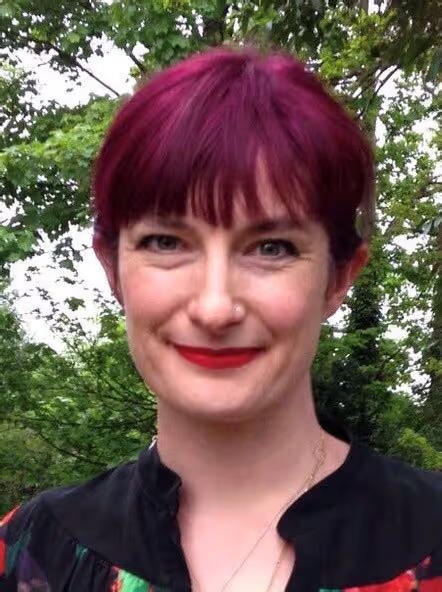
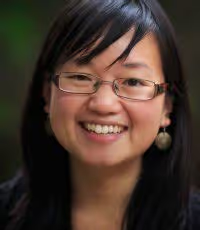
Audrey Lin
Episode Summary
Q1: Place
If we could do a flypast on any part of the world that is significant to you, which place, city or country would it be and why?
A hill overlooking Golden Gate Bridge
Q2: Life
Give us a glimpse into your life story so far with an emphasis on what you are doing currently?
I grew up in the US with parents who were immigrants from Taiwan. At college exposed to a lot of social issues and was introduced to a group that would gather once a week and sit in silence and then have dinner together. There was like a groundedness and a contentedness, and there was something I couldn't place my finger on, but there was something I wanted to learn from that. And as I got to know people, I learned a lot of them volunteered with this group called ServiceSpace. They started this experiment called Karma kitchen, which was a pay-it-forward restaurant all run by volunteers. A little experiment in generosity. And so I started volunteering with them and realised that as I started to spend my days trying to make other people's days, the stories in my head started changing, and that was changing the way I was showing up in the world. Whether it's in a restaurant where you're welcoming strangers or if it's a news portal where you're hearing about the beautiful things people are doing every day, suddenly, those walls that used to be up when I walked around in the world, they kind of dissolved a little bit.
Q3: Reset
Where on earth is your place or reset or re-charge?
Any place of stillness
Q4: Wonder
What wonder of the natural world excites you the most?
The spark in peoples eyes
Q5: Hopefulness
What is your story of hopefulness (not your own) about a person, business or non-profit who are doing amazing things for the world?
The overwhelming kindness of a bus driver to a blind passenger.
Q6: Insight
As we prepare to re-enter, what insight, wisdom or question would you like to share with us?
In our polarised world today we don’t need more leaders we really need more ladders.

Transcript
Intro:
Orbiting 250 miles above Earth, the space station provides the ultimate view of planet Earth. From this perspective, we ask our guests to engage with six questions that orbit around wonder and stories of hopefulness. For these next few minutes, this is our wonder space.
Steve (host):
Welcome to the eighty fourth episode of the WonderSpace podcast, which is a creative expression of a family trust called Panahpur. My name is Steve Cole, and since September 2020, I have asked the same six questions to over 80 people from around the world. People like Pedro Tirak from Sistema B in Argentina, who in his final insight talked about our need to humanize the economic system. He suggested that business needed to include three elements, heart and emotion, the need for business to build community, and finally, need for business to build legacy on a daily basis. Pedro was our tenth guest on Wonder Space, and you can hear his episode at ourwonder.space.
Steve (host):
For our third year, we are excited once again to be collaborating with Ask Nature, who are a project of the Biomimicry Institute. Their work looks to nature for inspiration to solve design problems in a regenerative way. Here is another moment to help us to re wonder.
Ask Nature:
As dolphins leap through waves and dive into the deep, their whistles and squeaks create a far reaching sphere of sound around them. They use these sounds to communicate with each other, and they span a wide range of frequencies from low to high, even beyond the range of human hearing. But as the sound waves propagate out in all directions, they bounce off both the ocean floor and the surface of the water and can end up interfering with the other parts of the wave. This could make the signal hard to interpret for a listener, and that's why the wide range of frequency is helpful. If a portion of a signal gets interfered with at one frequency, it may still get through at another, and the whole message can be transmitted without distortion of meaning.
Ask Nature:
Humans are now mimicking this approach to improve underwater communication in tsunami monitoring systems and underwater exploration vehicles, and even in an underwater telescope built to detect neutrinos from distant stars. Cutting edge technology we owe to our underwater cousins. This
Steve (host):
This week on Wonderspace, we welcome Audrey Lin from San Francisco, who volunteers with a nonprofit called Service Space. They leverage technology to encourage everyday people around the world to do small acts of service, and were nominated by Ruth Rogers from The Canvas, who was our guest on the thirty second episode. As part of her role within Service Space, Audrey recently launched Karuna, which is an online platform for amplifying everyday stories of courageous kindness. From this place of wonder space, with an expansive overview of Earth, I start by asking Audrey, if we could do a fly past on any part of the world that is significant to you, which place, city or country would it be, and why?
Audrey:
I live in Northern California, the San Francisco Bay Area, and there's this area of hills that there's a period in my life where I used to go there almost every day and, sit on top of the hill and you could see everything. You could see the curve of the horizon, you could see the Golden Gate Bridge, you could see the city, you could see the hills. And one of my favorite things to look at were the bridges and the freeways because the cars and the people looked like little ants. And there was something so comforting about that. And it just kind of zoomed me out of my life and whatever importance I thought I had.
Audrey:
It just kind of zapped it out of me. And it was just there was like it was almost like this load of pressure taken off because suddenly I remembered it's not about you. It's not about your life, but it's you know, we're all connected in this greater scheme, and we don't necessarily have control.
Steve (host):
Audrey, give us a glimpse into your life story so far, with an emphasis on what you're doing currently.
Audrey:
I grew up in The US, in Massachusetts, the state of Massachusetts, like the Northeast Of The US. I grew up in a little suburb. My parents were immigrants from Taiwan. And I think from a young age, I saw them working really hard, you know, and it's the immigrant mentality of getting the American dream and working really hard to have that stability for your family, and they really valued education. And I just felt like they really gave my sister and me so much, whatever that, you know, they gave themselves so little and gave us so much.
Audrey:
And I think in my teenage years, I really was very curious and I didn't have a religion. So, science, my parents were scientists, so there was kind of like science was kind of our religion in a way, how we saw the world. So, I think I just really held a lot of questions of what's the meaning of life, you know? I didn't have a bigger story to tell me that. It was just like we're here, we're molecules, and that's it.
Audrey:
And in the meantime, I felt like I don't want to just live a big carrot and stick game, you know? I don't want to live for the weekends when I grow up. I want to, like, really be alive. I don't want to go through life sleeping. And when I was in college, I was exposed to a lot of different social issues.
Audrey:
I wanted to try to make a difference, and but it just started to feel like everyone was kind of fighting for peace. And so I wondered, you know, like, how I got to learn about people like Gandhi or Martin Luther King Jr, people that really tried to embody the change that they wanted to see in the world. And so I started learning about non violence and then that started introduced me to meditation And that introduced me to this kind of group of people that they would come together once a week and they would sit in silence. They didn't even call it meditation. Like, we'll sit in silence, we'll read a passage, reflect on it, have dinner.
Audrey:
It was just a very casual thing in a living room. And as I got to know these folks, I started thinking, wow, there's something they know everyone knows that I don't. Like, there's something like, I'll have what you're having. What are you having? Kind of thing.
Audrey:
And it wasn't shiny. It wasn't glossy. It was very kind of simple. There is like a groundedness and a contentedness. And there is something I couldn't place my finger on it, but there is something I wanted to learn from that.
Audrey:
And as I got to know people, I learned a lot of them volunteered with this group. At that time, was called Charity Focus, now it's called Service Space. But, you know, they started this experiment where, like, one of the local ones was something called Karma Kitchen. It was just like a pit for a restaurant all run by volunteers. It's just like a little experiment in generosity.
Audrey:
So I started volunteering with them and realizing that as I started to spend my days trying to make other people's days, the stories in my head started changing and that was changing the way I was showing up in the world and what I thought was possible. Because before I'd walk around thinking, okay, people are good, but, you know, I can't trust everybody. And then you, you know, whether it's in a restaurant where you're welcoming strangers as if you're welcoming them into your own home or if it's like this news portal where you're, you know, hearing about the beautiful things people are doing every day, suddenly, you know, those walls that used to be up when I walked around in the world, they kind of dissolved a little bit. So, for me, I think over the years, I've worked in as an educator in different capacities, but maybe the last four years or so, I've kind of been more of a full time volunteer and it really wasn't planned. I left my job because I thought, okay, I'll take three months to volunteer.
Audrey:
And I really want to just learn, you know, from this space. Three months turned into three years, turned into a whole host of different projects and a deeper faith, I think, in not knowing. Usually we think we have to, like, have some grand vision and we have to really know it and execute it and have a plan. I don't know what the world needs. None of us do.
Audrey:
But maybe when we come together with this intention to serve a greater wholeness and we just hold that and we're humble that we know that we don't know, we can take little steps forward to try. And so, I think the universe never ceases to amaze me and I'm not stuck on trying to pay my bills. If I need to pay my bills and I don't know how, I'll get a job. Like, it's it's very simple in that sense, and I I will do whatever job I need to do. But I think it's all part of kind of a grander scheme, and I and it's not like one way is a gift and one way is not a gift necessarily.
Audrey:
It's all though, like, life is such a precious gift, and we find ourselves in different circumstances, and those circumstances are the gifts being given to us. Where
Steve (host):
Where on earth is your place of reset or recharge?
Audrey:
I think for me, my place of reset or recharge would definitely be stillness, like being in any place of stillness. And for me, that's a meditation practice, but it could be different for everybody. And I think when I take the time to close my eyes, you know, and sit in stillness and just see what's inside this body, what's inside this mind. It's this visceral reminder that no two moments are the same. I'm not the same person that I was a split second ago, you know, that everything is constantly arising and passing, everything's constantly changing.
Audrey:
So it's very humbling and I think that's that always gives me perspective.
Steve (host):
What wonder of the natural world excites you the most?
Audrey:
One that really inspires me, I don't know, maybe I'm very human centric these days, I live in a city, but it's really the spark in people's eyes. I guess it could be a spark in animals' eyes too. But just, I think there was one time I was at this event and there were a bunch of people standing in a circle and this man was doing kind of an opening ceremony and he had us look off into the horizon. So, everyone adjusted their gaze to the horizon. Then he said, Look as far as you can.
Audrey:
Look as far as you can. Then he said, Okay, now look at the person across from you. I remember looking at the person across from me and seeing their eyes. I remember thinking, and then that person said, Look as far as you can again. And I remember thinking, Oh my gosh, the farthest place to look is not necessarily off into the horizon.
Audrey:
It's actually in someone's eyes. It's like some people say the longest journey is from the head to the heart. And I think whenever you see a spark in someone's eyes, I feel like there's a story there, and there's something something to be learned.
Steve (host):
Audrey, what is your story of hopefulness that's not your own about a person, business or nonprofit who are doing amazing things for the world?
Audrey:
So the story that came to mind was a bus driver. I was on this bus like seven or eight years ago, but it still stays in my heart because I was taking this bus just downtown and I was reading a book and I suddenly hear this bus driver talking very loudly. He was at a stop, and he just is beaming with, like, kindness. He just says, oh, it's so good to see you here today, ma'am.
Audrey:
You know, here, come right on up. There's a seat right behind me. And he's speaking pretty loudly. No one's really noticing that because it's a bus. And so this woman comes on and I just kind of look up and she has a walking stick.
Audrey:
She's blind. And so she sits right behind this bus driver and, you know, he closes the door, drives on, and then he, you know, at the next stop I started noticing this bus driver and he's like the friendliest bus driver. And when this woman got off the bus, or it was her stop, he actually asked her, he said, what stop are you at? So, like, he could pay attention to let her know when that stop reached. And so he got to her stop and said, okay, this is your stop, ma'am.
Audrey:
It's been a pleasure having you on the bus today. And he, you know, talks to the person behind her saying, can you make sure she gets on the subway okay? And so it was just I watching that, I just remember thinking like, wow, that's that is something really significant right there, you know, and just that care for a perfect stranger when you didn't have to do that. And I remember thinking, I got to tell him I really appreciated that. And then as soon as I had that thought, was like, Oh, people don't do that.
Audrey:
Shouldn't do that. And I think that's where the volunteering came in. Was like, no people do do this, like, it's okay, you can do this.' And so when it was my stop, I went up to him and I said, you know, I really appreciate what you did for that blind moment, really made my day to see that.' And he looked at me and he said, You know, thank you so much. My brother is deaf. So when I see somebody, you know, that has a disability or different capabilities, I just try to help them when I can, but I'm really touched that you noticed.
Audrey:
And it just, you know, I got off the bus, I felt like I was on cloud nine because it was this simple connection. I don't even remember his name. He probably didn't even remember me. This was seven or eight years ago. But there's something about that possibility of, like, we're all just travelers, you know, for whatever time we have here.
Audrey:
And and if we can just lighten the the lighten the backpack of someone else along the way, like, why not?
Steve (host):
Finally, as we prepare to reenter the Earth's atmosphere, what insight, wisdom, or question would you like to leave with us?
Audrey:
I think for these times right now, you know, there's so many polarities in our world, there's so many problems in the world. And I think one of the things that I've been thinking about is it feels like we don't really need more leaders. We actually, there's a mentor many years ago who a bunch of us were going on a leadership retreat and we said, do you want to come? And he said, leader? I don't want to be a leader.
Audrey:
I want to be a ladder. He was the king of puns. So, you know, and I thought, wow, yeah, I want to be a ladder too. We all want to be ladders too. It's a laddership retreat.
Audrey:
And so I think in our kind of polarized world today, we don't really need more leaders, but we really just need more ladders, you know, like more people that can be stepping stones for others to climb up and over. And so, yeah, I guess how can you can you be a ladder? How can you kind of just make someone's day a little bit brighter in some small way?
Steve (host):
You can find out more about the work of Audrey at karunanews.org. What is your story of hopefulness that's not your own, about a person, business, or nonprofit who are doing amazing things for the world? We would love you to consider recording yourself in under thirty seconds, sharing your story on your phone through your video or the voice memo or recorder app. You can then simply upload the recording on the link on our website, ourwonder.space. Start with your name and where you are from, and then share your story of hopefulness in under thirty seconds, and we will look to include them in future episodes.
Steve (host):
Thanks to Audrey for joining us on Wonder Space this week. Let's continue to search for and find ways of sharing wonder and stories of hopefulness. We need them like never before. Thanks for joining us.