Episode #
82
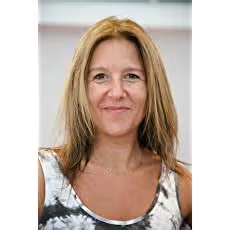
Nicole Yershon
Episode Summary
Q1: Place
If we could do a flypast on any part of the world that is significant to you, which place, city or country would it be and why?
Havana in Cuba
Q2: Life
Give us a glimpse into your life story so far with an emphasis on what you are doing currently?
First job age 13 selling blouses on a stall at Petticoat Lane market on a Sunday morning. My Dad has always been an incredible inspiration and did amazingly well in the advertising arena. He was kind of like the true meaning of the word entrepreneur. I have always been an intrapreneur working in large companies such as Ogilvy before founding the NY collective. Today a connector, an executor of ideas who brings someone in like a conductor of an orchestra.
Q3: Reset
Where on earth is your place or reset or re-charge?
Home at the Lime house Basin near Canary Wharf
Q4: Wonder
What wonder of the natural world excites you the most?
The wonder of water that makes up over 70% of the planet.
Q5: Hopefulness
What is your story of hopefulness (not your own) about a person, business or non-profit who are doing amazing things for the world?
My son Max who was often getting expelled from school. After putting suitable support in place Max began to excel which inspired the rough diamond programme in Ogilvy which then led to them considering and employing people from a wider spectrum of thinkers. I carried on with that feeling of wanting to work with organisations like that, which led to a position on the board of Creative Conscience. I'm also the chair of the Ideas College to give kids a chance in life that ordinarily they wouldn't have had.
Q6: Insight
As we prepare to re-enter, what insight, wisdom or question would you like to share with us?
The power of saying YES!!

Transcript
Intro:
Orbiting 250 miles above, the space station provides us with the ultimate view of planet Earth. From this perspective, we ask our guests to engage with six questions that orbit around wonder and stories of hopefulness. For the next few minutes, this is our wonder space.
Steve (host):
Welcome to the eighty second episode of the Wonder Space podcast, which is a creative expression of a family trust called Panahpur. My name is Steve Cole, and since September 2020, I have asked the same six questions to over 80 people from around the world. People like Zarlasht Halaimzai from Kabul in Afghanistan, who in episode 30 talked about her own extraordinary story which led to starting a non profit called the Refugee Trauma Initiative, which is now called AMNA. In just six years, teams have helped more than 10,000 refugees build resilience through therapy groups, family counseling, and early childhood support. For our third year, we are excited once again to be collaborating with Ask Nature, who are a project of the Biomimicry Institute.
Steve (host):
Their work around the world looks to nature inspiration to solve design problems in a regenerative way. Here is another moment to help us to re wonder. Many
Ask Nature:
Different animals have taken to the skies in flight. Insects buzz, birds flap, and bats seem to scoop giant handfuls of air climbing and crawling through the atmosphere. As these furry fliers dart about after insect prey, they maneuver with astonishing dexterity. It may seem amazing that they're able to do this despite being little furry mammals instead of fine feathered birds, but the opposite is the case. The delicate mammalian hairs covering bat wings actually serve as tiny sensors detecting wind speed and direction at every point along their surfaces.
Ask Nature:
Signals from these hairs rush to the brain and give the bats the information they need to make precision adjustments to their wing shapes and motions to catch prey, avoid predators, and thrive high above their scurrying mammal relatives below.
Steve (host):
This week on Wonderspace, we welcome Nicole Yershon, who was introduced to me by the founder of Creative Conscience, Chrissy Levett. Nicole sits at the intersection of business, creativity, technology, and marketing. She is a best selling author and the founder of the Ogilvy Labs before more recently starting the NY Collective. From this place of wonder space with an expansive overview of Earth, I start by asking Nicole, if we could do a fly past on any part of the world that is significant to you, which place, city or country would it be and why?
Nicole:
It would be Cuba and Havana. And I love it because it's a place of contradictions. So you have extremely well educated people, money spent on their education and their health and doctors and cures, yet they're so extremely poor in wealth. And yet the place is loud with music, and they're literally dancing on the streets. Just can stop you in your tracks.
Nicole:
But one thing that was very sad for us when we went there, we'd gone to a place called Vinyalis, which is about six hours out from Havana. And we got really friendly speaking to the driver. And he's got maybe, I don't know, two or three jobs just to make ends meet. Very well educated, just the most, not your usual conversations that you would have with the driver taking you there. And then we agreed when we got back that he'd come with us and we'd have a drink on the terrace in the hotel on the roof, have a lemonade or whatever.
Nicole:
And the guards wouldn't let him in. There were guards in the hotel and they just would not let him in. And that just really upset everyone. It made our driver feel really bad. And the contradictions there that it's so incredible and yet so messed up.
Nicole:
So I would say Cuba if I was gonna do like a fly past.
Steve (host):
Nicole, give us a glimpse into your life story so far with an emphasis on what you were doing currently.
Nicole:
I had a very privileged upbringing with my parents, but there was a very strong work ethic that came from them, where you kind of, and you were allowed to speak your mind and there were no lies. So therefore it bred courage and faced consequences for actions and learned from them, So from a very early age, and I had my first job when I was aged 13, selling blouses on a stall at Petticoat Lane Market. So up every Sunday and on the tube at 05:30 in the morning to get there, whatever the weather. I give a really good story of my mum and her and how she kind of taught me this work ethic, is that when I got my first job at age 19, I had a salary. And my mum was insistent on taking rent from me.
Nicole:
It was something small, like £50 a month or something like that. But and then every time my salary went up, she insisted on it going up. And I used to really resent her. I used to think, why do you need that? I'm living at home, you don't need my money type thing.
Nicole:
It was a very privileged life that I was living. I went to finishing school and I got married at the Dorchester and just very, very privileged. I just couldn't understand why she would want it. Anyway, when I got engaged to be married, she gave me back and I was buying a house with my ex husband and she gave me back $20, which is what I'd saved. But I didn't know I was saving.
Nicole:
So my dad has always been an incredible inspiration to me. He's working class in the East End and did amazingly well in the advertising arena. So he's kind of an entrepreneur, set up his own company, took media out of agencies, and so therefore created this mix of creative agencies and media agencies. He was one of the first to do that. And so, he was kind of like the true meaning of the word entrepreneur.
Nicole:
And I have always been an intrapreneur. So I always worked at large companies and was very entrepreneurial spirited within a very large company. So the maverick, the naughty one, they say no, I do it anyway. And then my innovation lab at Oakley got closed down. And then the intrapreneur became an entrepreneur.
Nicole:
So now I run my own show, it's called the NY Collective. I consult, I kind of get pulled into lots of different projects. Normally love it when someone says I've got a problem and I don't really know what to do. And I normally find when people say they have an idea, most of the time it goes in the bottom drawer because they don't know how to execute it. So that's kind of like my sweet spot, the super connector and an executor of ideas and bringing someone in like a conductor of an orchestra.
Nicole:
So that's where I am now, guess the intrapreneur is now the entrepreneur.
Steve (host):
Where on earth is your place of reset or recharge?
Nicole:
I thought about this one for quite a while because I'm thinking on a beach or But actually, after COVID, we did six weeks in New York. We just did a work from anywhere. And we just thought, what would it be like to just live and work in a totally different city? And so we did that. And what was so amazing was when we came home, it was such a beautiful feeling that I thought actually, that's where I recharge and reset.
Nicole:
And I didn't realise it really, until I got back from New York and the madness, however lovely it was there. Home is home. And we've really made this into kind of like an oasis to recharge and reset. What
Steve (host):
wonder of the natural world excites you the most?
Nicole:
I think water. And I've always thought, I know everyone is kind of like space and wow and amazing. And I've always thought water. So 70% of our planet, why are we not spending more doing more on what we already have on the planet? Why can't we do more in exploring how we could live under, over, through, you know, whatever which way?
Nicole:
Yeah, I don't feel that humans have explored it enough.
Steve (host):
Nicole, what is your story of hopefulness about a person, business, or nonprofit who are doing amazing things for the world?
Nicole:
It's a story about my son, Max. He was about to be expelled from school every week. I would get a phone call that he'd done this, that or the other. And for me as a working parent and as a stressor even on relationships, was really hard. And so I basically went to the school and had a head to head with the head master, because I thought the things they were putting him up on were ridiculous.
Nicole:
And they were trying to push him through this sausage factory of learning and not understanding that he's not someone, you know, sit down and shut up and I don't want to hear from you in eight hours. He's just not that kid. So I started sending them through blog posts from Seth Godin about hunters and farmers, and sending them through Sir Ken Robinson, TED Talks, and having to re educate the school and the system as to how you actually go about teaching and getting the best out of kids. Which then led us to us having a translator teacher called Mr Wilson. And Mr Wilson was amazing because he understood Max and he understood the teachers.
Nicole:
So Max could go to Mr Wilson with what some other teacher had said or done, and Max might have reacted so he could take his pent up reaction to Mr. Wilson. Mr. Wilson could say, well, what they actually mean is this. And then Max could go, oh, okay, well, that's fine.
Nicole:
But rather than the, you do as I say, or I'm your teacher, and you sit down and shut up that whole thing that Max couldn't adhere to. And I couldn't either. So I totally understood where he was coming from. I totally could empathise. And he didn't need to go on Ritalin and he wasn't ADHD, or he might have been, I don't know, but it was just common sense, just to not treat a child like that.
Nicole:
So my whole ethos with Max then, and there was the success story with Max. So it wasn't hopeless because I kept at it and he ended up deputy head boy, then ended up going to Reading University and getting a first. So I then just thought, well, if I could do that for him, my little part, maybe I could do that with other rough diamonds. And that's what made me set up the rough diamond programme in Ogilby for them to hire alternative divergent thinkers and people with a diverse aspect to living. So Max was my kind of feeling of hopelessness, but turning it into advantage and setting that up, which then had me, when they closed down the lab and they closed down the rough diamond way of working, I carried on with that feeling of wanting to work with organisations like that, which is why I was on the board of Creative Conscience, and wanting to see what they were doing, and how they were trying to solve the problems of the world with using creativity to problem solve and looking at people, purpose and planet.
Nicole:
And I've also, I'm the chair of a school that's still to be opened with Ideas College, in wanting to be a free school, to have 50 or 60 kids that aren't naturally academic, and that aren't able to go through the school system, and give them a chance in life that ordinarily they wouldn't have had. If I can just keep doing those little bits of change personally, then I feel a bit more hopeful.
Steve (host):
Finally, as we prepare to re enter, what insight, wisdom or question would you like to share with us?
Nicole:
I think backing off from the last question, was about me feeling hopelessness, which then turns into hopefulness. There's a book from Yuval Noah Harari, he's done a few amazing books, but one of the quotes from his book is the best advice I can give a 15 year old is don't rely on the adults too much. Most of them mean well, but they just don't understand the world. So I think that kind of that's a really good advice piece of advice that kind of backs up from the rough diamond thing that we're talking about. But my few things that I kind of feel that wisdom and insights, the power of saying yes.
Nicole:
It's quite profound. And actually, I've even found it more difficult after COVID to say yes. I've been kind of CBA, as my daughter would say, that can't be asked. You know, someone asked to do something on that, just CBA. So I just came back from Bulgaria.
Nicole:
And I said yes to it. And then as it was getting closer, I was thinking, what have I done? Because I'm not gonna know anybody. I only know one other person. It's an unconference.
Nicole:
So you're always on, apart from when you're sleeping, you're always talking, you're setting the agenda for this unconference. Why am I doing this? With all strangers, but by the end of it, oh my God, it was just life changing. The people that I met, the learnings that I got, all just to make that little effort. And the power of serendipity that came out of it of someone that I know that knows someone else who was with them the week before or the crossover of life with total strangers was just amazing.
Steve (host):
You can find out more about the work of Nicole at nicolejerchen.com. What is your story of hopefulness that is not your own? About a person, business, or nonprofit who are doing amazing things for the world? We would love you to consider recording yourself in under 30, sharing your story on your phone through your video or voice memo or recorder app. You can then simply upload the recording to the link on our website, ourwonder.space.
Steve (host):
Start with your name and where you are from, and then share your story of hopefulness in under thirty seconds, and we will look to include them in future episodes. I want to thank Nicole for joining us on WonderSpace this week. Let's continue to search for and find ways of sharing wonder and stories of hopefulness. We need them like never before. Thanks for joining us.