Episode #
81
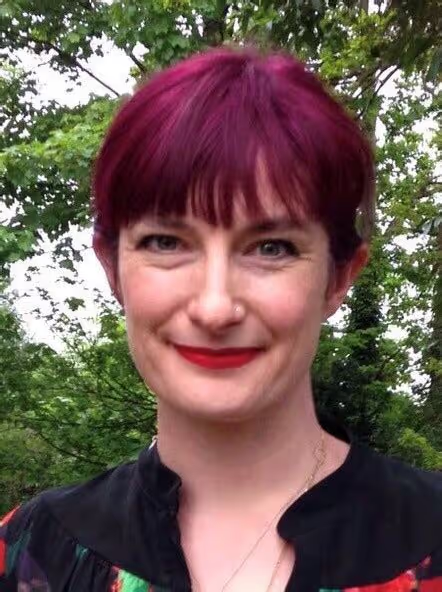
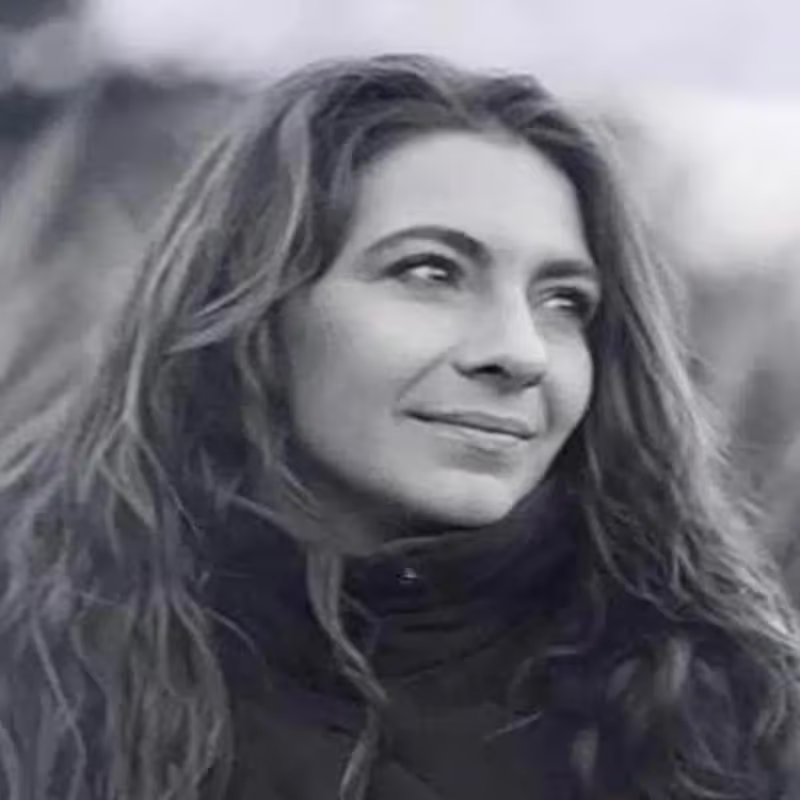
Sophie Shnapp
Episode Summary
Q1: Place
If we could do a flypast on any part of the world that is significant to you, which place, city or country would it be and why?
The Sacred Music Festival in Fez, Morocco
Q2: Life
Give us a glimpse into your life story so far with an emphasis on what you are doing currently?
Studied environmental engineering but was more interested in culture and hanging out with the art kids at Glasgow School of Art. Went into environmental politics for 15 years but sensed that all the passions aligned when approached to be part of Brian Eno's music and climate charity earth percent. Now also putting energy into Culture COP which is taking place in tandem to COP in Egypt.
Q3: Reset
Where on earth is your place or reset or re-charge?
A hill in Dumfries and Galloway, Scotland
Q4: Wonder
What wonder of the natural world excites you the most?
Mycelium networks
Q5: Hopefulness
What is your story of hopefulness (not your own) about a person, business or non-profit who are doing amazing things for the world?
Earth Percent as a charity to unleash the power of music and service of the planet
Q6: Insight
As we prepare to re-enter, what insight, wisdom or question would you like to share with us?
Learn to live in and through purpose

Transcript
Intro:
Orbiting two fifty miles above, the space station provides us with the ultimate view of planet Earth. From this perspective, we ask our guests to engage with six questions that orbit around wonder and stories of hopefulness. For the next few minutes, this is our wonder space.
Steve (host):
Welcome to the eighty first episode of Wonder Space. My name is Steve Cole, and this is the first episode of our third year. For anyone joining for the first time, Wonderspace is a creative expression of a family trust called Panipur that seeks to provide places of refuge for leaders pursuing change. Since September 2020, we have asked the same six questions to over 80 people from around the world. People like Associated Press photographer Mohamed Mahayson in episode six, who in answer to our first question chose Pakistan as the country he would choose to fly over.
Steve (host):
A country that has shaped his photography more than any other. Pakistan, he said, is where I learn never to judge a country by the cover, and to always give everything a chance to know it better. For our third year, we are excited once again to be collaborating with Ask Nature, who are a project of the Biomimicry Institute. Their work around the world looks to nature for inspiration, to solve design problems in a regenerative way. Here is another re wonder moment from Andrew Howley.
Ask Nature:
Woven through just a single shovelful of soil are literally miles of fibres. They're created when fungi break down plant material to make tissue for themselves. This tissue has unique physical characteristics that make it useful and inspiring for humans as well. The tube shaped threads, collectively known as mycelium, branch and fuse as they reach far and wide to harvest food for the fungi. On the inside of the threads are proteins and chitin fibers held together with sugars that provide rigidity and strength.
Ask Nature:
On the outside, beta glucans form a gel like material that gives flexibility and expandability. The combination of the fibers and the spaces between them gives the overall material its highly desirable traits. It is at the same time strong and flexible. It can be compressed and bounce back. It slows the spread of heat and sound.
Ask Nature:
And because the shape of the space and amount of food available influence the density and direction of growth, a mycelium mat can be custom grown to take on a variety of physical characteristics. Mycelium can then either be utilized directly by humans or inspire the design of other high performance sustainable materials.
Steve (host):
For the first Wonderspace episode of our new year, we welcome Sophie Schnepp, who is a climate specialist and on the founding committee of Brian Eno's music and climate charity Earth Percent. Sophie is also a driving force in Culture COP that's going to be held in tandem alongside COP27 in Egypt. From this place of wonder space with an expansive overview of Earth, I start by asking Sophie if we could do a fly past on any part of the world that is significant to you, which place, city, or country would it be, and why?
Sophie:
Yeah. This one this one is an interesting one. I think it it has to be Morocco Fairs at the Sacred Music Festival. It was the first time I heard Sufi music and the first time I moved my body to Sufi music. And the movement kind of took over our bodies.
Sophie:
I was with a group of friends of my parents and I was I was quite young, kind of teenager. And we were moving with people around us in the same movement of just bopping our knees up and down for about an hour. I was like, I I didn't realize out of movement and out of music this this feeling could exist. And so it was the first step into understanding where our bodies and minds can take us.
Steve (host):
Sophie, give us a glimpse into your life story so far, with an emphasis on what you are doing currently.
Sophie:
I remember as a child always being very focused on what was fair, whether it was within the rules or out with the rules. What I thought was fair was my own justice, DAAL, let's say, a form of justice radar. I remember really fighting my ground for whatever I thought was fair. I think this comes from many different things, I remember driving down a street with my parents, and there was one side of the road that was filled with lots of houses that were, like, kinda squeaky clean and gorgeous, and the other side of the road was another country, and it was and and the houses were kind of, like, ruthless and kind of falling apart and I was like, dad, what why why are the two sides so different? And and he said, well, that's, you know, based on kind of the economic growth of of each side and I just remember having kind of goosebumps and thinking that's profoundly unfair.
Sophie:
And this kind of thing has always been with me and through me. I'm always It's always about truth and justice in my life, which can be fun and other times can be, you know, a bit more challenging. But So that's kind of where my passion has come from. So when when we're 17 and we're told to choose a subject at university, I was like, okay, well, causes are the things that's, you know, the the most potent in our lifetime, and it's the the biggest crisis of our time. This is what we need to kinda change.
Sophie:
So I jumped straight into into environmental engineering and smashed it, though it wasn't I don't think it was my full calling because I was always hanging out with the art kids at at Glasgow School of Art, and it was Sorry. I I didn't really have friends at at uni. I had friends in the evening at nighttime and concerts and culture and like moving and stuff was always at the forefront of my passion. I found it really hard in this moment to kind of link purpose and passion together. I went from studying engineering to then go into environmental politics that I've been doing for the past fifteen years.
Sophie:
And that definitely fed my purpose led, let's save the planet mission, but what I realized is two things. One, from a personal level, I wasn't being true to who I am and I wasn't in in this field of culture and movement and music, but also the politicians are really struggling to get progressive policies in place because they don't have the people power behind them to support them. So there was just this kind of eureka moment that happened about three or four years ago that was like, the key to making change is clearly culture. Culture is at the forefront of all revolutions and revelations and movement. So that moment kind of happened alongside me running along the canal and my friend saying, hey, there's this brand new charity that are not even started yet that is founded by Brian Eno and my really good friend, Hiroki, works there.
Sophie:
You should really get in touch with them. It's really up your street. And I thought, wow. I can't believe the music industry is now now joining this fight, there's a space for me, you know? It's amazing.
Sophie:
And so what we know is that culture has got such a power to make change, and that's why I'm doing what I'm doing. Working with Earth Percent and working on a bigger scale, something really important is called Culture COP that's going to be held in tandem alongside COP that's happening in Egypt, but it's bringing the cultural sector into the climate fight. As Amitav Ghosh said, the climate crisis is also a crisis of culture and thus of imagination. And we believe that now is the time to start retelling the stories of our world, falling back in love with our world.
Steve (host):
Where on earth is your place of reset or recharge?
Sophie:
Very, very simple. Bardanic Hill, Monie Ive, Dumfries And Galloway, Scotland. It's the hill behind my house. It's Scotland is kind of Scotland is where I was born and where I grew up from the age of 10 and it's it's just a place of profound nature. And I this hill was a place of my refuge for for many different things that have happened in my life, but it's it's the place where you kind of walk up and the wind is slapping you across the face and the grass is like changes color every year, every season, every moment and the pine trees are so big and vast and there's this pigeon house that's haunted and spooky, but it it really it brings out all of the elements in Scotland and it just allows me to feel like I'm alive and I am protected by mother nature.
Sophie:
And so I go up there every single time I go home. It's the first thing I do is I run up the hill, take my shoes off, and just like it's like a big blanket or a big bed of Scotland that I lie on, and I'm just like, oh, I'm I'm in my rightful place.
Steve (host):
What wonder of the natural world excites you the most?
Sophie:
Hands down, my cilium networks. It's just I mean, from being able to the Mexicans looking into how they can get rid of nappy waste and waste because it's a source of food for for these networks or from how interconnected they are and and and underground and then like, it's almost like they are their own movement, own community and then they pop their heads up and give you a little mushroom sometimes and, you know, the research is now going into how amazing it is to kind of use mushrooms to cure all forms of mental illnesses and as well as body issues and more and more. And I just believe that this is a huge key to unlock that's so available to us that we're not putting enough resources nor space into.
Steve (host):
Sophie, what is your story of hopefulness that's not your own, about a person, business or nonprofit who are doing amazing things for the world?
Sophie:
Story of hopefulness for me is the charity that I have been so lucky to be working with over the past two to three years, and and this is Earth Percent. And Earth Percent are a charity set up to unleash the power of music and service of the planet. And they do this in two ways. They do this in a monetary way and in a community based way. So what we do at Earth Percent is engage the music industry from artists all the way up to their management and the production companies and anyone that you can imagine gathering up in the music industry.
Sophie:
We help them to find innovative mechanisms to give back to Mother Earth, give back to the planet. And we do this via a grant making making mechanism. So we there's many, many ways that you can provide and give back to Mother Earth via Earth Percent, whether it's giving a a cut of your touring income to Earth Percent, or whether it's giving a song to Earth percent or whether it's writing Mother Earth into one of your songs and sharing your song credits with Mother Earth. We are here for the innovation. We are here for the systemic change and we are here to help anybody that wants to put some finances back into Mother Earth.
Sophie:
The amazing thing about Earth Present is that we're actually doing it via a team of really amazing strategic advisors who help us to distribute the funds within five key action areas that are all around kind of climate justice, systemic change, biodiversity, and also helping the music industry greenify itself, as well as climate mitigation, of course, which is one of the big ones. So we do so we do this monetarily, and then the other amazing thing, the other part side that brings me such hope is this community building aspect around bringing the music sector together to do something good, and what you see is, like, people's egos just drop to the floor because we're doing something purpose driven that makes complete sense because we only have this one planet, and and everybody gets it. We're we're we all know that this the time is up and we have to move. So to form a community of people who all want to make change and work together is just this whole new world for the music industry that's been very, siloed into egos, and and everybody's racing against each other to get to number one. And again, it comes back to the value system, doesn't it?
Sophie:
Like, to be a musician in this day and age, you you you have to have x x amount of listens and x amount of fans and do x amount of touring, and it's all based around how many people love you. And that's really tough for a human being or for a band, you know, on their on their ego, on their personalities, when they all they wanna be doing is is creating music. And so it's just amazing to reshuffle it all and say, hey, the most important thing for us Earth Percent is that we value the planet and why don't you join us and show the rest of the world that it's cool. And what we know is that politicians are the least trusted people on this planet and musicians are the most adored and cherished people on this planet. So if a musician comes out to say, hey, this is something I profoundly care about, all of their fans, boom.
Sophie:
They're on the climate train and we've got more people caring about what we need to be doing, which is just an all around amazing win win situation.
Steve (host):
Finally, as we prepare to reenter the Earth's atmosphere, what insight, wisdom, or question would you like to share with us?
Sophie:
If we're living, working, acting, being through purpose, finally, you feel entirely aligned with who you are. So I'd say like, look inside, find your passion, realize that, you know, this world is to be cherished and adored, and find a way to link your passion with giving back to the world and find community and boom. I keep saying boom, but but that's it. Like, your life begins. You find this radical joy that you didn't know existed within because you're living in purpose.
Steve (host):
You can find out more about the work of Earth Percent at earthpercent.org. What is your story of hopefulness that is not your own about a person, business or nonprofit who are doing amazing things for the world? Please record yourself in under thirty seconds sharing your stories on your phone through your video or the voice memo or recorder app. Then simply upload the recording to the link on our website, ourwonder.space. Start with your name and where you are from, and then share your story of hopefulness in under thirty seconds, and we will look to include them in future episodes.
Steve (host):
Previous episodes of Wonder Space can also be found at ourwonder.space. Thanks to Sophie for joining us on Wonder Space this week. Let's continue to search for and find ways of sharing wonder and stories of hopefulness. We need them like never before. Thanks for joining us.