Episode #
80
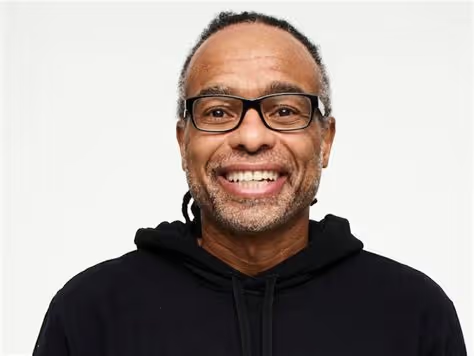
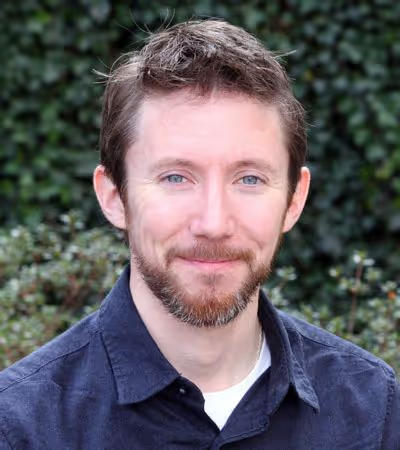
Andrew Howley
Episode Summary
Q1: Place
If we could do a flypast on any part of the world that is significant to you, which place, city or country would it be and why?
Grand Canyon
Q2: Life
Give us a glimpse into your life story so far with an emphasis on what you are doing currently?
Grew up in Long Island, New York. Outside all the time, but never really in the outdoors. Studied anthropology and archaeology in college, worked for America Online in the early days of the internet, and then worked at National Geographic for over a decade. Those kinds of experiences and interests are what led to a role at the Biomimicry Institute where he is now the Chief Editor of AskNature, a website that collects all we know about the way that the natural world works and puts it in a language that's easy for everyone to understand whether you have any biology training or not?
Q3: Reset
Where on earth is your place or reset or re-charge?
Just about anywhere if running
Q4: Wonder
What wonder of the natural world excites you the most?
The natural growth of nature itself
Q5: Hopefulness
What is your story of hopefulness (not your own) about a person, business or non-profit who are doing amazing things for the world?
The slow ways project in the UK who are encouraging people to use existing paths that criss cross the landscape and move at the speed of natural human movement.
Q6: Insight
As we prepare to re-enter, what insight, wisdom or question would you like to share with us?
Look for connections between things, the ways that other living things are doing things and the ways that we humans are.

Transcript
Steve (host):
Welcome to the WonderSpace Podcast, it's great to have you on board. My name is Steve Cole and over the past 79 episodes I have been asking the same 6 questions to amazing people from around the world. People from around the world. The questions orbit around wonder and stories of hopefulness and the setting for each journey is a shared window on the space station from where we see everything from a different perspective. Usually at this time in the podcast we hear from 1 of the team at asknature.org who help us to re-wonder.
Steve (host):
Throughout our second Wonderspace year, Ask Nature have written and produced 40 mind-blowing audio clips that we have used as part of each episode. The main content creator is Andrew Howley from Williamsburg in Virginia who is a science writer and the chief editor of asknature.org which is part of the biomimicry Institute. For the 80th and last episode before our summer reset we wanted to ask our 6 wonder space questions to Andrew and promote the amazing work and vision of Ask Nature and the Biomiracle Institute. With this panoramic view above Earth, I start by asking Andrew, if we could do a fly past on any part of the world that is significant to you, Which place, city or country would it be and why?
Andrew:
I'd like to fly over the Grand Canyon. It's something that loomed very large for me at an important time of my life. You know just having graduated college I was thinking of you know wanting to get out and explore and to see the world. And I realized that I hadn't even really seen my own country, you know, the United States. And the Grand Canyon seemed just to be the most iconic place to see.
Andrew:
I eventually went with my brother and it was the start of our camping and hiking together, the first experience like that that we had, and that kicked off a lot of great memories. And then it's also continued to feature into things that I've learned and explored. And 1 of the best things that I've learned is that the rock through which the canyon is carved was laid down in the inland sea in the middle of North America from sediments that had eroded down from what is now the Blue Ridge Mountains, but were in the deep past huge rocky mountains in the eastern part of the country. So to think of this really iconic and amazing part of the West being built of parts of the East from longer ago and just a beautiful amount of layers and connectivity that I really love to reflect on.
Steve (host):
Andrew give us a glimpse into your life story so far with an emphasis on what you are doing currently.
Andrew:
So I grew up in Long Island New York in an area that was you know all the streets were in a grid and there were lots of sidewalks and lots of yards with fences. And we were outside all the time, but never really in the outdoors, I kind of felt. So when I became an adult and started exploring in much bigger landscapes and wilder places in the United States and around the world. That became something that was always new and exciting but also had relationship to those early experiences of just the wild world of your own yard as a kid. And so it's always been an interest of mine to see the way that things kind of relate to each other and change and grow and then that kind of worked backwards too to get into the origins of things and why are they the way that they are.
Andrew:
So I studied anthropology and archaeology in college. I started working during that time online at America Online in the early days of the internet and loving that and then wanting to align that with what I was really interested in. I ended up working at National Geographic for over a decade and that's where I really was able to combine those interests of new technology and the things that we're able to do with computers and the internet now and having them relate to the origins of things, the origins of culture and the origins of nature, you know, and the evolution of organisms. And so that's kind of present, those themes are present in everywhere that you look in human history and in natural history. And I love that term because it kind of combines those 2 things.
Andrew:
I love nature, I love history, I love natural history about why is the world the way that it is and what does that mean and how do we relate to it. And so those kinds of experiences and interests are what attracted me to the Biomimicry Institute where I am now as chief editor of Ask Nature. So asknature.org is the website that collects all we know about the way that the natural world works and puts it in a language that's easy for everyone to understand, whether you have any biology training or not, because of the idea of what we can do through the practice of biomimicry to look at the way that nature does things and let that inform the way that we as humans do things. And there's very basic levels where that happens very directly. You know, maybe you can design a more efficient wing by looking at the wing shapes of birds and other flying creatures.
Andrew:
But then there's deeper ways also about the systems and how a tree is not just growing in isolation, it's creating an environment around itself. Many trees together create a whole microclimate and that tracks certain animal and plant life and creates, you know, weather conditions of humidity and temperature and the different ways that all of these things work together can inform the ways that we look at ourselves and the things that we produce, the environments that we create, and the ways that we do things. Are we working in balance with each other and with the rest of nature? Because that's, I think, the real beauty and magic of biomimicry that resonates with these things that I've always been interested in is that human beings are not something completely separate from the natural world. We're a part of it And we can be a really wonderful part of it.
Andrew:
And you see that throughout human history and cultures. And even today, in any culture, there's ways that we're interacting with other living things in really beautiful and wonderful ways and I think we can really cultivate that. And that for me really drives me and resonates with those things that I've always been interested in.
Steve (host):
Where on earth is your place of reset or recharge?
Andrew:
I can reset or recharge just about anywhere if I can go running. Just a few miles is enough to get my heart racing and you know your legs moving And it's kind of a unifying experience that can kind of make you at home wherever you are because I've run for a long time and once my body's moving that way it just connects to all those experiences and it feels very much at home and it always does just you know recharge my mind and my body as well. You can be just on a little path outside of a city or just along the river but moving at a running speed, certain things drown out and your attention is drawn towards other things like the birds and the trees and you can just connect to all of them.
Steve (host):
What wonder of the natural world excites you the
Andrew:
most? For me it's life itself. It's the fact that a natural growth of nature itself has been to create living things, and the living things create other living things and interact with them. And it's not that life connects all of us to each other. We are all connected to each other through life.
Andrew:
There's no sense of us as anything other than growths and developments of this initial spark of life that has made Earth what it is and who knows how many other places what they are but we know for certain that that there's Earth and it connects all of us living things together We can see that genetically through the history of evolution of the species and individuals. But it also connects us to the non-living things. You know, The borders become really blurred as you look and say, well, I'm alive, my brain is alive, the cells in my brain are alive. Are the molecules moving through the cells alive? Are they not?
Andrew:
That's hard lines to draw. Then what's all that different between the water that's making up 90% of our bodies and the water that's you know out in the atmosphere it's just astounding and inspiring that life is something that that nature has produced and is a reflection of whatever it is that nature is.
Steve (host):
Andrew what is your story of hopefulness that's not your own about a person business or nonprofit who are doing amazing things for the world.
Andrew:
1 of the stories that I've found really hopeful and inspiring that's come out in the past few years, especially during the pandemic, was the Slow Ways project there in the UK, where they're encouraging people to use the paths that you know crisscross the landscape to move at the speed of natural human movement from town to town, village to village, on errands or on adventures to find adventures that you can take yourself on with no great form of transportation just with your own 2 feet or however it is that you get around. And I think 1 of the really beautiful things is that it's making use of pathways that have been there from time immemorial. This isn't about putting in walkways all across Britain. This is about encouraging people to use the paths that are there through greater use to have greater awareness and security and usefulness of those paths to give new life to things that have been around for countless generations. And I think that's really nice because it's something that Britain has that not everywhere has to have this extensive network of footpaths.
Andrew:
A lot of places have it, other places don't. Here in the United States, we don't have a lot of walking paths through open landscapes where you can go from town to town or city to city just because of the way that things have developed here. There's areas that are older, where things are more preserved from earlier times and generations. Going back thousands of years, there's roads that we have and hiking paths that go back, but not to the extent that there are in Britain. So I find it's a really beautiful way of connecting people to history, to the landscape, and to all of the other living things that are sharing that landscape and always have.
Andrew:
And hopefully we'll share it better as we move forward and reconnect with ways of engaging in a world like this.
Steve (host):
Finally, as we prepare to re-enter the Earth's atmosphere, What insight, wisdom or question would you like to share with us?
Andrew:
Look for connections between things. Look for existing connections and make your own connections between seemingly unconnected things. That's been a driving force, I think, in the work that I've done, you know, in science communication and in storytelling in general. This is a big part of what makes biomimicry very exciting and inspiring to me is the idea of there are connections between the ways that other living things are doing things and the ways that we humans are and that's exciting and it's inspiring and it's challenging. It's to say, you know, this small creature has found a way to accomplish this task which is, you know, boggling our minds to try to solve.
Andrew:
And if we can do it, you know, half as well as they are, we're going to be doing it better than we've ever dreamed. And finding those connections makes that possible, and it makes it compelling, and it makes it relatively easy to understand. So that's exciting for me professionally, but it's also just personally what's driven me and given me so much enjoyment and richness out of life to see the connections that can exist between things. In particular, to connect what we're doing today and what could be in the future with what's been done in the past. I think that the best future that we can build is 1 that's layered and woven with the experience of different people from different times and different cultures and different organisms and the different things that we learn about all the different aspects of life and the universe.
Andrew:
And the more we can layer and build upon it, the richer it's going to be and the closer to an ultimate truth we'll get. And that comes in large part, I think, through making the connections and finding the connections between things.
Steve (host):
To find out more go to asknature.org and biomimicry.org. To engage with the previous 79 Wonderspace episodes, go to our website ourwonder.space. After producing 40 Wonderspace episodes in our second year, we are going to take a few months to reset before starting again in September. I want to thank our guests over this time who have expanded our horizons and reminded us that alongside crisis and emergency are always compelling stories of hope from us. I want to thank my producer and designer Dan from Oodle Design and Sam for his editorial magic over this past year.
Steve (host):
I hope
Andrew:
you