Episode #
79
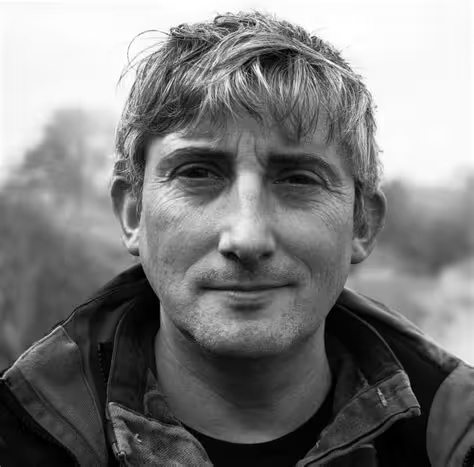
Joshua Coombes
Episode Summary
Q1: Place
If we could do a flypast on any part of the world that is significant to you, which place, city or country would it be and why?
London
Q2: Life
Give us a glimpse into your life story so far with an emphasis on what you are doing currently?
Grew up in Exeter in Devon. Played the guitar in bands which shaped the early years but by mid-twenties was driven by a need to make money and started hairdressing which eventually changed his life trajectory. From the salon, Josh started to go out on the streets and build connections with homeless people by cutting their hair. Compelling photography and storytelling on social media then led to the founding of the Do something for nothing movement, a publishing deal, and multiple speaking opportunities around the world.
Q3: Reset
Where on earth is your place or reset or re-charge?
Hills or Mountains. Anywhere with a big view.
Q4: Wonder
What wonder of the natural world excites you the most?
The silence and stillness of the desert
Q5: Hopefulness
What is your story of hopefulness (not your own) about a person, business or non-profit who are doing amazing things for the world?
Friend Paul who founded Pauly's Project in Skid Row in LA. Inspired by his autistic son who was born blind, the foundation today is bringing music, support and practical help to hundreds of homeless people on Skid Row.
Q6: Insight
As we prepare to re-enter, what insight, wisdom or question would you like to share with us?
I'm trying to see beneath the surface of how we first perceive one another. Words like empathy, are only real if they embody the full spectrum. Homeless - Wealthy - Politicians...

Transcript
Speaker 0:
Welcome to the Wanda Space Podcast, it's great to have you on board. My name is Steve Cole and over the past 78 episodes I have been asking the same 6 questions to amazing people from around the world. The questions orbit around wonder and stories of hopefulness and the setting for each journey is a shared window on the space station from where we see everything from a different perspective. Before we introduce our guest this week our friends at asknature.org are going to help us to rewonder.
Speaker 1:
Deep In the ocean below the point where 99% of sunlight is filtered out, the eyes of many fish point upward. This allows them to see shadows of predators, prey, or potential mates swimming above, but it leaves everything beneath them cloaked in mystery. The brown-snout spookfish has found a way around this. It has outgrowths from its upward-facing eyes that open downwards. Light from bioluminescent creatures below enters these outgrowths and hits a stack of reflective plates that act as a mirror.
Speaker 1:
This curved mirror gathers, reflects and focuses the faint light from below like a telescope to create sharp images on the outgrowth's retina. This double vision gives spookfish a valuable advantage as they compete with other animals to find food and avoid becoming food in almost total darkness.
Speaker 0:
Our orbit this week will take us down the west coast of America and to experience these views with us in this ultimate window seat we welcome Joshua Coovs. In 2015 whilst working at a London hair salon Joshua took to the streets with his scissors to build relationships and offer haircuts to men and women experiencing homelessness in the capital. He began posting transformative images on social media to amplify the voices of those he met and Do Something For Nothing
Speaker 2:
was born.
Speaker 0:
A movement that encourages people to connect their skills and time to those who need them. With this panoramic view above Earth, I start by asking Josh, if we could do a flypast on any part of the world that is significant to you, which place, city or country would it be and why?
Speaker 2:
Well for me, where a lot of my work that I'm doing now started is in London and I think a lot of my kind of experiences and growing into who I am now have been in London, have been in that city so I think that yeah that's probably despite a lot of traveling and like despite a lot of amazing places I've been I think as far as people and connections and where I'm at now I think that's will always remain a very important place to me.
Speaker 0:
Josh, give us a glimpse into your life story so far with an emphasis on what you are doing currently.
Speaker 2:
Music is something that I always go back to and it's kind of what really I guess gave me the the energy and really I think the the ethos that stays with me until this day like I obviously going back as far as maybe a good place to start is my teenage years in school that wasn't a very positive experience for me, it was 1 that left me feeling quite a great sense of kind of what am I going to do next because I didn't end up with any GCSEs or any grades to like move forward academically. So finding a guitar and some friends and joining a band was basically the way that I kind of, well not only found my people but also found an education through bands and listening to groups of kind of like punk music from the sort of really the late 70s, albeit that I was coming at it about 30 years later, was a bit of a, it was a new school for me and it was people and it was, you know, on the face of it looked a bit spiky and kind of a bit gnarly, but actually it was all about putting your arm around the person next to you and people who were on the fringes, opening the door for them.
Speaker 2:
And growing up in Exeter and Devon, that was my upbringing. And a pretty small, what was a small town feel is a lot bigger now, you know, and it really feels like the city that it is, but it's still kind of really, you know, it's a small place and I knew I wanted to get out and music kind of did that for me also, you know, it allowed me to travel, you know, playing gigs in different places. And then, yeah, mid-20s I got into cutting hair and that wasn't really something that I planned to be honest, Steve. It was something that was, you know, at the end of a certain period of my life I was looking for a way to make some money but also to find a job and a career that I thought would suit me and I've always been a people person. And yeah, walking by a salon 1 day, I just decided to walk in and ask for a chance and that was mid-20s and I started working in a salon there and that sort of led me to doing what I do now and giving haircuts on the street for people who are experiencing homelessness.
Speaker 2:
So that was a transition that happened. But from working in a salon to providing this and connecting with people in quite a vulnerable position, obviously, It's not only been a way to cut hair and get to know people, but to tell stories around kind of what can be a group of people who are often invisible. And yeah, that's changed my personal trajectory in ways I couldn't have imagined. And the stories I began to tell initially were on social media. It was something that I kind of felt really drawn to do because I think we all walk by people like who are living on the street, people who are experiencing homelessness.
Speaker 2:
And I think we all know the feelings that confront us in that moment and kind of that curiosity but perhaps feeling sometimes really helpless to an issue that we all see is growing that is all kind of all around us all the time but seems to be rising and the stories that I was hearing with each person it just you know dissolved all these myths that I think we might hear sometimes, these kind of preconceptions, you know, as to why somebody might end up in this position. And it sort of got to the heart of, you know, this person that I was seeing, it sort of penetrated all the statistics when you bring it down to 1 person. I thought those stories were really important to tell. So, Do Something For Nothing is important to mention is the sort of, broadly speaking, like the movement of other people getting involved. It's what I used to use on social media and still do as a hashtag to sort of inspire other people to hopefully encourage them to get involved in their own way.
Speaker 2:
And the book is also, you know, the title is Do Something For Nothing. And I'm just trying to bring people closer to the lives of people who are sometimes overlooked. I give talks at events, more corporate settings as well. It can be I think quite motivational to get people involved. However you're looking to kind of impact socially, maybe help people in your community participate.
Speaker 2:
So that's actually the way that I'm able to make income now because I've left my job in the cell a long time ago to be able to continue to do the work that I do. For me it's nature, like recharging and I know that looks different for everyone, but I like being up high. I really like hiking I don't do it half as much as I should but when I have in my life I think wow should be doing this every week if possible So wherever I end up to be still and be rooted somewhere if there's a hill nearby then I'll be happy. I think when I get above it all it really does literally get me above the noise but I think for my mental state and well-being it's the happiest I am when I get up high somewhere here.
Speaker 0:
What wonder of the natural world excites you the most.
Speaker 2:
Deserts are a place that are actually really magical. I have spent time in 1 desert before and there's something really magic about being there. There's something about the stillness. It's something about kind of confronting yourself. I don't know why, but it gets so still there sometimes that I think that does really excite me but also it's really enchanting in some ways.
Speaker 0:
Josh, what is your story of hopefulness that's not your own, about a person, business or non-profit who are doing amazing things for the world.
Speaker 2:
The person really is my friend Paul. He lives in LA. His son was born blind and autistic and he founded an organisation called Paulie's Project. I think we all know somebody in our life who wakes up each day and makes the choice, because it is a choice, to walk on a sunny side of the street or take inventory of the things he's grateful for instead of the things that he isn't. And bringing up his son and how he is for, you know, in the sense of a caregiver for his son is incredible, but that's actually led him to many other things and he inspires loads of people.
Speaker 2:
So he saw the way that his son responded to music and how that really soothed him. And he lives quite close to Skid Row, which is an area of downtown Los Angeles where there's like thousands of people who are living on the street and experiencing homelessness. And 1 day he went out with like a few cheap kind of CD Walkmans way back when and started giving people, donating them some music so they could listen to. And then he got some funding for it and he started going out there with these headsets. And before you know it, he pretty much served 1 whole street down there with people who've all got access to music to listen to.
Speaker 2:
But that actually now really has transitioned into something that's like you know much bigger which is LA is such a contrasting place for people who have and have not and he has managed to bring together all kinds of different people who come down and volunteer like bi-weekly and and go down there with a big entourage of cars with different things that they give, like essential products. But the main thing he does is he knows everybody down there by name and he knows them and what they need and He helps them along when they can to different pathways in their life. But he just, he has this relationship with people who are sometimes broadcast and dehumanized in the mainstream media as people
Speaker 0:
you should be scared of, people
Speaker 2:
you should be frightened of. And the way that he kind of does his work is, it's just really inspiring, mate. And it always comes back to his son. It comes back to his son and this challenge that he was faced with, that he decided to completely embody and make his strength, not his weakness.
Speaker 0:
Finally, as we prepare to reenter, what insight, wisdom or question would you like to share with us?
Speaker 2:
Yeah, for me, it's very similar to the subtitle of my book which is seeing beneath the surface of homelessness via a simple act of a haircut. Well, that's my version but honestly I'm really into trying to see beneath the surface of what it is we first kind of how we first perceive 1 another I've realized that words like empathy for me are only real if they're embodied full spectrum and by that I mean I work on the street people are very vulnerable who need a lot of help who might have a lot of stigma surrounding their life and judgment calls from people outside. But I also know that person driving down the street in a flash car and, you know, kind of maybe cutting people up and kind of might look like they care a lot more about the hedonistic things in life than they do the soulful kind of parts of our experience. I have a lot of empathy for them as well. I have to have empathy for politicians who might seem like they're screwing everything up in their own way because I think that it doesn't ever give anybody a pass but what it does is it creates a way of living where you're on a path of understanding, understanding even when things seem very difficult, trying to understand that there's a person beyond the layers that you see.
Speaker 0:
To find out more about the work of Josh, go to the website dosomethingfornothing.org. To engage with the previous 78 Wonderspace episodes go to our website ourwonder.space. I want to thank Josh for joining us on Wonderspace and I hope you can join us next week for more wonders and stories of hopefulness