Episode #
78
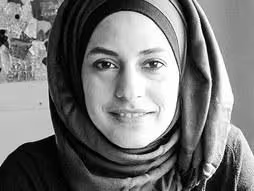
Marwa Al-Sabouni
Episode Summary
Q1: Place
If we could do a flypast on any part of the world that is significant to you, which place, city or country would it be and why?
Medina in Saudi Arabia.
Q2: Life
Give us a glimpse into your life story so far with an emphasis on what you are doing currently?
Trained as an Architect and had a practice with her husband in Homs in Syria, which was then destroyed in the war. Decided to stay in Homs with the family, worked towards a PHD and decided to write a book about the war and the role of architecture which was published by Thames and Hudson in 2016. Opportunities to speak internationally then led to a TED talk and another book called Building for hope that questions how we reconnect with home and how we re-establish the sense of belonging?
Q3: Reset
Where on earth is your place or reset or re-charge?
Riding a horse and reading a book.
Q4: Wonder
What wonder of the natural world excites you the most?
The wonder of horses as a powerful form of therapy in the trauma of war.
Q5: Hopefulness
What is your story of hopefulness (not your own) about a person, business or non-profit who are doing amazing things for the world?
The everyday kindness of people in Homs.
Q6: Insight
As we prepare to re-enter, what insight, wisdom or question would you like to share with us?
Whatever you do, do it not for yourself but for a higher cause or another person.

Transcript
Speaker 0:
Welcome to the Wonderspace podcast, it's great to have you on board. My name is Steve Cole and over the past 77 episodes I have been asking the same 6 questions to amazing people from around the world. People from around the world. The questions orbit around wonder and stories of hopefulness and the setting for each journey is a shared window on the space station from where we see everything from a different perspective. Before we introduce our guests this week our friends at AskNature.org are going to help us to re-wonder.
Speaker 1:
Not every spider waits on a web for prey to get caught. Some shun the silk and hunt on the move. For these spiders, the key to success is information gathered by hundreds of trichobothria, hairs of varying length and thickness protruding from their lanky legs and connected directly to 3 or 4 nerve cells. When an insect flies nearby, it sets the air around it in motion. The movement of the air, even the vibrations from sound, sets the hairs moving too.
Speaker 1:
Since each hair is suspended in a flexible membrane, even the slightest movement is conducted right to the nerves. In a split second, the nervous system is able to combine information from the many different hairs into a clear picture of where and when the spider needs to strike in order to capture its next meal.
Speaker 0:
Our orbit this week will take us across the Middle East and to experience these views with us in this ultimate window seat we welcome Marwa Al-Sabourney. Marwa is an award-winning architect and author and lives with her husband and 2 children in war-torn homes in Syria. Her 2016 book The Battle for Home gained her invitations to speak to audiences, institutes and experts across the world. In her TED Talk, Mawa suggests that Syria's architecture was 1 of the key causes of war by dividing its once tolerant and multicultural society into single identity enclaves defined by class and religion. In her latest book Building for Hope Marwa explores how citizen buildings might be rebuilt in the aftermath of conflict, crisis or financial depression.
Speaker 0:
In 2019 she was named 1 of the world's top 50 thinkers in Prospect magazine. With this panoramic view above earth I start by asking Marwa if we could do a flypast on any part of the world that is significant to you which place city or country would it be and why?
Speaker 2:
1 of those places would be the Medina in what is now Saudi Arabia, which was Al-Hijaz before. And Al-Medina means in Arabic, literally it means the city. And this place, I think 1 of the most successful examples of migration integration happened because Prophet Muhammad, peace be upon him, immigrated with his followers to Medina and the reaction of the people there, how they embraced those new people, those newcomers. And from there, the journey they took together from 622 in less than 25 years, the whole region transformed and 1 of the great civilizations happened in such an incredibly short amount of time.
Speaker 0:
Marwa, give us a glimpse into your life story so far with an emphasis on what you are doing currently?
Speaker 2:
Well, I think I'll start with my age. So I'm currently 41. I'm an architect and author. My work has come into light, I think, bizarrely because of the war in my country which took place in 2011. At the time I was working as an architect in the studio I have with my husband.
Speaker 2:
He's a bit more senior than I, he's 8 years older. So we worked in the studio and I was studying for my higher education. At the time I was pursuing my PhD. When the war happened, actually everything changed, obviously. Our studio burned down and our city was destroyed and our life was put on hold, actually.
Speaker 2:
And afterwards, I just, you know, I continued to work on my higher education, but I had the idea to write a book about it, to write a book about the war in my city, about the role of architecture and the ideas that I was exploring. And with a lot of encouragement actually from my husband, I wrote the book and it was published in London by Thames and Hudson in 2016. Since then, I mean, my whole life changed. Because of that book, everything in my life actually changed. And fortunately, it has received a lot of good press and was well received by the media and by critics.
Speaker 2:
And I did a TikTok as well about the book and that meant that more exposure of my ideas and my work happened. Afterwards, I was invited to different cities around the world to speak internationally about my work and about my ideas and about what it means to be an architect in Syria and what does it mean for architecture to be a factor that is enduring destruction and death actually. Those years between 2016 and 2019 were really active in terms of traveling. I traveled to so many places around the world and met so many people and made a lot of good friendships actually along the way, which was a blessing. And led me to write another book, which was Building for Hope, was published in 2020.
Speaker 2:
And it was right in the middle of the chaos of the corona and pandemic. But also, I think it also resonated with that global situation because it spoke about what does it mean to settle in and how we can rebuild in aftermath of crisis, which is something that every city now is contemplating. So my latest book, Building for Hope, revolves around 5 fears. And I start from the fear of death and end up with the fear of boredom. But in essence, the book is about how we reconnect with home and how we just establish or reestablish the sense of belonging and the sense of home that we've lost in so many places around the world.
Speaker 2:
How cities can recover actually in the aftermath of not only the physical destruction like it's happening here in my country but also the invisible destruction that is seeping through our cities all around the world.
Speaker 0:
Where on earth is your place of reset or recharge?
Speaker 2:
Well I believe in a poetry verse that I think summarises where I think I actually recharge and find comfort. And this poetry verse is by a very renowned poet from the Abbasid era. And it actually, do you mind if I say it in Arabic? First, I will translate. Well, it says, Azzo makanin fiddunia sarjun sabehon wakhayru jaleesin fil anami kitabu.
Speaker 2:
Which means the dearest place in the whole world is the galloping saddle and the best friend among all people is the book. And I mean, I think it just summarizes where I actually find comfort. I go and ride on my horse and when I need to switch off from the whole world, I find it on saddle. Also reading books, just recharging with ideas and with people and places. It's just the imagination that the book can just give you while sitting in is amazing as well.
Speaker 0:
What wonder of the natural world excites you the most?
Speaker 2:
Well, I think this links to the previous question. For me, I met horses later in life about 6 years ago And it was because of also the loss that happened in war. Actually, my husband, again, he's the source of inspiration in our family. He thought that because we've lost so many people around us, we have no relatives around us. Almost everyone has travelled or migrated.
Speaker 2:
And for that, he thought that we should reconnect, especially for the children, to reconnect with something or somebody out of our immediate circle. And that's when the horses came in. We went to a place where they keep horses and we met the horses there. I was the farthest person to imagine. I was literally afraid of cats and dogs, So I couldn't imagine myself around horses.
Speaker 2:
But I mean, horses are just fascinating creatures. And the way people react around those animals is just amazing. How they, you know, they have, they've become also part of the experimental curing methods. I mean with the kids or people with autism for example, they show great results and with elderly people and of course I can testify to this I mean with people with the trauma of the war just you know it's amazing how these I see them as wonders of the world and I think it's just you know they are amazing creatures that everyone should just try to be around.
Speaker 0:
Marwa, what is your story of hopefulness that's not your own, about a person, business or non-profit who are doing amazing things for the world?
Speaker 2:
Well, I find this question a bit difficult because usually the people who do good, they do not promote it. You know, they do it in silence and in secrecy. So it's something that, you know, I don't have an access to. But for me, just observing people on a daily basis, I find many stories of hope. Just watching people being kind to other people.
Speaker 2:
Just today, before I come in here to have this conversation, a man, a young man actually, with something like a carriage or something, he had been selling fruits in the street. And he wanted to cross with this carriage. And he found it very difficult. It's a bumpy road and traffic is there. And he just stumbled when he was crossing.
Speaker 2:
And some of those fruits just spilled out in the street. And immediately, people flooded in and tried to help him out. And they just started picking the fruit up and stopped the traffic and some of the cars just you know slowed down and asked if he is alright and he just you know crossed and he just you know moved on and continued with his carriage and went on to the next side of the road to continue selling.
Speaker 0:
Finally, as we prepare to re-enter, what insight, wisdom or question would you like to share with us?
Speaker 2:
I think it's something that I tell myself all the time, try to commit to. It's not the easiest thing, but I mean it's something that I honestly try to say to myself every day. It's whatever you do or you are doing just try to do it not for yourself, just try to do it for a higher cause or another person and you know try not to do it for yourself
Speaker 0:
To find out more about Mawa, I recommend her 10-minute TED talk, which has been seen by over 1 million people. Her 2 award-winning books The Battle for Home and Building for Hope are published by Thames and Hudson and available online. To engage with the previous 77 Wonderspace episodes go to our website ourwonder.space. I want to thank Marwa for joining us on Wonderspace and I hope
Speaker 2:
you