Episode #
77
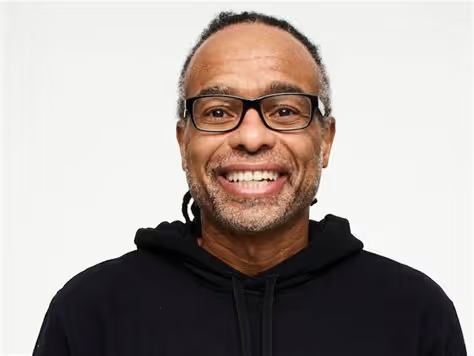
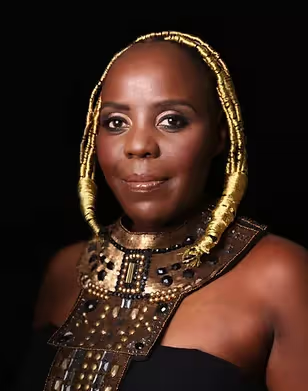
Amooti Binaisa
Episode Summary
Q1: Place
If we could do a flypast on any part of the world that is significant to you, which place, city or country would it be and why?
Fort Portal in Uganda
Q2: Life
Give us a glimpse into your life story so far with an emphasis on what you are doing currently?
Travelled to 55 countries and worked in 35 of those for conglomerates and philanthropists. Now the campaign director for a project called 8 billion, a project of the Resilient Foundation which is the charity arm of Waterbear affectionately known as the Netflix for the environment. 8 billion was born out of asking the question, how can we tell the stories of the 8 billion people on earth but from their personal perspective? The aim is to flip the content creation methodology and narrative across the world and try to build those stories of community resilience from the community perspective. It starts in Africa this year leading up to COP27 in Egypt.
Q3: Reset
Where on earth is your place or reset or re-charge?
Sitting down at a baby grand piano
Q4: Wonder
What wonder of the natural world excites you the most?
Victoria Falls in Zimbabwe
Q5: Hopefulness
What is your story of hopefulness (not your own) about a person, business or non-profit who are doing amazing things for the world?
The Waterbear streaming platform. 'Knowledge is like a garden, if it's not cultivated, you cannot harvest it'. African Proverb
Q6: Insight
As we prepare to re-enter, what insight, wisdom or question would you like to share with us?
We need to move away from the I and move closer to the WE.

Transcript
Speaker 0:
Welcome to the Wonderspace podcast, it's great to have you on board. My name is Steve Cole and over the past 76 episodes I have been asking the same 6 questions to amazing people from around the world. The questions orbit around wonder and stories of hopefulness and the setting for each journey is a shared window on the space station from where we see everything from a different perspective. Before we introduce our guests this week our friends at asknature.org are going to help us to rewonder.
Speaker 1:
In a Malaysian rainforest, a male treehole frog seeks a mate. His call is a single note chirp, and the louder it sounds, the farther it will reach, increasing the likelihood that a female will hear and respond to it. To give his call an extra boost, he positions himself in a water-filled hollow in the trunk of a tree, and plays it like a musical instrument. Croak by croak he adjusts the pitch of his call until he's found the resonant frequency of the wood, the note that makes the tree itself vibrate and ring out. Then his croaks become longer in duration with fewer breaks in between.
Speaker 1:
The troubadour has found the right sound for the stage and his real performance begins.
Speaker 0:
Our orbit this week will take us across Africa and to experience these views with us in this ultimate window seat we welcome Amuti Binesa. Amuti is the Africa campaign director for 8 billion which is a project of the Resilient Foundation enabling storytellers and filmmakers to take part in changing the world. Her own story is extraordinary and uniquely brings together the worlds of business, politics and creativity. With this panoramic view above earth, I start by asking Amuti, if we could do a fly pass on any part of the world that is significant to you which place city or country would it be and why?
Speaker 2:
It would have to be Fort Portal where my mother comes from and it's significant to me because it's first of all it's very beautiful It's in the west of Uganda and it's where all the Tia states are. So it's very cool and they've got these beautiful crater lakes which you rarely see anywhere because there was volcanic activity years ago. And so they kind of surprise you as you walk through Africa because you don't expect something like that. And it's also the region where the big national parks are with all the animals. So we used to always drive through there and you know look at all the giraffes and things just as we're casually going to meet with her friends and her families in the village so to speak.
Speaker 2:
It's my at-home place if I had to feel at home somewhere it would be there for sure, 100%.
Speaker 0:
Amuti, give us a glimpse into your life story so far with an emphasis on what you are doing currently.
Speaker 2:
I was born in Uganda, East Africa and have lived in Africa, New York and the UK. I have travelled to 55 countries and worked in 35 of those for conglomerates, philanthropists and you know also been an entrepreneur myself. And what I've noted along the way is humanity's common need for meaningful connection to each other and also to the environment. I come from a family who are originally activists. So my dad fought for the independence of Uganda in order to get the British to give us independence.
Speaker 2:
And he was sent to jail and all sorts of things and he used to walk the street. And he became the first attorney general, wrote the first constitution for the country. And really, there were extraordinary parents that I come from. My mother was a theatre nurse but also a parent to 7 kids so that was a job in itself. And my parents are both from the, my father's from the kingdom of Buganda and my mother's from the Kingdom of Toru.
Speaker 2:
So both of them are princes and princesses. So growing up there was an added layer of, you know, being responsible and being caring for other members in our community because we had a very privileged position. That being said, we then had to leave because, again, my parents being activists, because of EDR Mean, they kicked off basically. And they weren't shy in making their opinions known. And as you know, a lot of people were being murdered etc during the EDR mean days so we had to leave Uganda and that's the first time we left and then when he was got rid of we went back my father got made president And he was such an activist though, again, even in his presidency, that he immediately went to the country to say, okay, we're going to have an election.
Speaker 2:
And that was frowned upon by the powers that be. So he was couped and he was couped by the current president, which is interesting because he was his Minister of Defence at the time. Fast forward to when he passed away, He was 1 of the few presidents who actually got a state funeral. And when he was buried, the day was declared a bank holiday for the whole country because of his fight for independence, because of his, you know, real true commitment to Uganda and its people. And the fact that he never looked to murder anybody, he just used words, the power of words and storytelling, which is exactly what I'm doing today as it so happens.
Speaker 2:
So I'm currently, by joy and great joy, the campaign director for a project called 8 Billion, which is being run by the Resilient Foundation and that is the charity arm of Water Bear, affectionately known as the Netflix for the environment. So 8 billion was born out of asking the question, how can we tell the stories of the 8 billion people on earth but from their personal perspective? So our aim is to flip the content creation methodology and narrative across the world and try to build those stories of community resilience from the community perspective who really are the people on the front lines of climate change and the environment. We're starting in Africa this year because COP27 is in Egypt. That's the climate change conference.
Speaker 2:
So what's unique and what I love about this project as well is that we're gathering ambassadors from across the continent who will be our content creators. What's exciting is that each content creator is going to be given the resources to be able to host storytelling workshops and try and up skill local talent in their communities. So the impact goals of the project are not just to document the content but also a skills transfer, education and training in order to build the next generation of storytellers from the grassroots level. So basically we're creating a digital community of atomic activists led by storytelling, partnership and technology.
Speaker 0:
Where on earth is your place of reset or recharge?
Speaker 2:
What I do every day if I need to reset or recharge, I sit down at my baby, called my baby grand piano, and I play and sing and write songs, whether it's jazz or classical, but immediately, because you know, music, as you know, just takes you on a journey, so you're immediately like, okay, I've forgotten, what was I upset about? Sometimes I can sit for hours and think, haven't I got things to do?
Speaker 0:
What wonder of the natural world excites you the most?
Speaker 2:
The Victoria Falls, which sit between Zimbabwe and Zambia. When I went there it's absolutely incredible because as you walk through the falls you have multiple rainbows like small rainbows, big rainbows. It was extraordinary. It was very shocking because I think a few years ago there was a drought and quite a heavy drought and it just almost dried up to a little trickle. So you know, climate change situation is real.
Speaker 0:
Amuti, what is your story of hopefulness that's not your own about a person, business or non-profit who are doing amazing things for the world?
Speaker 2:
My story of hopefulness with a business is WaterBear. What they've done is they've created this streaming platform which you know about, but it's also about impact. There's no subscription fee, there's no advertising. Because traditionally the film industry has been driven by advertisers, what they want, and also commissioning editors what they want and therefore the stories are built from that perspective. I thought it was very brave that they started it in I think it was about December 2020 and in 18 short months they've managed to partner with 150 NGOs.
Speaker 2:
They're in 194 countries. I mean, if I could build a platform for Africa, I think it would be on the water level, I hope. But the most important thing is that they've turned intention into action. So you can have an intention to help save the planet, but they've given you a way of taking action through advocacy, through giving funds to these charities, through volunteer, all sorts of ways that you can actually engage. And I think we only have 1 planet.
Speaker 2:
So how do you start a movement? You've got to get people engaged from the beginning. That's how change is created. There's an African proverb that says, knowledge is like a garden. If it's not cultivated you cannot harvest it so yeah I love what they do
Speaker 0:
finally as we prepare to re-enter what insight wisdom or question would you like to share with us?
Speaker 2:
For me, I always ask the question is, what's our world and what makes our world? Today, people are all about the eye, their self-identifying is all about me, looking on Instagram, all of that. But if we come together, I think we become our best selves, as we've seen from this pandemic. And if we're in concert as well with all that is around us, the world around us, the plants, the animals, then we're even more enhanced to become our best version of ourselves. So I really think my wisdom is we need to move away from the I and move closer to the we because we've seen that that's the only way to go that's forward and there's also another African saying you know in Africa we're raised on these if you want to go quickly go alone if you want to go far go together go together.
Speaker 0:
To find out more about the work of 8billion go to 8-billion.org In her story of hopefulness Amuti talked about Water Bear which you can join at waterbear.com. To engage with the previous 76 Wonderspace episodes go to our website ourwonder.space. I want to thank Amuti for joining us on Wonderspace and I hope you can join us next week for more wonders and stories of hope from us.