Episode #
76
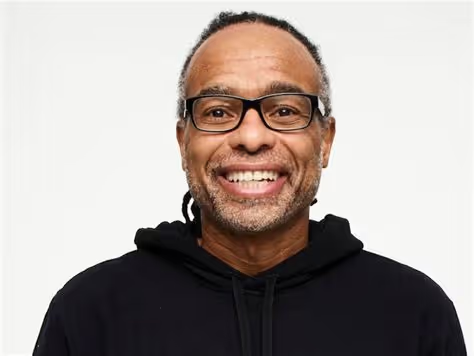
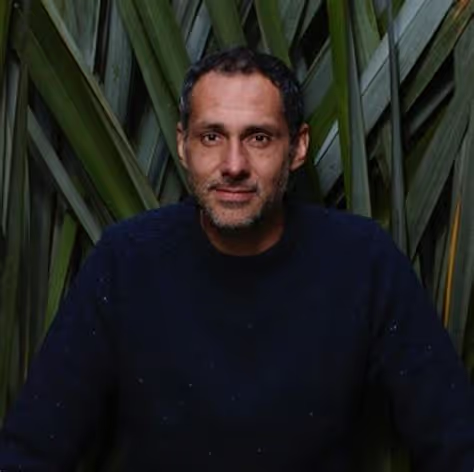
Andres Roberts
Episode Summary
Q1: Place
If we could do a flypast on any part of the world that is significant to you, which place, city or country would it be and why?
Bogota in Columbia
Q2: Life
Give us a glimpse into your life story so far with an emphasis on what you are doing currently?
Born in Bogota in Columbia I've always had questions about how we connect to the bigger story in life and how we feel whole ourselves. I've always felt like I wanted to do something a little bit different to the main system. I've come to believe that the dominant story of life today is one of disconnection rather than interconnection. With the Bio Leadership Project, we work to help change the story of human development and human progress by asking what life would look like if we authentically connected with nature? What if we rekindled a culture and a worldview of interconnection and care for all of life?
Q3: Reset
Where on earth is your place or reset or re-charge?
Cold Water
Q4: Wonder
What wonder of the natural world excites you the most?
The Human Eye and a Peacock Butterfly
Q5: Hopefulness
What is your story of hopefulness (not your own) about a person, business or non-profit who are doing amazing things for the world?
The 80 people who have been part of the Bio Leadership Fellowship, all carrying a story that is changing the world in so many beautiful and creative ways.
Q6: Insight
As we prepare to re-enter, what insight, wisdom or question would you like to share with us?
The art of letting go. Change isn't possible without somehow letting go.

Transcript
Speaker 0:
Welcome to the Wonderspace podcast, it's great to have you on board. My name is Steve Cole and over the past 75 episodes I have been asking the same 6 questions to amazing people from around the world. People from around the world. The questions orbit around wonder and stories of hopefulness and the setting for each journey is a shared window on the space station from where we see everything from a different perspective. Before we introduce our guest this week, our friends at AskNature.org are going to help us to rewonder.
Speaker 1:
In the rich foliage of a cherry tree, a caterpillar is turning a leaf into a tube-shaped shelter. The cherry leaf roller begins along the underside, biting chunks out of the tough central vein to allow the leaf to be more easily rolled up. She then begins to exude silk and attaches 1 end of the fiber to the tip of the leaf, stretches it out like a rubber band, and attaches the other end to the underside, some 10 millimeters away. She swings her head back and forth, repeating the action countless times. Each strand creates a tiny amount of pull, and together, many strands create enough tension to cause the leaf to start to curl.
Speaker 1:
After several hours she seals up the sides locking herself in a cozy shelter to slowly eat the rolled up layers of leafy goodness out of sight and reach of predators.
Speaker 0:
Our orbit this week will take us across both North and South America and to experience these views with us in this ultimate window seat we welcome Andres Roberts. Andres is an educator, leadership advisor and is the founding partner of the Bio Leadership Project, a movement to help transform human systems and the paradigm of leadership by working with nature. In his TEDx talk he suggests that making nature our guide might be the most important innovation of our times. With this panoramic view above Earth I start by asking Andres if we could do a fly past on any part of the world that is significant to you, which place, city or country would it be and why?
Speaker 2:
My heart took me straight to Colombia and very specifically to Bogotá, which is the city where I was born and where I lived until I was 7 years of age. And It's amazing to me that I haven't spent so much time in Colombia in my adult life, but my body remembers so many sights and sounds. And when I have been back, I've found it amazing that I know the shape of the mountains around the city of Colombia and the sound of the streets are really familiar to me and colours are really familiar to me and people's gestures are really familiar to me so it's extraordinary. As I say I haven't spent so much time there in my life since I was a boy but my heart would long to plug in there for a little bit of time.
Speaker 0:
Andres give us a glimpse into your life story so far with an emphasis on what you are doing currently.
Speaker 2:
I was born in Colombia and my folks, my dad, my mum, my grandmother, they all gave me a sense that I was alright, you know, that I belonged and that's always stayed with me. And if I say today, if that's 1 thing I could give my daughter or the main thing I'd love to give my daughter a sense of belonging, that's big. I've always had questions around wholeness. I've always had questions around how we connect to the bigger story in life and how we feel whole ourselves. And I think maybe that comes from having lived in different places as a boy.
Speaker 2:
And I think maybe that links to, well, another thought is I've always been a bit of a rebel. I've always felt like I wanted to do something a little bit different to the main system and maybe that's where those things fits together because I've come to believe that the dominant story of life today is 1 of disconnection rather than an understanding of interconnection. I've been really lucky to learn from people who have a capacity to heal and connect and build resilience in very beautiful ways. And I had a moment in my life where, to quote the Leonard Cohen quote, you know, there was a big crack, but I got to learn about change and growth. And the heart of the BioLeadership Project speaks to the fact that we've come to live life today in organizations, in cities and communities in a way that's very disconnected from the whole.
Speaker 2:
It's disconnected from nature, we live life disconnected from each other. So with the BioLeadership project we work to help change the story of human development and human progress by saying what would life look like if we authentically connected with nature and What if we rekindled a culture and a worldview of interconnection and care for all of life and the BioLeadership project is about supporting many kinds of movement and experience and change process that starts from that place.
Speaker 0:
Where on earth is your place of reset or recharge?
Speaker 2:
I actually thought about the element of water and sometimes it's a swim in the sea, sometimes it's jumping into cold water. And every morning now, I will for a moment have a cold shower, regardless of what season it is. There's something about the experience of being in water that for me takes me back to being a wild animal for a moment and that's that's the best way of resetting I suppose to go back to a bit of wildness.
Speaker 0:
What wonder of the natural world excites you the most?
Speaker 2:
So many things excite me about the natural world and I very quickly go to life itself. You know, all aspects of the natural world represent life. But funnily enough, the human eye came to mind. I feel like we've come so far away from being in touch with pure nature and and by that we've come so far away from being in touch with the fact that we're nature ourselves. That just looking at someone's eye or just looking at my own eye sometimes takes me to this place of thinking, wow, we're part of something so extraordinarily miraculous.
Speaker 2:
So the human eye. And then I remembered the peacock butterfly. Earlier this spring, I was walking along a river and sat down and a little peacock butterfly came and sort of nestled on my knee. And I was able to just stare into that eye on its wing for a good couple of minutes before it moved. I thought, wow, how on earth did that evolve to look like that?
Speaker 2:
It was such a beautiful way of connecting with deep time and how long life has taken to evolve.
Speaker 0:
Andres, what is your story of hopefulness as not your own? About a person, business or non-profit who are doing amazing things for the world.
Speaker 2:
So many thoughts and possible things to say come to mind with this, but over the last 2 years, we've set up something which we've called the Bioleadership Fellowship. And it's a call for people all around the world to come and be part of a community with each person holding a question or a project of potential change or of good work for people and planet by working with nature. And it's through that that I've got to meet already 80 people and more, each of whom is carrying a story where they genuinely are doing something for the good of this life in so many beautiful and creative ways. And just last week we held a virtual Pecha Kucha session where we had 4 or 5 fellows each present the story of what they're working on. I mean, I wish I could name every single 1 of the fellows but Kai if you ever hear this or if you know we hear it a woman in Kenya who is bringing deep feminine wisdom, the know-how of doulas, regenerative farming, social change, you know all of these things together to support a different way of helping people grow in the world and so many other people in this fellowship every day giving me hope And I think the thing is that something we constantly say with the BioLeadership Fellowship, nobody can do it alone.
Speaker 2:
It doesn't matter if you are the Secretary General of the UN, whether you are Patagonia as a business, whether you're an organic farmer in India, you can't do it alone. But what we're doing is starting to connect threads of connection across communities that are really committed to making change happen. And all of a sudden you start to see that cultures are shifting and there's so much work to do but the fact that the dots are getting connected is what gives me buckets of hope.
Speaker 0:
Finally as we prepare to re-enter what insight, wisdom or question would you like to share with us?
Speaker 2:
I think the thing that I'm most experimenting with right now and that I'm learning about all the time is just the art of letting go. Like I feel like change isn't possible, growth can't be possible, maturity, without somehow letting go a little bit of who we were, of what we knew, of where we're going, of getting it right. And I feel like the world is so pressured, You know, we live in such intense times, and times where we feel like we have to get things right, where we have to fix things, where we have to be clever or quick. And I'm just noticing that whenever I try to let go a little bit more it helps me and whenever I am with people and suggest we do a little bit of letting go then it shifts the quality of how things move. So there's something in the potential and in the emptiness of letting go that feels useful.
Speaker 0:
To find out more about the work of Andres, go to wayofnature.co.uk and bio-leadership.org. To engage with the previous 75 Wonderspace episodes, go to our website ourwonder.space. I want to thank Andres for joining us on Wonderspace and I hope you can join us next week for more wonders and stories of hopefulness.