Episode #
75
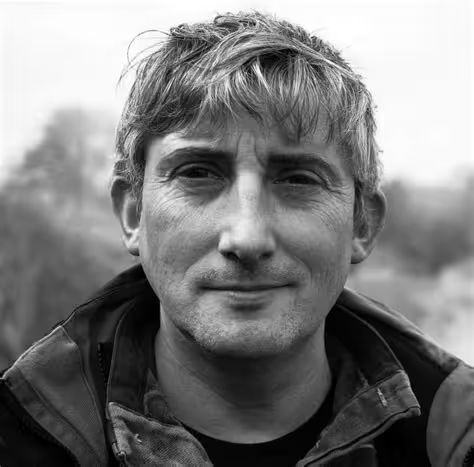
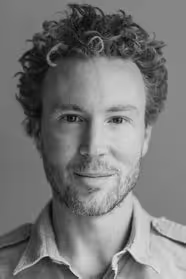
Ben Rawlence
Episode Summary
Q1: Place
If we could do a flypast on any part of the world that is significant to you, which place, city or country would it be and why?
The east coast of Africa, on the rim of the Indian Ocean
Q2: Life
Give us a glimpse into your life story so far with an emphasis on what you are doing currently?
Early career taught English in Tanzania which provoked questions about the world and why it was arranged in the way it was which led to SOAS University in London. Got a scholarship to the University of Chicago to do a master's in international relations and ended up working at the UN for a think tank looking at interdisciplinary global security around food, water and environment. Back to the UK and became a script writer for the Lib Dems and led the campaign against the Iraq war. After a burn out went back to Africa and worked for Human Rights Watch which led to the first book Radio Congo and a second book City of Thorns about the largest refugee camp in the world. The latest book The Treeline focusses on the Northern end of the world and the amazing function of the Boreal Forest. Recently founded Black Mountains College in Wales to put into practise a core curriculum for the 21st century.
Q3: Reset
Where on earth is your place or reset or re-charge?
Cold Water
Q4: Wonder
What wonder of the natural world excites you the most?
The Interconnectedness of Nature
Q5: Hopefulness
What is your story of hopefulness (not your own) about a person, business or non-profit who are doing amazing things for the world?
A community that is processing its history and coming to be a force for indigenous land use and protection and conservation in Canada. They have rightly recognised that that relationship with the forest is their key to adaptation and survival in the future and they're blazing a trail showing the rest of us how it's done. They are showing that despair is often the first step towards repair and that processing the past is often the key to unlocking a more transformative and positive future.
Q6: Insight
As we prepare to re-enter, what insight, wisdom or question would you like to share with us?
Climate change is not just a planetary emergency, it's an opportunity for a new kind of relationship with nature. What's your role in that transition?

Transcript
Steve (host):
Welcome to the Wonderspace podcast, it's great to have you on board. My name is Steve Cole and over the past 74 episodes I have been asking the same 6 questions to amazing people from around the world. People from around the world. The questions orbit around wonder and stories of hopefulness and the setting for each journey is a shared window on the space station from where we see everything from a different perspective. Before we introduce our guests this week our friends at asknature.org are going to help us to rewonder.
Andrew:
Scampering from limb to limb in a cold Alaskan forest, a squirrel finally reaches the end of a branch and leaps. Initially, he falls as would any other mammal in such a position, but then he spreads his own limbs revealing wing-like membranes between them, and is borne by the air some 30 meters away. While technically gliding as opposed to flying, he still exerts deft control over his path, tilting slightly upward to catch more lift and speeding ahead. When reaching his destination, he rotates almost completely vertically, picking up even more lift that rockets him briefly upward, and intense drag that slows his momentum, allowing for a gentle four-footed touchdown on a vertical tree trunk.
Steve (host):
Our orbit this week will take us from West Africa to the Alps and to experience these views with us in this ultimate window seat we welcome Steve (host). Ben is a journalist and activist and has written for the New York Times and The Guardian. He is also the founding director of Black Mountains College in Wales, which is an institution devoted to creative and adaptive thinking in the face of the climate and ecological emergency. His latest book, The Tree Line, has been described as a spellbinding blend of nature, travel and science writing and is a book I highly recommend. With this panoramic view above earth I start by asking Ben if we could do a flypast on any part of the world that is significant to you which place city or country would it be and why?
Ben Rawlence:
I would like to do a fly-past along the east coast of Africa on the rim of the Indian Ocean. And if we could do it in time travel, where actually we were going back to the 1960s or the 1970s, which was when I was born. It's a place that's very important to me personally because it's where my sort of awakening began, of coming to a grammar school in the south of England and not knowing too much about the world, but then finding myself wanting to get as far away as possible and finding myself a job teaching English in Tanzania blew my mind to suddenly come face to face with these whole other ways of imagining the world and different language and different cultures and perspectives. So both from a kind of personal perspective in terms of opening my eyes to the wonders of the planet and all the, you know, the sort of historical legacies of colonialism and I started asking questions like why is my country richer than this 1? But then also from an environmental point of view, the wonder of that biodiversity and to see some of the changes that are happening now, that's where it would be for me.
Steve (host):
Ben, give us a glimpse into your life story so far with an emphasis on what you are doing currently?
Ben Rawlence:
So the way we make sense of our own life I think is a bit like the app Storify where you know it's the significant moments and you sort of make sense of the journey at the end, perhaps sometimes, or you sort of edit the story as you go along. But from where I'm standing now, it does seem as though there was a thread. So having, as I said, grown up in south of England, ended up teaching English in Tanzania, starting to ask questions about the world and why it was arranged in the way it was. I then was desperate to learn more about Swahili and this basically to get back to Tanzania as fast as I could. So I went to SOAS at University of London.
Ben Rawlence:
I was lucky to be the last generation that got student fees paid. And then through that experience, wanted to find out more about the sort of political structures that were shaping the world so I applied and I got a scholarship to the University of Chicago to do a master's in international relations. That gave me a very different experience of education And then through my life got involved in social science research, interdisciplinary research, sort of inspired by that in Chicago, and I ended up working at the at the UN for a think tank looking at interdisciplinary global security. So redefining what we mean by security, not nuclear weapons and balance of power politics, but this emerging field that in the late 90s was called human security. So that was about food and water and environment.
Ben Rawlence:
And then of course 9-11 happened and it was all about terrorism. So I of course was very motivated to try and undo that logic and make the case that this was a distraction. And I joined the Lib Dems back in the UK, I wrote speeches for Charles Kennedy and Min Campbell and led the campaign against the Iraq war in 2003, but got very burned out as a 20 something staffer in the UK parliament and went back to Africa and got involved in political campaigns there with friends who I'd been at the University of Dar es Salaam with, working for the opposition party in Tanzania. And human rights and kind of democratic reform there was all about livelihoods and our access to land and water and our environment and actually the same kind of human security issues. Of course all my friends ended up in jail and but I didn't because I was a white foreigner And I ended up then campaigning to get them out and worked for, that led into a job for Human Rights Watch and 10 years working in the Horn of Africa on all sorts of emerging political and human rights problems, mostly driven by climate change.
Ben Rawlence:
Famine and war in Somalia, deforestation in Congo, and that led me to my first book, Radio Congo, which was a journey amongst the resource wars of East Congo to see how people were surviving in the middle of that war. And then onto a second 1, looking at City of Thorns, which is the largest refugee camp in the world or was then and is soon to be again because of the famine, current famine. And both of those books were looking at how people are surviving in extreme circumstances where their habitat has been destroyed. So this latest book now, The Tree Line, is about trying to catch a glimpse of that process happening at the northern end of the world, and at the same time stopping to wonder at the amazing function of the boreal forest, which is the largest biome on the planet, after the ocean. And all of the ecosystem services that that provides in terms of weather, wind, rain, water discharge, regulation, I mean, it's absolutely essential to the functioning of our planet.
Ben Rawlence:
So that was my kind of deep dive into the current situation of climate science. And I was astonished by my growing understanding of how badly prepared we are and how off the pace our governments are. And this is now common knowledge, but for the last sort of 5, 6 years, it hasn't been so widely understood. So that was the beginning then of the idea that we need to get ready and we need new kinds of education because I hadn't my experience in politics taught me that we can't rely on politicians to get ahead of the curve. We've got to actually train new leaders who are new kinds of humans, who can have a new kind of relationship with nature and who can really drive and engineer systems change at speed and scale.
Ben Rawlence:
So my current job is trying to found a university of the National Park, Breckenbeekers National Park, called Black Mountains College, really putting into practice what a core curriculum would look like for the 21st century for young people. And I'm pleased to say we started teaching last year and we're looking now to launch a degree program in the next year or 2 which we just got validated last week. So join us in the Brecon Beacons to pursue new kinds of being in the world.
Steve (host):
Where on earth is your place of reset or recharge?
Ben Rawlence:
So for me, reset or recharge is cold water. Here at Black Mountains College, we're a big believer in embodied learning, that we learn through our whole bodies, that memory is dispersed in all our senses. And there's actually emerging research from 1 of our affiliates, Hannah Poikinon about, she's a dancer and a neuroscientist, and shows that dancers have learned with all the cells in all the different parts of their body. And actually, just like nature, if you want to go from 1 state to another, from 1 equilibrium to another, there has to be some kind of transformation. So if you want, for example, water to turn into ice or turn into steam, You have to disrupt those molecules.
Ben Rawlence:
They have to boil or they have to freeze and they have to reconfigure So actually I think you have to act upon the body To make those molecules vibrate at a certain pitch in order for them to reset or they all reconfigure in a new way. So those breakthroughs for me mentally have to happen on the body. So that's why I find cold water at least twice a week and we're blessed with cold lakes here in Wales. So That's what it is for me.
Steve (host):
What wonder of the natural world excites you the most?
Ben Rawlence:
For me, the wonder of the natural world that excites me the most is the interconnectedness. And I am continually being blown away. So in the boreal forest you have of course the wood-wide web, this connectedness, this dialogue between the trees and sharing of nutrients and information. But then there's another layer because as I came to study mysevial networks in the boreal forest, I realized actually there's a question here, and it's in the Alaska chapter of my book. Are the fungi below the soil actually farmers of carbon and nutrients and they're actually controlling which trees grow and which shrubs take over.
Ben Rawlence:
So for example, in the tundra, you've got this unexplained situation where in some places white spruce is zooming up and in other places it's the willow and the white spruce isn't. And is that because actually there is a little fungal farmer below the soil saying I need these nutrients and I need this tree. So there are architects potentially who are actually much more intelligent and controlling things. And then there's a third layer, which we look at in the Canada chapter, which is this connection between the forest and the sea, that the decomposing leaves in the forest provide iron in the form of humic acid, so they leach out of the decomposing leaves into the water table that's carried down the rivers into the ocean where iron doesn't naturally occur in the ocean but the phytoplankton need it as a catalyst for photosynthesis. So there are 2 ways in which iron gets into the ocean.
Ben Rawlence:
1 is silicon and sand blown off deserts but the other much underappreciated and only just beginning to be realized, is the humic acid that holds the iron that comes down the rivers, which is why you have big blooms of life in estuaries, and why in fact the beluga that I was looking at in the Churchill River in northern Canada, why they come to carve in the estuary is because that's where the bloom of the capelin are and the capelin eat the zooplankton and the zooplankton eat the phytoplankton and so on. So this whole ecosystem in the Arctic actually is linked to the deciduous trees. So it's that connectedness that I find incredible and we're only just you know we're at the beginning of a renaissance in our understanding of this stuff just at the time when we need it the most.
Steve (host):
Ben what is your story of hopefulness that's not your own about a person, business or nonprofit who are doing amazing things for the world?
Ben Rawlence:
So in Canada I came across a community group called Pimachuan Aki And Pimachuan Aki is both a people and a land. And it's recently been declared by UNESCO as a World Heritage Site. Not just for its environmental credentials, but for what's protected is the fundamental relationship between the humans and the land. And the story of Pimachwanaki was a couple of community activists in this First Nations reserve, reservation in northern Canada, in the Boreal Forest. We're really alarmed at the number of kids being taken into care and taken away from their parents, their First Nations parents.
Ben Rawlence:
And of course, there's a lot of addiction and alcohol abuse and trauma in those communities. And as we're finding out now more and more in Canada, the legacy of residential schools where missionary schools kidnapped kids or took them away, or in some cases, parents gave them away. And they saw a link between the trauma and the negative situation of parenting situation of some of these families and the legacy that the grandparents had often had in these schools. And they thought, well, how do we fix this? And they started a program, it was basically called a Back to the Land program.
Ben Rawlence:
So they would, they called them healing camps. So historically in the reservation every season they would go back to their trap lines which was a hundred miles up river to the watershed where nobody lived because it was only this fly-in village on the river on the edge of Lake Winnipeg And they reactivated these old camps that used to be there for ceremonies, for shamanistic healing and so on. And they bought tents and they went up river and took the elders and the young people and started these intergenerational dialogues. And amazing things happened. And the elders broke down and cried and told their stories of what had happened to them when they were kids and shameful things like being raped that they'd never talked about before.
Ben Rawlence:
And they started speaking, of course, in their own language, the young people learning again Anishinaabe, the language that they had that they had lost and which was not taught in the school. So 2 things happened was the language came back, they started teaching Anishinabe in the school again, they then formed an alliance with all the other neighboring villages, 4 reserves came together and protected Pimachuanaki, which means the land that gives life. And they did a cultural atlas of all the places in the reserve. And this reserve is the size of Denmark. To show the cultural value of it.
Ben Rawlence:
And it's now the largest protected forest in North America. And the community is processing its history and coming to be a force for Indigenous land use and protection and conservation in Canada. And they're starting to be recognized as such. And it's just fantastic. And yes, we're in a context of climate change and all sorts of rapid transformations happening to that forest.
Ben Rawlence:
But they have rightly recognized that that relationship with the forest is their key to adaptation and survival in the future and they're blazing a trail showing the rest of us how it's done. So for me that is such a wonderful story. It shows that despair is the first step towards repair and that actually processing the past is always, well often, the key to unlocking a more transformative and positive future.
Steve (host):
Finally, as we prepare to reenter, what insight, wisdom or question would you like to share with us?
Ben Rawlence:
You can't be a force for change and take on corporations and governments and difficult global challenges unless you are a whole, healed, empowered, supported person. So that whole kind of arc of the struggle as it were, and struggles perhaps the wrong word, but that kind of arc of change, if we're going to have a transition to a new kind of way of being with nature, and just today we've got the Stockholm Environmental Institute talking about, you know, a scientific report saying we must fundamentally redefine our relationship with nature in terms of material resource use and footprint and energy use and all these other things. So climate change is a is a not just a planetary emergency it's an opportunity it's an opportunity for a that new kind of relationship with nature that transition. So What's your role in that transition?
Steve (host):
To find out more about the work of Ben and the college go to blackmountancollege.uk You can purchase the tree line book from all good bookshops. To engage with the previous 74 Wonderspace episodes, go to our website ourwonder.space. I want to thank Ben for joining us on Wonderspace and I hope you can join us next week for more wonders and stories of hopefulness.
Ben Rawlence:
Thanks for watching!