Episode #
73
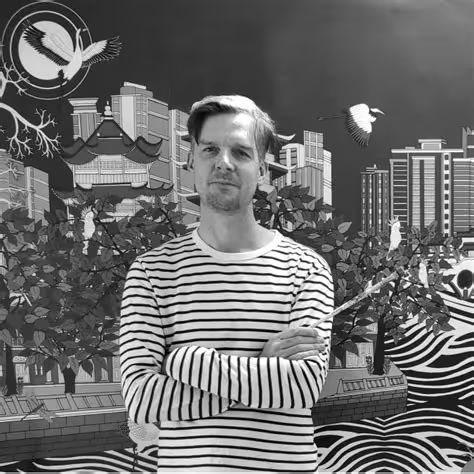
Rob Pepper
Episode Summary
Q1: Place
If we could do a flypast on any part of the world that is significant to you, which place, city or country would it be and why?
Shanghai
Q2: Life
Give us a glimpse into your life story so far with an emphasis on what you are doing currently?
Parents split up at 12 which was hugely challenging. Post school, set up a business with Amy who he eventually married before going to Art school. Went to Australia and had first solo shows before eventually moving back to London to do a residency at the Florence trust in Highbury. In 2004 approached to work for The Art Academy and eventually became Principal in 2017. Alongside that role Rob always ran his art practice.
Q3: Reset
Where on earth is your place or reset or re-charge?
The Marsh Wood Vale in West Dorset
Q4: Wonder
What wonder of the natural world excites you the most?
Swallows and their migration from Africa
Q5: Hopefulness
What is your story of hopefulness (not your own) about a person, business or non-profit who are doing amazing things for the world?
The love of families who are opening up their homes to host Ukrainian families. Secondly, a school friend who is part of a band who have been world leaders in addressing their environmental footprint.
Q6: Insight
As we prepare to re-enter, what insight, wisdom or question would you like to share with us?
Be good to work with and sometimes stop to have a cup of tea.

Transcript
Speaker 0:
Welcome to the Wonderspace podcast. It's great to have you on board. My name is Steve Cole and over the past 72 episodes I have been asking the same 6 questions to amazing people from around the world. The questions orbit around wonder and stories of hopefulness and the setting for each journey is a shared window on the space station from where we see everything from a different perspective. Before we introduce our guest this week, our friends at asknature.org are going to help us to re-wonder.
Speaker 1:
Broken reeds and hollow stems are a common sight in the Fed country. But these apparently dead and damaged structures are actually a life-giving part of the community of plants. This is because reeds generally grow not as isolated clumps, but as offshoots of each other, all connected to a sprawling horizontal underground stem. Further underground, the roots of the reeds are drowning in the waterlogged ground, unable to take in the oxygen they would have access to in air pockets within drier soil. As the wind whistles overhead, it pushes fresh air into those broken stems and oxygen races through the vast hollow network of plant tissue until it reaches the roots to be taken up into the living cells.
Speaker 0:
Our orbit this week will take us from Mexico to Boston in America and to experience these views with us in this ultimate window seat, we welcome Rob Pepper. Rob is an artist, designer and the current principal of Art Academy in London. In 2003 he joined a small community of artists that wanted to challenge the way art education was being taught. Since then Rob has helped develop the Art Academy which today has over 3, 500 students and 100 artists regularly employed. As an artist Rob has had solo exhibitions in cities around the world and most recently has exhibited in Shanghai.
Speaker 0:
With this panoramic view above earth I start by asking Rob if we could do a flypast on any part of the world that is significant to you which place city or country would it be and why?
Speaker 2:
I think the place that I would look to fly past currently is 1 of my favorite cities in the world is Shanghai and I've chosen that because well currently it's a bit of a tricky situation, but pre-pandemic and pre-lead lockdowns, Shanghai to me has kind of almost revolutionized my world. It's this amazing space with, It's almost like a parallel universe. We all know a little bit about Shanghai, but not a huge amount. But I love it and I love the people there. It's so familiar in many ways because the old quarter is very European, but it's also kind of otherworldly because of all the new architecture and all the new kind of projects that are going on there.
Speaker 2:
I think also from a business point of view, I've had many opportunities and they kind of embrace artists in a way that they don't over in the UK so much or it's kind of, yeah, they properly respect IP and artist work and they look to integrate business and art in a way that I've not really seen elsewhere. So I'm choosing Shanghai And it's, yeah, I think it's kind of a funny 1 because it's not a kind of romantic, it's kind of romantic in some ways, but it's not like, you know, this place of beauty or it's just really exciting.
Speaker 0:
Rob, give us a glimpse into your life story so far with an emphasis on what you are doing currently.
Speaker 2:
I was born in Devon, 1977. Grew up kind of pretty normal household for the first part of my life. 1 older brother went to local primary school, then went to schools in Exeter. And then my parents split up when I was about 12, and that was a bit of a car crash in many ways. It wasn't a kind of a happy ending to their, that period of their life.
Speaker 2:
Ended up kind of having a very different lifestyle after that to what I was doing before that. Having a lot of responsibility, magically had a younger half-brother that came and joined us, but then ended up with a single parent, single mum, who brought us through teenage years with no money. We grew up quite pretty poor, income support, rural poverty really, but went to good schools. It was this weird mix. During that period, I became very aware of money and how little we had compared to other people would help with the bills from the age of 14.
Speaker 2:
When I came to A levels, particularly when I'm in my 50s and A levels, I didn't want to get a job. That was my kind of aim in life. And that's not that I didn't want to work. I love, you know, I work really hard, but I didn't want to be accountable to other people. And so I was kind of an independent thinker and actually got together with my now wife Amy at the end of school and had this beautiful post-school life where we created a business.
Speaker 2:
We used to do cabinet market every week, making things. My mates were doing gap years and stuff. They were working in supermarkets or DIY stores. We set up independently, started to work and started to use what I made to make money. Then I went to art school and wanted to be an artist.
Speaker 2:
My whole life since then has been about how you incorporate sustainable creativity whilst living the best life that you can possibly live. So that's kind of what I've done. So went to art school, went to Australia, had my first solo shows in Australia, did painting, drawing. I did sculpture at university, but actually when I left university, my sculpture said sculpture is great, but make sure it's flat pack because you end up being kind of doing a lot of storage. So started to make paintings, drew every day, did a blog.
Speaker 2:
We're in Australia, doing really well in Australia, and then I realized that actually I wanted to come back to London. So we moved back to London. I did a residency at the Florence Trust in Highbury. That was the landing spot. Then 1 day, I had, near the end, it was a 1 year program, at the end of that, got an email saying, you know, we're looking for tutors at this place called the Art Academy.
Speaker 2:
And so I didn't do what I was taught to do, which is like send the CV, send a covering letter. I was just like, here's my website, if you're interested, give me a call. And so the then principal gave me a call within about 20 minutes. We met the next day and they offered me a job Which was here's a studio in return for your studio. You got to do a bit of teaching so about 2004 and through that Amazing place I have became a senior member of the management team, I became Vice Principal in 2010 and then became Principal in 2017.
Speaker 2:
Alongside that, always running my art practice. So the the Art Academy is a space of artists who are teaching rather than teachers that know a bit about art. So we all have our own careers, we all have our own kind of practice, and we really reflect those practices in the teaching that we do. And so that's kind of grown. It's gone from a place of 30-odd students when I arrived to currently we do an academic, we have a BA that's been validated by the Open University that we've written and we have about 3 and a half thousand public course students.
Speaker 2:
So at the moment the exciting thing with the Academy is that we are growing, even though the pandemic has been tough. We've survived it. We're in Zone 1, Central London. The big news is that we are moving buildings next to Tate Modern. Beginning of 2023, we will have a kind of state of the art artist-led art school.
Speaker 2:
And although we want to get bigger, we want to kind of remain small. And it's an amazing space, amazing opportunity, and we want to be the best art school that people can come to. And that's because we believe that artists should spend more time with artists, so you're in a class one-on-one. And yeah, it's an amazing life that I have, and It's all grounded in that practicality of creativity and trying to find a way of being sustainable, which is not necessarily about having lots and lots of success, but it's about how can I pay the rent, how can I pay my mortgage, how can I bring up kids whilst being an artist? And if I can do that, then I'm being successful.
Speaker 2:
My place of reset and recharge is the Martyrs' Reveille. I don't want to talk about it because then everyone will come. It's a space outside of Bridport in West Dorset and it's boundaried by these hills. We have Egerton Hill to the east, we have Pilsenpen to the north, and we have Lambeth's Castle to the west. Each 1 has become a rite of passage for us.
Speaker 2:
So on the North, we got married in 2010. On the West, my father-in-law's ashes have been buried and then my mother passed away 6 months ago. And the day she died, we sat on the East Hill of that and looked over this valley. And it's kind of our house in the middle of it, our kids school is there, it's this really beautiful bit like Hobbiton space that whenever I haven't kind of travelled a lot, whenever I come through into it, I'm like, I'm home.
Speaker 0:
What wonder of the natural world excites you the most?
Speaker 2:
The wonder of the natural world that excites me the most, and I'm actually looking out the window because I know they're here but I haven't seen them yet, is the day that the swallows arrive from migration from Africa. It comes at end of April, beginning of May. I haven't seen 1 yet, but I know that they're here because somebody's told me. I get so excited because I'm like, summer's here. They've been away, but they're back.
Speaker 2:
It's like there's something about the way they fly, the kind of the joy they have in just movement, the fact they've been away and they've come back, it's the mark of the summer season. That's it.
Speaker 0:
Rob, what is your story of hopefulness that's not your own? About a person, business or non-profit who are doing amazing things for the world?
Speaker 2:
We're going to talk about 2 things of hopefulness at the moment that are kind of both small and big or both of them really. So the first 1 is the amount of families that are currently sponsoring the Ukrainian refugees. We're helping, we haven't got the space to host a family ourselves, but we're helping a family in the village. And kind of watching that journey of people who are opening up their homes, opening up their lives, trying to help, but also knowing that it's complex, that this family that are here have got a loved 1 or loved 1 still abroad, fighting in all sorts of trouble, and that they're grateful to be here, but they're also angry that they're here because they don't they want to go home. So this is, I think, it's a really complex situation that is not gonna get easier for people.
Speaker 2:
And I think that's a journey that so many families and households are gonna go on through the next few months. So I think it's an amazing aspect of what they're doing, but I think we all need to be hopeful for the fact that the love that people are showing for that isn't it is a wonderful thing but having patience too because it's gonna be complex and the other 1 is a friend of mine who I'm in school with actually who are a band who have made a decision that a few years ago that they're not going to tour until they've worked to have to do that sustainably. So Coldplay kind of, they made that statement, probably a statement that Chris made kind of irrationally in 1 interview, But they've then gone through this period of like, you know, they bring so much joy and hope when they have their shows and it's such a kind of communal experience. But they decided that we're going to do it from an environmental standpoint. And they've really stood by that and have been kind of world leaders within the entertainment industry, I think, in going, this is what we do.
Speaker 2:
It's not needed. A big concert in some ways is not needed, but actually we really desperately need those moments of collective togetherness. But they're also like, it has a big impact. So what can we do about it? And I think if you go to their website for their new tour and look at what they've done environmentally with the solar and the batteries and thinking locally as well as globally, working with local partners as well as much as possible.
Speaker 2:
They need to move around, so looking at which fuel they use and just doing a real massive audit on their footprint when they do these big events. They're lucky in that they have a lot of cash flow to be able to do that, but I think lots of businesses can take that as a lead. So I think that's kind of a much bigger scale like thing within the arts particularly of how do we renegotiate our footprint and what we do and our impact on the environment. So those are my 2 stories of hopefulness.
Speaker 0:
Finally, as we prepare to re-enter, what insight, wisdom or question would you like to share with us?
Speaker 2:
I don't really feel like I have anything that I can share, so I'm going to use other people's. I'm going to give you 2. 1 was a good friend of mine who said, as I was starting out, is like, be good to work with. We've got to work. Especially if you're creative, be good to work with.
Speaker 2:
Getting that balance right between sticking with your artistic integrity whilst being kind to others and being kind is a really thing that I try and do in all of the things that I work on. That's 1 bit of insight. The other 1 is from my mum who would be like, Rob, just sit down and have a cup of tea. Stop being so busy. Just sit down.
Speaker 2:
Let's have a cup of tea. Those are my 2 big bits of insight. Being good to work with and just stop and have a cup of tea with your mates or your family and chill out a bit.
Speaker 0:
To find out more, go to robpepper.co.uk and artacademy.org.uk. To engage with the previous 72 Wonderspace episodes, go to our website ourwonder.space. I want to thank Rob for joining us on Wonderspace and I hope you can join us next week for more wonders and stories of hopefulness.