Episode #
72
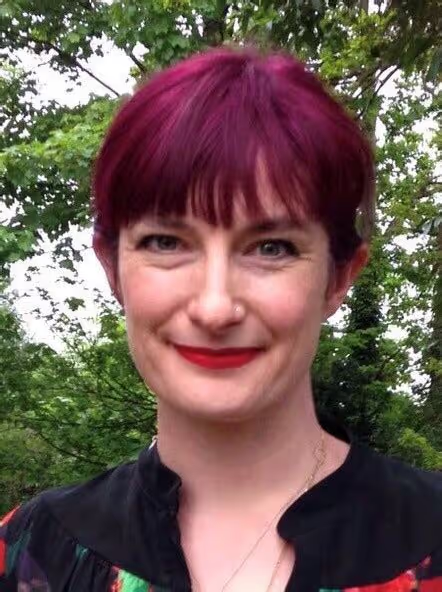
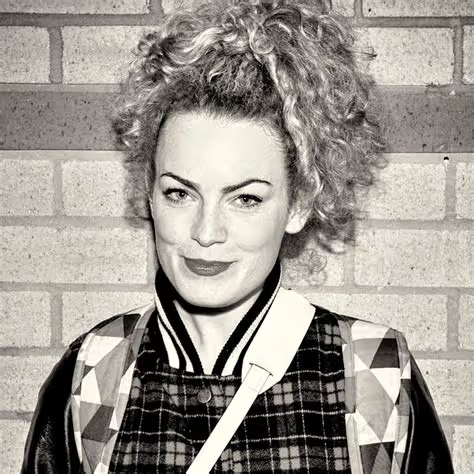
Evie Manning
Episode Summary
Q1: Place
If we could do a flypast on any part of the world that is significant to you, which place, city or country would it be and why?
Bradford. 'I could track almost every show that we've made to a conversation that's happened in Bradford or in my area where I live'.
Q2: Life
Give us a glimpse into your life story so far with an emphasis on what you are doing currently?
The early days of Common Wealth were very DIY, working in big squatting buildings, making really big ambitious pieces with lots of different artists, all pretty renegade. Became much more socially engaged, thinking about what change we could make with our work which led to a show called Eye Glass House which focussed on the issue of domestic abuse. This piece led to a change of law on policing and how policing was viewed around the issue of domestic abuse in Scotland. The most recent show was Peaceophobia, a piece about Islamophobia.
Q3: Reset
Where on earth is your place or reset or re-charge?
The perspective that comes from being near the sea.
Q4: Wonder
What wonder of the natural world excites you the most?
Flowers with their own ecosystems
Q5: Hopefulness
What is your story of hopefulness (not your own) about a person, business or non-profit who are doing amazing things for the world?
Ibra, who has remarkably transformed an underused park with a notorious reputation into a large scale chicken coop and peacock farm.
Q6: Insight
As we prepare to re-enter, what insight, wisdom or question would you like to share with us?
My provocation would be for people to embrace the amateur

Transcript
Speaker 0:
Welcome to the Wonderspace podcast, it's great to have you on board. My name is Steve Cole and over the past 71 episodes I have been asking the same 6 questions to amazing people from around the world. The questions orbit around wonder and stories of hopefulness and the setting for each journey is a shared window on the space station from where we see everything from a different perspective. Before we introduce our guests this week, our friends at asknature.org are going to help us to re-wonder.
Speaker 1:
Bats are artists and they paint with sound. Human painters know well that in raking light, which shines nearly parallel to a surface as the sun does at dawn and dusk, shadows are greatly extended, making tiny objects and textures dramatically more visible. Bats make use of the same effect with raking sound. By angling their high-pitched chirps to either side of an object of interest, the echo comes back not as a bright, direct beam, but in steeply angled waves that exaggerate details and any change in position of the object, revealing more information to the bat with every sound it makes.
Speaker 0:
Our orbit this week will take us over cities such as Bradford in the north of England. And to experience these views with us in this ultimate window seat we welcome Evie Manning. Evie is the co-founder and artistic director of Commonwealth Theatre based in Bradford and Cardiff. They are known as a company that takes theatre out of its conventional comfort zones and were nominated by the team at Goodchance who are the creators of The Jungle and The Walk with Amal.
Speaker 2:
Hi I'm Dina from Goodchance we're nominating Evie from Commonwealth Theatre because we think they're making really exciting work with the people, for the people and it's something that we at Good Chance really believe in. And Eevee is a powerhouse that's bringing important issues to public spaces in a really exciting and innovative way. Hope you enjoy.
Speaker 0:
With this panoramic view above earth, I start by asking EV, if we could do a fly passed on any part of the world that is significant to you, which place, city or country would it be and why?
Speaker 3:
I almost feel like embarrassed to say it, but I do think it would be Bradford, which is where I grew up. Because I was thinking about international, you know, the fancy places I've been. But really the place that shaped me and shaped my work is Bradford. And I live now 1 street away from where I grew up. And so my mum still lives there and a lot of our work at Commonwealth to be honest has been inspired by people on my street, conversations with people on the way to school.
Speaker 3:
Like I could track almost every show that we've made to a conversation that's happened in Bradford or in my area where I live. So like we did a show about Muslim female boxers that came out of a conversation with a neighbour on the way to school and she was boxing and wore full burqa and had 11 children and I was like wow and then I found out there was a boxing gym close by and Bradford to me because I grew up here so I've got all the kind of ghosts and the layers of childhood and teenage years and then also me as an adult coming back because I went away for a few years and then came back and I really had this pull always to come back because I don't know if people would know Bradford but it's quite a kind of neglected place and growing up here you're really aware of like its reputation and what people think and say about it and you know that as well because you live it and you live through you know you see it you experience it like I you know literally you experience the poverty you experience the how hard it can be and then I think as an adult I went away and had my adventures and then I came back about 11 years ago when my son was born because I knew this was where I could really do something.
Speaker 3:
And also where people want it. There's like a want here that people do want it and there's not much going on and so people will really get behind things. So I think Bradford is a city, it's totally international, like a lot of places are, but I think the thing that does characterize it is that it's kind of forgotten in a lot of ways and then in a way people have to tell their own story, they have to make their own place and define it themselves rather than it being defined by other people. So I think that is quite kind of characteristic of what Commonwealth do as well, which is about really telling your story from your place.
Speaker 0:
Evie, give us a glimpse into your life story so far with an emphasis on what you are doing currently.
Speaker 3:
So I grew up in Bradford as I've said and then I really just started making plays like in my back garden with the kids from the area and we were just always out, we'd make kids in the old people's home. We'd do all sorts, we'd basically just be out and about all day long from morning till night, like a true 80s kid. And then, So we were kind of always making and scrapping around. And then I just always knew I had this instinct for wanting to do performance and make something. And I met a really lovely, older actor who's in his 80s who said, when you first get into acting, you think acting is about showing off and getting attention, which is what every kid wants on some level.
Speaker 3:
But then as you kind of get older, you realise that it's about sharing attention. And I thought that was such a beautiful way of putting it, because it is, it's about like, how do we share what we want to focus on, who we are. Anyway, sorry, that was a bit of a tangent. Commonwealth, when we first started, we were very DIY. We were working in big, squatted buildings, just taking over buildings, working with lots of different artists.
Speaker 3:
And it was all pretty renegade because we didn't have permission to be in those places. So we were just kind of making it happen and doing it and not really caring about any legalities or anything that told us we couldn't do it. We were just kind of going en masse taking over buildings and we might negotiate something with the landlord at some point, but really we were just pretty direct action in squatting basically, and making really big ambitious pieces. So actually the early days of Commonwealth when we were at our most ambitious I'd say, because we were working in like 30 rooms and we had no boundaries really to stop us. Then when I had my son and I moved back to live with my mum when I was pregnant and I was in the attic and Then basically an ambulance was called for my next door neighbor and it turned out that her and her children had been experiencing very extreme domestic abuse for years.
Speaker 3:
I was her friend, I knew her And this thing really struck me that just on the other side of the wall, this was happening and I didn't know about it. And so I started to think about what it would be to take our style of theatre that we've been doing, which was taking over big buildings and working simultaneously, and then making a piece about domestic abuse that happened in a house and was simultaneous and promenade and all those things we'd been doing in the big squatted adventurous places but doing it about domestic abuse and that really was when Commonwealth was kind of born in a serious way and we really became much more socially engaged and thinking about what change we could make with our work. So that ended up being a show called Eyeglass House which toured to different houses across the country. And on the journey of that show, it was pretty extraordinary because we, you know, we worked with the Scottish police force and managed to change the law on policing and how policing was viewed of domestic abuse in Scotland. We worked with all level of people basically.
Speaker 3:
We worked with health and social care workers, with midwives, with police. So the show itself was like a kind of, it became like a training tool, But then it also was a massive intervention in kind of local areas, because we would be in a normal house on a residential street. And so we'd have loads of local people and people who'd never been to the theater before would come and see the show. But it also became a bit of a talking point because people would come up to us in the street and say, oh, have you made the play about domestic abuse? Like, I've got my friend and I know he's hurting his wife and I don't know what to do.
Speaker 3:
And so it was such a kind of amazing intervention in a way for our kind of creative journeys, because it was all the things we wanted to do like it was like literal street theatre because we were on people's streets making theatre like quite unusual stuff that no one's really seen before because it was more like it was almost like an installation it was like live art and with live compositions It was really beautiful as a piece of art, but then really directly with people. And so I think that player being our kind of first proper 1, because it's when we first got some funding and we kind of took it seriously. And My son was like 6 months old when we started that and came on tour with us and I just brought him along for the ride as well. So all of that really defined the company I think. Since then Commonwealth, we've been making all our shows site specific, they're all political, more and more they're with people who are co-creators, so people who are making work from their own lived experience.
Speaker 3:
So nearly every show we've made now in the last 10 years has been people's lived experience And the last show we made, just to bring it up to date, it was Peaceophobia. And Peaceophobia was made with free young Muslim men who are also car enthusiasts. So they're really passionate about modifying their engines and cars and they're kind of using that in a way as an escape from lots of different things. So the piece is really about Islamophobia and it's exploring how modified car culture and Islam and the practice of Islam and faith can be a kind of antidote to the Islamophobia that shapes a lot of the young men's lives. And that piece was really unique because it was, I co-directed that show with 6 Young Women from Speakers Corner.
Speaker 3:
So Speakers Corner is a young political, kind of creative social space. It's been going for 5 years. And it's mainly young women. It's young women led, but we say it's open to everybody, but it's young women led, mainly Muslim women. And they make campaigns.
Speaker 3:
So there's like a campaign model at Speakers Corner which is what do you want to say about the world and then they'll make a campaign which sometimes has a creative output or sometimes it's not of a protest or the kind of expression of what they want to say is different and with Peaceophobia it started as a campaign, it started as a car rally and then it developed with Speakers Corner and with the Young Men to become a play. So I'm really proud of the kind of evolution of that as a way of working and kind of excited about what that means for the future like how you can really take something from a campaign and build it not just the co-creators being in it but also shaping it as directors essentially and sharing that power.
Speaker 0:
Where on earth is your place of reset or recharge?
Speaker 3:
For me every time for reset or recharge is just going to be by the sea and wherever that is in the world but the sea is so powerful to me And it's funny because Bradford's really landlocked, we're actually like 1 of the furthest places away from the sea. But it's so powerful to me to just sit with the ocean and have perspective and see the waves. So I think No matter where I'm in the world or if I'm in a city where there's a sea nearby, I'll always make that journey because I just know that that sorts me out. So yeah, the sea would be my reset.
Speaker 0:
What wonder of the natural world excites you the most?
Speaker 3:
This is a bit of a girly answer, but I think it would be like flowers. Cause I just love, especially now cause we're in spring, but I love the blossom and the growth and the colors and just like the literal natural diversity of flowers and how many different shapes and sizes and are just so beautiful because they've got such little ecosystems going on. I just think they're amazing and kind of it is interesting because they're not necessarily, they don't have a purpose for humans. The purpose is beauty, so I think flowers.
Speaker 0:
Evie, what is your story of hopefulness that's not your own? About a person, business or non-profit who's doing amazing things for the world?
Speaker 3:
So my story of hopefulness is someone called Ibra who is based in Bradford and basically he lives in a community called Bradford March just around the corner. And there was a patch of kind of grass, like a little park that was a very underused park and there'd been quite a lot of violence there with teenagers and Ibra was diagnosed with cancer and basically had quite a bit of time on his hands and he was in recovery and then he basically just decided to repopulate this little park So he's really taking it on himself as like a personal mission. 1 of the first things he did, and this is just beautiful, he bought like a chicken coop. So basically he again did it without any planning permission or any permission from the council. He just thought no 1 cares about this land.
Speaker 3:
It is technically council property but he built a chicken coop and it's really for all of the elders so there's a lot of like older men who then come and feed the chickens but obviously that also engages young children. So there's this chicken coop and then it's also now a peacock kind of farm. So they're breeding peacocks. There was loads of peacocks walking around. And then he, again, he did all of this off his own back.
Speaker 3:
He bought a container and put this container there and then went around all the houses and asked everyone if they had spare bike in their cellar or a broken bike they didn't use, filled this container with bikes and then he literally just gives them away. It's not even like a loan project, but really what he's done essentially is he's created this little real, again, like an ecosystem of people on this little park area and so now the teenagers still hang out there but they're kind of hanging out and talking about the chickens. Do you see what I mean? And there's just that engagement at all the different levels and so when I've gone down there because I just love being there it's just so nice because you literally have like every generation and there's something about it that's quite leveling I think having the chickens there and the peacocks because even if things are feeling a bit tense or whatever or whatever's going on then you can always get distracted by the chickens and the peacocks. But Ibra, I think Ibra, he is just totally inspirational because he's not waited for anybody for money or funding or permission.
Speaker 3:
In fact, he actively doesn't want funding because he wants it to be people-led and then he basically in a really unofficial way it's not like they have regular meetings or anything but he will just if something happens in the area he'll go on knock on doors and get out people and say what are we gonna do about it and I just think it's quite extraordinary really because he's really shaping his doorstep. It's just like reclaiming the land. So yeah, I think that's my starting point for that.
Speaker 0:
Finally, as we prepare to re-enter, what insight, wisdom or question would you like to share with us?
Speaker 3:
Recently I've been reading about the idea of the amateur and I think it's really struck a chord with me because Commonwealth has become more kind of professionalized but the kind of theory of the amateur is that you should sit well and rest well in not always being a professional or being DIY or being like making it up as you're going along and making discoveries and that that's where the kind of new exciting things will happen. So that's where innovation will happen is in the amateurs. But the amateurs are often told like, oh, you're just an amateur, stop messing about. You know, there's amateurs in every kind of industry and often they're overlooked, or not even just in every industry, in every walk of life. And being an amateur is actually really powerful, but it's not given that kind of sense of prestige.
Speaker 3:
So I think it's just been exciting me because it also feels a bit disruptive. Like now Commonwealth, you know, we get NPO funding from Arts Council, so we're actually quite kind of like legit now. And because of our journey, that doesn't always feel that comfortable. And I think I'm trying to think about the amateur in me as like someone who can also disrupt the systems that I've ended up in because I've ended up in these quite tightly conformist kind of things answering to government agendas and Arts Council agendas. But I'm thinking of how the amateur and the kind of not always knowing what you're doing and not being intimidated by that and not feeling scared so I think my kind of provocation would be for people to really embrace their amateur.
Speaker 0:
To find out more about Commonwealth Theatre go to commonwealththeatre.co.uk To engage with the previous 71 Wonderspace episodes go to our website ourwonder.space I want to thank Evie for joining us on Wonderspace and I hope you can join us next week for more wonders and stories of hopefulness.