Episode #
69
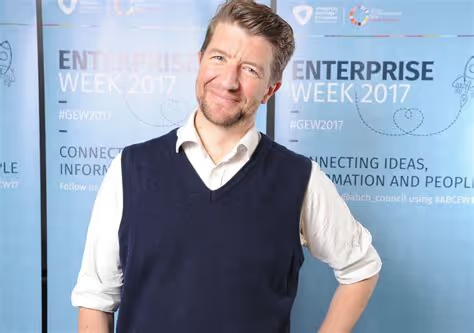
Christoph Warrack
Episode Summary
Q1: Place
If we could do a flypast on any part of the world that is significant to you, which place, city or country would it be and why?
Brixton in London. I put my life back together and was helped by the amazing people of Brixton.
Q3: Reset
Where on earth is your place or reset or re-charge?
Yorkshire. I was born and raised in the wilds of the Yorkshire Moors.
Q4: Wonder
What wonder of the natural world excites you the most?
The wonder of rain. I feel more invigorated by some drizzle.
Q5: Hopefulness
What is your story of hopefulness (not your own) about a person, business or non-profit who are doing amazing things for the world?
The amazing team at Doc Society who enable people making powerful documentary films to connect with audiences across the world, get funders, sort out strategy, partnerships and create movements. An impact documentary powerhouse!
Q6: Insight
As we prepare to re-enter, what insight, wisdom or question would you like to share with us?
When we are in circle, we are capable of things that we aren't capable of alone. And that goes for everyone in the circle.

Transcript
Speaker 0:
Welcome to the Wonderspace podcast. It's great to have you on board. My name is Steve Cole and over the past 68 episodes I have been asking the same 6 questions to amazing people from around the world. People from around the world. The questions orbit around wonder and stories of hopefulness and the setting for each journey is a shared window on the space station from where we see everything from a different perspective.
Speaker 0:
Before we introduce our guests this week our friends at AskNature.org are going to help us to rewonder.
Speaker 1:
In shallow turbulent streams around the world, just a few centimeters from the surface, element beetles cling to rocks, facing into the rushing currents, nibbling microscopic food particles, and breathing from a cloak of fresh air wrapped around them. Tiny hairs, millions per square millimeter, hold the air in place. Tiny holes in the exoskeletons allow them to breathe and tiny molecules of dissolved air in the water keep the bubbles stocked with oxygen. Now Bernoulli's principle. As the water picks up speed flowing past the bug its pressure drops continuously releasing the dissolved air into the beetles big bubbles.
Speaker 0:
Our orbit this week will provide some great views over cities such as London, Paris and Amsterdam. And to experience these views with us in this ultimate window seat we welcome Christophe Warrick. Christophe is the founder of Open Cinema and Airbase which are social franchises enabling communities across Europe to build skills through cinema filmmaking and courses. He is also the co-founder of B Foundry who are currently mentoring 10 environmental startups. With this panoramic view above Earth I start by asking Christoph if we could do a flypast on any part of the world that is significant to you.
Speaker 0:
Which place, city or country would it be and why?
Speaker 2:
So I'm gonna go for Brixton because it was the first place I lived in London and it was I was coming out of a period of real sort of chaos. I'd actually had a kind of a breakdown, age 23, coming back from traveling widely in Asia. And in Brixton, I put my life back together and was helped to do that by all the amazing people of Brixton. Anybody who's ever lived there knows how amazing it is. In the late 90s it still had some of its rougher edges and within weeks I found myself collared by a bunch of old ladies in the local church run by the Jesuits, the wonderful Jesuits, and those old ladies basically within weeks had me going to visit people in prison, sitting with the old people in the community who had no 1 else to talk to, volunteering on homelessness projects, helping the young people with their first communion, all sorts.
Speaker 2:
And that experience of volunteering opened out to me how our society and civilization really holds together, which is this understory of the people out there you never hear of every day keeping the internal lights on for the good folk of this world. So yeah, kudos to Brixton and I always get a lift when I cross that bridge from the north to the south heading that way.
Speaker 0:
Christophe give us a glimpse into your life story so far with an emphasis on what you are doing currently.
Speaker 2:
From Brixton forwards I spent the next 10 years working in film, learning about storytelling, about a big complicated industry, about the challenges of finding work and keeping work and making good work as an artist, as I felt myself then to be, in what is really quite a kind of mechanistic industry and somebody described making a film as being like doing the hurdles holding a glass of champagne. Alongside working in film, I was volunteering, as I've said, in homelessness centers and care homes and prisons and finding out about community spaces. And I began to realize that there was a huge amount of value missing culturally from those spaces. There was a great amount of exclusion. And I wanted to find a way to bring film into those spaces so by the time I was living in the West End and volunteering on a soup kitchen in Soho Square I realized fortuitously that not only were there homeless people all over these streets, but there were filmmakers all over these streets.
Speaker 2:
So couldn't we find a way to bring these people together and then just sort of set them running and see what happened? So I set up a weekly film club called the Open House Film Club up in the parish room at St. Patrick's in Soho Square, and started asking street homeless people, living and sleeping on the streets, what kind of movies they wanted to watch. And so we started a kind of participatory film club with 12-week seasons, structured around the themes coming from them. We started asking in the filmmakers to come and talk to them.
Speaker 2:
Oscar-winning filmmakers, palm-door winning filmmakers, technicians, actors, directors, producers, all sorts And it was the greatest cinema on the face of the earth. It was absolutely mind blowing for me, for our participants and for the filmmakers. So I kind of ran that for 4 years and thought there's a lot going on here that I need to find a way to unpack a bit more and Eventually people started saying to me you've got a you've got to scale this out You know people started hearing about it some of the homeless people started saying this was the only door they would go through in the given week because it was a place where they felt really kind of free accepted and and had a wonderful time and explored all sorts of interesting things in a very liberated way. So we Set it up me and my vauntice as a social enterprise in 2009. We called it Open Cinema and we met some heroes of mine who I'll come back to later in our chat, who then helped me build it out as a social enterprise.
Speaker 2:
And I spent the next 10 years running it, helping it spread itself across the UK, Ireland, and then to Finland and the Nordic and Baltic countries, and becoming an open cinema, meaning a cinema that people can own, they can program, they can build up their idea of who they are and what their dreams are and how to make those dreams a reality and we would do that by building pathways with partners into education, employment, housing and community. Partnering with people like the Open University, with Cisco, with the BFI, with Homeless Link, with homelessness organisations who have themselves those partners. So it was a brilliant funnel into support. And based, as I had no idea then, on what's called the capabilities approach to human development, which is really just about giving people great tools and then off they go. Then we get to the pandemic.
Speaker 2:
I'd set up a second impact venture called Airbase, which does the same thing but for learning, converts any community space into a learning space. And they were both put on hold by the pandemic when, as Pope Francis said, the great reckoning unfolded across the world and everybody started rethinking what was really important to them, the people around them, the nature around them, the kind of work they were doing, a wave of purpose spreading across the world. Great green shoots really amongst a time of great suffering in many quarters. And I think those green shoots continue to grow. So I had wanted to put my shoulder to the wheel of renewing and regenerating our beautiful and beloved planet and Biosphere and found myself on a January morning in Soho, back in Soho, at the beginning of 2020, pulled together with 3 other phenomenal social entrepreneurs to find a way to contribute.
Speaker 2:
So we put together a thing called Moving Beyond, which met at Findhorn before the COP and we pulled together 60 corporate leaders and built of them a band of brothers and sisters to renew their own businesses, products and services. And along with that we have a platform called Gather that's now spun out, that's a platform for community collaboration on climate. And that holding structure, B-Fundry, is what I'm now working on, which is essentially working on mapping the landscape of innovation to renew the earth and the capital to fund it. So that's where I am and I'm also hoping to help some of the politicians to get their heads in gear and all this stuff ahead of the next election. Well it has to be Yorkshire which is where I was born and raised in the wilds of the North York Moors.
Speaker 2:
This could have been the flyover. I mean literally when you said in the first question in the flyover, of course, I never to be pictured this beautiful remote village called Rivo, where in the 12th century, a group of monks sent north by the amazing St. Bernard, who by the age of 30 had founded something like 300 monasteries. I mean, there's social entrepreneurship, creating jobs, purpose, community, all sorts. And he sent a bunch of...
Speaker 2:
He sent 6 months north to the wilds of the north of England and a local good egg called Walter Lusbeck gave them this valley and they built a monastery there and the ruins, ruined by Henry VIII, another salutary lesson in power and its corruptions and abuses demolished the place at the end of the 16th century and but its beautiful ruins remain surrounded by swifts and Swallows and Kestrels and Merlins and that's where my family have lived for a long time and where my parents still live and so that's the place where I go to walk the woods but any patch of woodland will do me.
Speaker 0:
What wonder of the natural world excites you the most?
Speaker 2:
So great question and I feel I've talked a bit too much about history in the last 1 where that was really supposed to be about regenerating but I think I am regenerated by these threads of history that come together with nature just underneath it all. I'm going to go for rain because it's a rainy day today. I love water. As a Yorkshireman, I love foul weather. And I feel almost more invigorated by some drizzle, some fog, some grey light.
Speaker 2:
I love it. And actually having done a lot of swimming like many people in the last couple of years, I actually went swimming in the rain at 1 point And that was an amazing experience which I already recommend to any brothers and sisters listening. So yeah, and also there's a great story as you'll know, Steve from the Old Testament, of God sending the dew fall and it not returning to him until it's work of nourishing and enriching and helping things to grow has been done and that is 1 of the great metaphors for the work of his words in the world. So Rain has all sorts of wonders within it.
Speaker 0:
Christophe, what is your story of hopefulness that's not your own? About a person, business or non-profit who are doing amazing things for the world?
Speaker 2:
I'm going to pick out some people who I owe a lot of grass-tude and inspiration and energy to. The amazing team at an outfit called Doc Society who essentially enable people making powerful documentary films about the most important stories of our time to connect with audiences across the world, to get funded, to sort out their thinking, their strategy, their partnerships, and to create movements and to enable the people who watch those films to take really concrete next steps once they're inspired by that movie and about what's possible in addressing in in in helping them to address that challenge. So they are an impact documentary powerhouse. They picked me up when I was kind of at my wit's end in 2009 and not sure what I was gonna do and I bumped into them at a film festival in Brighton and told them I was making a documentary about the Israeli-Palestinian conflict and I was also running a film club for homeless people and they dropped their cappuccinos and said We've got to come and check that out. And they came in and they volunteered for a night and they said they really wanted to help.
Speaker 2:
So the incubators opened cinema for a year in their offices in Bethnal Green and then in Soho. And they've gone on being an amazing champion and supporter. They introduced me to ways of thinking about how to create impact, how to run an organization, how to build partnerships. They are just some of the most extraordinary people I've met. They took me along to the Skoll World Forum, which is sort of like the Oscars of impact, bit overwhelming, but it's good to have a few clueless rookies like me knocking around with all these, you know, the great and the good.
Speaker 2:
And I've gone on learning so much from their example. Whenever I feel a bit unsure or a bit flat about what I'm doing, I open up their website and just the force of quality that comes out of that place is a wind at the sails of any of us. So yeah, it's got to be the good dog society.
Speaker 0:
Finally, as we prepare to re-enter, what insight, wisdom or question would you like to share with us?
Speaker 2:
After years of refining work on Open Cinema with Johnny Ives' 1 word theory of design rather, refine, just that 1 word, refine, very, very good word for a change maker, I arrived at our mission statement for Open Cinema, which is to enable any individual or community to move from exclusion to participation. And that breakdown I referred to when I was 23 was essentially an experience of chronic exclusion, of not chronic but severe exclusion, of just a dissembling of my understanding and my relationship and my ability to work with the world. And so that set me on a course to serve that mission of participation, because the obverse of exclusion is participation. So in my current work at Be Foundry and moving beyond and gather, 1 thing I found powerfully having been at the cold face of what's often lonely, hard work as a social entrepreneur, working with amazing people far more accomplished and impressive than me is that when we are in circle we are capable of things that we aren't capable of alone and that goes for everyone in the circle and there is a there is a kind of mystery and a fund of beauty in that, that is something that I think everyone could do with in this time.
Speaker 2:
We need to get together and we need to discover what we're really capable of as individuals by getting together in our community, in our country, as a species and as an entire fraternal biosphere. So yeah, here's to it, Let's get together.
Speaker 0:
To find out more about the work of Christophe, go to bfoundry.org and opencinema.org. To engage with the previous 68 Wonderspace episodes, go to our website ourwonder.space I want to thank Christoph for joining us on Wonderspace and I hope you can join us next week for more wonders and stories of hopefulness.