
Episode #
68
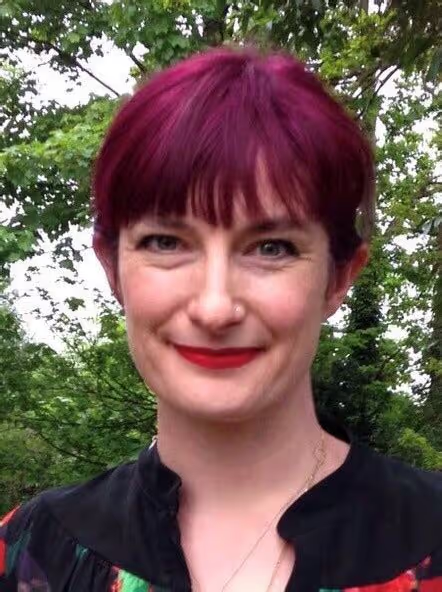
Charlotte Pyatt
Episode Summary
Q1: Place
If we could do a flypast on any part of the world that is significant to you, which place, city or country would it be and why?
Any wild natural contexts like the Amazon, Arctic or Coral reefs fascinate me. The opportunity then bring an artist into those spaces to spark a conversation really excites me
Q3: Reset
Where on earth is your place or reset or re-charge?
At home with family when the most responsibility I have is drawing mermaids and unicorns for my cousins.
Q4: Wonder
What wonder of the natural world excites you the most?
I'm always fascinated by spontaneous behaviour. There is this DIY sensibility within Grafitti culture that evolves in these spaces, which I find so fascinating when we then look at social and environmental projects.
Q5: Hopefulness
What is your story of hopefulness (not your own) about a person, business or non-profit who are doing amazing things for the world?
Simon Butler from Migrate Arts who work with some of the biggest artists working across contemporary art to raise awareness and funds for homeless and displaced people.
Q6: Insight
As we prepare to re-enter, what insight, wisdom or question would you like to share with us?
Find what it is that you're passionate about and then find people in the world that feel the way about it. We can only ever initiate change when we find our tribe.

Transcript
Speaker 0:
Welcome to the Wonderspace podcast, it's great to have you on board. My name is Steve Cole and over the past 67 episodes I have been asking the same 6 questions to amazing people from around the world. The questions orbit around wonder and stories of hopefulness and the setting for each journey is a shared window on the space station from where we see everything from a different perspective. Before we introduce our guest this week our friends at asknature.org are going to help us to rewonder.
Speaker 1:
When adult gannets careen and dive into the ocean from a height of 30 meters at a speed of 20 meters per second, the impact should force water right into their nasal passages and drown them. But it doesn't because gannets don't have nostrils. As an embryonic gannet grows inside its egg, the spaces in its skull that in other species would become nostrils or nares, fill in with bone and keratin giving the entire beak a smooth unbroken surface. Once the bird hatches it will breathe essentially through the corners of its mouth had a slight gap between the top and bottom bill where they meet the head, a gap the bird can easily close when plunging in for its next meal.
Speaker 0:
Our orbit this week will take us over the islands of Indonesia And to experience these views with us in this ultimate window seat, we welcome Charlotte Payatt. Charlotte is a creative consultant and director with a passion for projects activating positive change and discussion through art. From consultancy to creative production over the past 10 years Charlotte has been managing artist profiles, independent projects and cultural initiatives. Charlotte was nominated by the founder of Love Welcomes, Abby Hewitt, who was our 15th guest on Wonderspace.
Speaker 2:
I nominated Charlotte Pyatt for Wonderspace because the first time I ever met her she inspired me so much with her dedication to parts of the world that have been forgotten and her true belief that art could be part of the way we look at inequality and situations that are needing change. She's a positive person with really true skills in the art world and she combines them to make the world a better place.
Speaker 0:
With this panoramic view above earth I start by asking Charlotte if we could do a flypast on any part of the world that is significant to you. Which place, city or country would it be and why?
Speaker 3:
If I could do a flypast for anywhere in the world I don't think I'd have a specific location. It would be more of the tone of the space in which I would be flying over. So I never quite knew what I wanted to do in the arts. I knew I wanted to do art and I knew I wanted to do travel, like my 2 greatest passions. And wherever I fell between that, that's what I wanted to do, which is how I came to be doing what it is I'm doing now.
Speaker 3:
And So with anyone who's avidly passionate about travel, it's finding the most absurd, most out of the way, most off the beaten track place, and then finding a way to exist there. And I think that when you do art and you work with artists and creative professionals, you have this really unique opportunity of creating a moment of impact. So if I could fly over anywhere, it would be maybe the coral reefs in Australia, the rainforests in the Amazon, the ice in the Arctic, any 1 of these kind of wild, natural contexts fascinate me and the opportunity to bring an artist into those spaces to then spark a conversation that that just really excites me.
Speaker 0:
Charlotte give us a glimpse into your life story so far with an emphasis on what you are doing currently.
Speaker 3:
So I didn't know how I wanted to infiltrate the world of the arts, I just knew I wanted to. So I came in a little late and I didn't really get started until I was about 26, because I took about 8 years traveling the world, which I loved. And so I had been working in property actually, and I was an operations manager. So I was working at quite a high level and I had this absurd thought that since I was working at a certain level in business, I could take those transferable skills and I could just enter them into culture. And that was not correct.
Speaker 3:
So I tried making a big play for like galleries and museums for hey I have all this experience and knowledge here can I work with you and it was just like from the top no no no no no until I was literally at Tea Girl, you know, I will make tea for you? You don't have experience. You can't make tea in a museum. So eventually I got to start in a gallery in West London. And I loved it.
Speaker 3:
I loved that interaction with the artists, putting on the shows, it was all very exciting. But I think that when you start working with galleries, you understand the ways in which this is actually a business and it's not there to necessarily support the needs of the artists, it's there to support the infrastructure of the business. So I quickly moved away from that and started doing my own productions. I got into artist management for a long time, working with my dear friends, Ernest Okarowicz, Axel Void and the Loe Bros. And I did that for about 8 years.
Speaker 3:
And I loved it, you know, that sense of camaraderie as well, being in a team, working out a problem. And these are all artists that, aside from being dedicated to their practice and what they were trying to achieve, they all had this wider consciousness of how their work was interacting in a wider context. Was it about social issues? Was it about environmental issues? They were so aware of their profile in the wider arts world.
Speaker 3:
It was about taking that momentum and finding a way to capitalizing on a space that mattered. And so I think as time went on, it was less about me helping that single person realize their vision and it became like further away, right? Like how do I create space for that to survive? How do I encourage other people to move into that space? So I went from being directly in the studio with the artist, then moving, you know, 1 step away, and I started curating my own projects.
Speaker 3:
And then it was like, 1 step away again, I started building cultural initiatives, 1 step away again. And now I'm consulting and liaising with organisations like the British Council, UNESCO. I run 2 cultural initiatives, Splash and Burn with Anis Sakharovic, which is all about using public art to raise awareness of palm oil devastation in Indonesia. The Toward 2030 What Are You Doing project, which is all about aligning public art with the sustainable development goals. I recently did a project in Bristol called Vanguard, Bristol Street Art.
Speaker 3:
For that project, I was able to curate 2 rooms, which I was so excited about. But for me, the best part of this project was that I was able to curate a space that was dedicated to artists who were choosing to align their platform with social and environmental commentary. And it's like there are hundreds, if not thousands of examples across the world of Artists taking the momentum around their profile and then channeling it channeling it towards something good And that feels really exciting to me. I was recently in Valencia with the artist Dolk for Las Vallas. It's an annual festival which sees a sculpture burned in the centre of town to celebrate the beginning of spring.
Speaker 3:
Dolk is an amazing artist and incredible environmental advocate that took the opportunity to take that moment and make it about climate awareness. He built a 23 meter polar bear in the center of town surrounded by 30 different critically endangered species that all have their own sub narratives for how they're affected in their part of the world and then just set it up in flames and it was it was spectacular and mesmerizing and you know like see that force of nature come together with art in such a powerful way. And it's conflicting at the same time, you know, like we look at these kinds of moments and our instinct is, well, that's bad for the environment, you know, and I'm so interested in this, us being able to have these difficult conversations where on 1 side we have artists that are pushing in these spaces to try and advocate and start a conversation and they're being held to account for their impact. And then you have in other spaces organizations that are continually infringing on that and perpetuating this shitty behavior. But, you know, they've always done it.
Speaker 3:
So let them just keep doing what they've always done I think the more we're able to talk about this the more we can actually move towards positive shifts both in our consciousness and in our behavior and I think fundamentally that's what I'm about taking this multidisciplinary multi-sector approach working with all kinds of different people to really support that narrative.
Speaker 0:
Where on earth is your place of reset or recharge?
Speaker 3:
At home with my family. So anyone who works in the creative industry will have the same problem. And that's the when you do what you love, you are always doing it. It is all day, all night, all weekend. And it's never a chore.
Speaker 3:
It is such a pleasure to be able to work in a field where you are just so happy to get up, do projects with your best friends and be inspired every day. But the downside of that is you don't find that time to then switch off. You know, you're always on, you're always solving a problem, you're always trying to fix something. And often when you do the kind of work that I am you're dealing with really heavy themes you know you're working with artists who are trying to contribute to the refugee crisis you're talking about deforestation or loss of wildlife and it can be heavy you know like emotionally despite physically working as hard as you are. And so I have a big family.
Speaker 3:
I have 3 sisters, my mom and dad. I've got 5 nieces and nephews, and I've got about 100 aunts and uncles and cousins. And so when I go home and I'm with my family, you know, the most responsibility I have is drawing mermaids and unicorns. And I'm really happy being in a space where that is my value sometimes, you know, so that's really my reset and recharge space.
Speaker 0:
What wonder of the natural world excites you the most?
Speaker 3:
I think in terms of natural wonder and things that inspire me and things that I see, 1 thing I'm always fascinated about is spontaneous behaviour. We talked a lot about my passion and my focus in working with artists evolving from graffiti culture and skateboarding. And there is this DIY sensibility that evolves in these spaces, which I find so fascinating when we then look at social and environmental projects. You have this very traditional approach to conservation, you know, there's a funding application, there's a tick box system and this is how we make change. And then you put an artist into a context like this and they say, let's get it done.
Speaker 3:
Let's just go. And they do. And they they don't just get it done. They get it done with flair. There's no plan.
Speaker 3:
But there is this confidence, this real, quiet, powerful confidence with an artist that immerses themselves in a space and then trusts that intuition, that spontaneity, and says, I know what to do. And they just work it out. And my first encounter with this was Ernest Sakharovic, the Lithuanian artist with whom I run the Splash and Burn project. And his ability to just enter a space and then be able to see through it, you know, like the matrix, you know, he could just read the code and would know what to do. I think more and more like this is 1 of the most fascinating aspects for me for working with artists, seeing that intuition at play and then trusting it.
Speaker 0:
What is your story of hopefulness that's not your own, about a person, business or non-profit, who are doing amazing things for the world?
Speaker 3:
My story of hopefulness would probably be a dear friend of mine called Simon Butler who runs an organization called Migrate Arts and Migrate's partner with some of the biggest artists working across contemporary art to raise awareness and funds for homeless and displaced people. A lot of what we've been talking about on the podcast has been the value of arts and culture and what role or impact that's able to have in these spaces. And I think what Simon does is he takes these juggernauts from the high art world, you know, these unapproachable, these art world elites, and then he finds a way to bridge authentically what it is he's trying to do in a meaningful way. I feel like there's great value in peer learning, you know, building this network of friends and associates and colleagues and mentors And Simon is 1 of these people for me who have always been so generous with his time, with his contacts, with his support. And aside from that, in a personal relationship, I respect the value of the work that he does in public space.
Speaker 3:
I respect the message that he tries to perpetuate and this push, you know, this ambition to always be better both for yourself and for your cause and the artists that you champion. So in terms of an example in the world of someone that is doing something meaningful, doing it successfully and doing it with some of the biggest artists in the world. I'd say Simon at Migrate.
Speaker 0:
Finally Sharla, as we prepare to re-enter, What insight, wisdom or question would you like to share with us?
Speaker 3:
I really love the expression, find what you love and let it kill you. As morbid as that sounds. Find what it is that you're passionate about and that you care about, and then find people in the world that feel the way about it that you feel. Like, we can only ever initiate change when we find our tribe, you know? So I would say find people in the world that believe what you believe and then find a way to do it together.
Speaker 3:
More than that, I think that we need to appreciate that we are not superhuman and we are not machines. And I think more and more in our ever more digital times, we find ourselves trying to read more, talk more, do more, be more, and really we need to be doing less and we need to be really honing our focus and our attention so that we can ensure that our actions are as meaningful as possible for the things that we care about. So taking space to look after yourself and to ensure that you are in the best form to be able to support the projects that you care about I think is the best advice I could give.
Speaker 0:
To connect and find out more about Charlotte go to her Instagram charlotte underscore piat. Information about the art initiative to fight conflict palm oil go to splashandburn.org To engage with the previous 67 Wonderspace episodes go to our website ourwonder.space I want to thank Charlotte for joining us on Wonderspace and I hope
Speaker 1:
you