Episode #
65
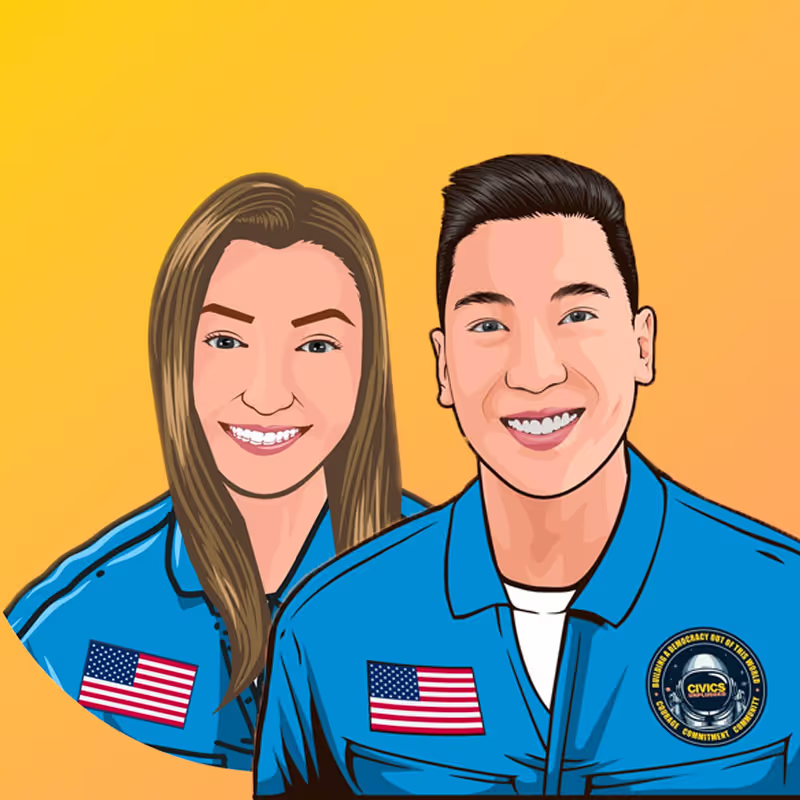
Madison Adams and Gary Sheng
Episode Summary
Q1: Place
If we could do a flypast on any part of the world that is significant to you, which place, city or country would it be and why?
Oklahoma and the whole of the US
Q2: Life
Give us a glimpse into your life story so far with an emphasis on what you are doing currently?
We're leveraging technology to empower young people to strengthen their communities and strengthen our democracy and in turn the world. We do that through the core fellowship, but we also experimenting with ways to better serve young people and the planet. We've created what's called the dream Dow which is essentially a training programme for young people to use web three technologies blockchain cryptocurrency, to make an impact in the world. We're also launching a climate fellowship that teaches young people how to find what we call their U shaped hole in the climate and energy space, so they can have a meaningful career.
Q3: Reset
Where on earth is your place or reset or re-charge?
Lake Tenkiller in Oklahoma (Madison)
Q4: Wonder
What wonder of the natural world excites you the most?
Mycelium networks, underground structures that connect and can span a whole continent.
Q5: Hopefulness
What is your story of hopefulness (not your own) about a person, business or non-profit who are doing amazing things for the world?
Gitcoin, which is a web three institution that has led the charge in normalising and celebrating the process of creating and funding public goods in the most people powered way possible.
Q6: Insight
As we prepare to re-enter, what insight, wisdom or question would you like to share with us?
How can we regenerate the world and make the tools that we have, adequately serve humanity?

Transcript
Speaker 0:
Welcome to the Wonderspace podcast, it's great to have you on board. My name is Steve Cole and over the past 64 episodes I have been asking the same 6 questions to amazing people from around the world. The questions orbit around wonder and stories of hopefulness and the setting for each journey is a shared window on the space station from where we see everything from a different perspective. Before we introduce our guests this week our friends at asknature.org are going to help us to rewonder.
Speaker 1:
Sunflowers and many other plants famously follow the Sun turning and bending throughout the day to face the light. But it's not the light drawing them closer, it's the shade pushing them away. Inside the plant cells, light on the sunny side repels hormones called oxens, concentrating them on the dark side. While there the hormones weaken the rigid walls of the plant cells allowing more water to flow into them causing the shaded cells to expand. That 1 sided expansion tilts the plant towards the light.
Speaker 1:
As the Sun moves so do the hormones and their impressive but temporary effects.
Speaker 0:
Our orbit this week will take us up the East Coast of America and to experience these views with us In this ultimate window seat we welcome Madison Adams and Gary Shea. Madison is the Director of Product and Gary is the co-founder and COO of Civics Unplugged, a social enterprise that empowers leaders of Gen Z with the training, funding and network they need to become Civic innovators. Gary and Madison were nominated by James Arbib from Rethink X, who is our 32nd guest on Wonderspace.
Speaker 2:
So I nominated the team at Civics Unplugged because they're smart, curious, motivated and driven by a genuine sense of purpose to create a better world. But they're also young enough to imagine a totally different system without the dogma and preconceptions that afflicts other earlier generations.
Speaker 0:
I start by asking Madison and Gary if we could do a flypast on any part of the world that is significant to you. Which place, city or country would it be and why?
Speaker 3:
So I would choose where I'm from which is Vertigris, Oklahoma. I think the population is like 4, 000 people and I would choose there because if I were to look down, I would see memories on every street and every place, which would be really cool to see. And I think that why it also means so much to me is from birth, I was instilled like a sense of community and the importance of it. I knew the names and faces of everyone in my school and it provided a very solid foundation for me. And so yeah, it means a lot to me.
Speaker 3:
It'd be really
Speaker 4:
cool to
Speaker 3:
see it from a bird's eye
Speaker 4:
view. I think I would want to look at all of the United States, maybe with exception to Hawaii or something. This is probably 1 way to see it. But I'd probably look at the US because I I Think this I have I feel like I have a good problem where I fall in love with so many different parts of the US for Different reasons. I think there's I think there needs to be greater appreciation for the pros and cons or or just like the kind of beautiful elegant differences, right in charming differences between like Miami Austin Houston Chicago the suburb of Chicago that I grew up in, and New York, all the different national parks, and San Francisco, but also Oakland, and Los Angeles, and the suburb of Los Angeles where my brother and his wife live.
Speaker 4:
And I would just take it all in because it's actually, I don't know if I've ever said this in a recording, but I wouldn't be born without America. And this is not just because, oh, my parents were born, you know, when they came to America and they decided to have a kid. It was, America gave my family political asylum when there was turmoil in China. And my brother was already born at that time. And if they had to immigrate back to China, I wouldn't be born.
Speaker 4:
And so I have deep gratitude for this country in ways I will never be able to repay back. But this is why I want to serve the country. This is why I want to serve also humanity. And a big part of how I plan to serve humanity beyond, I'm involved in some global groups, but America, whether we like it or not, has a lot of influence over how what happens in the world and I want to make sure that America is like a shining light for the world once again or for the first time if we don't feel like it has been.
Speaker 0:
Madison and Gary give us a glimpse into your story so far with an emphasis on what you are doing currently.
Speaker 4:
I believe that there is a war on the human spirit and it's not coming from just 1 source, it's not coming from 1 political party, It's not coming from a kind of just from 1 foreign country. I believe that there's something like a devil of dis-coordination, a devil of just chaos and confusion. That I'm sort of personifying like entropy in certain ways. I'm personifying this like meaning crisis that we're feeling But that that motivates it motivates me so much to help people find their purpose as it relates to regenerating the world because there's a lot of regenerating that needs to be done. And when, also when people find a purpose, their whole well-being improves.
Speaker 4:
So you could work out a lot, you could eat the right food, but if you don't have a purpose, you don't have hope in the future, you're gonna look like crap, you're gonna feel like crap and No 1 is better off for that. You are not an upward spiral, a source of upward spiral that you can be for people if you feel that purpose and you're radiating that optimism through the world. And so where I'm at right now is like I feel like we're in a make or break decade in America, in the world, in humanity, and Optimism is the new punk. When surveyed world leaders, only 3% of people, of those leaders, said that they were optimistic. And so it's like the most vogue thing to be optimistic for some reason today.
Speaker 4:
But like it's, and I like to say that right now it is naive to be optimistic, but it's also gonna be self-fulfilling. Because once enough people are optimistic and are building their communities, building public goods, building the future of humanity, regenerating the world, repairing ecosystems, that optimism is going to be increasingly warranted. So, you know, that optimism, I'm not saying I started the optimism, but we are quite early on in that journey of inspiring the world to believe that they can make a difference in the world and that they can flourish.
Speaker 3:
Yeah, and I guess I'll touch a little bit about the work that we're doing at Civics Unplugged. So Gary Co founded Civics Unplugged, which is the organization where we train people to be the civic innovators that our world needs. And I was a part of the first fellowship class, which is a 10-week program that gathers young people from 50 states and 50 countries to learn about case studies and civic innovation and give them the tools and the funding they need to create projects that, again, impact the world. And so the program is completely digital. It was digital first before the pandemic.
Speaker 3:
And so we're leveraging technology to empower young people to strengthen their communities and strengthen our democracy and in turn the world. And we do that through the core fellowship but we also are always experimenting with ways to better serve young people in the planet. We've created what's called the Dream Dow which is essentially a training program for young people to use web 3 technologies, blockchain, cryptocurrency to make an impact in the world. We're launching a climate fellowship that teaches young people how to find what we call their U-shaped hole in the climate and energy space so they can have a meaningful career. And so, yeah, I think we're in the business of training young civic innovators.
Speaker 4:
The Civics Unplugged co-founders, I'm 1 of them, came with slightly different angles. We came with different life stories. 1 of us was, for example, a NAMI, with a lot of respect for it, 10, He taught civics and history for 10 years and was a vice principal. So he understood, he cares deeply about the power of education, but also understood that the way this system has been structured does not facilitate the sort of empowering education that our future leaders need. Another 1 came from the perspective of a civil servant and also someone that actually ran for mayor of New York City with the purpose of actually reforming education to be more empowering.
Speaker 4:
I came from the lens of I worked at Google for 4 years and I just felt like an opportunity that I could use my superpowers to empower young people to change the world, right? And weave technology in an interesting way. So for example, people thought we were crazy for having a digital first leadership program in community when we launched in January 2020. What happened 2 months later? The pandemic.
Speaker 4:
And then people said that we were geniuses. And I was like, no, We just see where things are going and we also want kids to talk to each other We want people in Oklahoma to talk to New York to people talk to people in Idaho and then like our second program we had you know, we had international kids knocking on our door. And so we had this girl from Hong Kong, we had this girl from Singapore, we had this girl from Italy, and they all wanted to be part of this program. And so what we've realized is just through lots of, you know, We had an initial impression of what we were going to accomplish, but what actually happened has really just shaped what we realized we needed to double down on, which is we need to create this global community of young, optimistic, civic innovators that are going to support each other over the course of many many years We're gonna support them with funding internships and all that right, but they're gonna support each other And that's the most important thing and like, you know, we have kids in Russia. We have kids in Ukraine We have kids in India and Italy right in Singapore and Korea.
Speaker 4:
We had our first applicant from Japan last week. And so we're bringing together all these people that are going to be thinking from a whole human, human flourishing perspective from this very early age. And then where are they gonna be in 10 years? Where are they gonna be in 20 years? They're gonna be heads of states.
Speaker 4:
They're gonna be shaping global culture, global policy, global tech. It's gonna be beautiful.
Speaker 3:
Yeah, and I just want to hop in real quick and talk about the term civic innovation because I realize we're using it a lot and we hadn't talked about exactly what it means. And so I think that when Civics Unplugged was created we knew we were training a different kind of young leader and we didn't really have the terminology to say that, right? Like we're training the next heads of state, yes, but we don't want them to be using the same processes and seeing the world in the same way that the current heads of state do. And so we came up with the term civic innovation that kind of combines these 2 seemingly contradictory things.
Speaker 0:
Where on earth is your place of reset or recharge?
Speaker 3:
There's a lake in Oklahoma called Lake Tinkular and every summer my family is there every single weekend. I'm very close to my grandparents and all my aunts and uncles and my cousins and so we just spend weekends there and it's again that sense of community that I feel so lucky to have from my family and just to spend that time and enjoy their company. And so it's definitely very recharging for me.
Speaker 0:
What wonder of the natural world excites you the most?
Speaker 4:
I think the mycelial networks of underground structures of basically mushrooms that connect to each other, that have interconnectivity with trees and animals that can span an entire continent, it's amazing. We should bare minimum be taking inspiration from these structures, these natural structures of communication and wisdom in designing tech-powered systems of communication and collective intelligence. And this is why I'm so excited about Web3 because it's all about, like, the regenerative side of crypto web3 is all about coordination and solving problems.
Speaker 0:
What is your story of hopefulness that's not your own about a person business or nonprofit who are doing amazing things for the world?
Speaker 4:
I think hands down, it's Gitcoin, not Bitcoin, G-I-T coin, which is a Web 3 institution that has led the charge in normalizing and celebrating the process of creating and funding public goods in the most people powered way possible. So they started off by funding open source software, but they have, and they funded like tens of millions of dollars for open source software and for those everyone listening that isn't familiar with open source software, it is kind of a classic case of tragedy of the commons. Everyone uses open source software, everyone wants it, everyone benefits from it. Even you know just looking at 1 piece of software called Babel. I won't get into the details of it, but it's used by every phone basically.
Speaker 4:
And no 1 knows the name of the people that create it and no one's like donating to that right so they sought out to solve it and they're actually on the way to solving it and they're and they're so on the way to solving that they're like hey let's actually fund other public goods let's fund you know projects that are related to journalism and advocacy and regenerating the environment. So Gitcoin is not a silver bullet to regenerating the world, but it has inspired me and inspired Madison, inspired a lot of people to really, really think deeply about their role in advancing the common good. And they've made it really cool and fun. And they've opened it up to basically anyone around the world that wants to join this community that's building this movement about public goods. There anyone's welcome.
Speaker 4:
And I think that's just so beautiful.
Speaker 3:
Yeah, just to add on to that, I think that coin is a part of this, but I would just speak to the emerging regenerative movement in Web3 that wants to use Web3 technologies to make the world a better place. An interesting case study is what's happening with the Ukraine crisis. So individuals in Web3 have created multiple DAOs and other methods of getting funding to Ukraine and the Wethyr community has donated as much money to Ukraine as the UN, both at about 20 million. And so it's incredible to see in just a short amount of time what a group of individuals can do when they're rallied together around the power of a technology to do good in the world and see how it's donated.
Speaker 0:
And finally, as we prepare to re-enter, what insight, wisdom or question would you like to share with us?
Speaker 3:
I would have the question of how can we regenerate the world to help align it with that perspective if we were looking from a God's eye view. And so I think that's a lot of aligned with a lot of the work that we're doing at Civics Unplugged, the way that Gary is thinking about, you know, his life and what he does next is how can we regenerate the world and make the tools that we have adequately serve humanity.
Speaker 4:
That is the question, how do we work together to regenerate the world? And I think as we As Madison and I have been thinking about this question, we realized a sub-question which is how do we help people see that broader perspective? How do we allow people to be transported to space, at least metaphorically, so that they can see that there's so much at stake? When we're entrenched in the sort of mimetic warfare of like this culture war at national level and the global level, information warfare, it seems like impossible that we can work together and solve problems. You know, an initial idea, just initial approach that I think we've seen at Civic Zone Plug that works really well, that we encourage every leader to think deeply about is one-on-one conversations or small and small group conversations with people about what's at stake and you know we may have different biases towards how we might approach solving problems but we need to figure it out and we should value our differences.
Speaker 4:
Our differences are our gifts, in some ways they are our superpowers.
Speaker 0:
To find out more about the work of Civics Unplugged, Go to civicsunplugged.org. In their story of hopefulness Madison and Gary spoke about Gitcoin and you can find out more at gitcoin.co. To engage with the previous 64 Wonderspace episodes go to our website www.ourwonder.space I want to thank Madison and Gary for joining us on Wonderspace and I hope you can join us next week for more wonders and stories of hopefulness.