Episode #
61
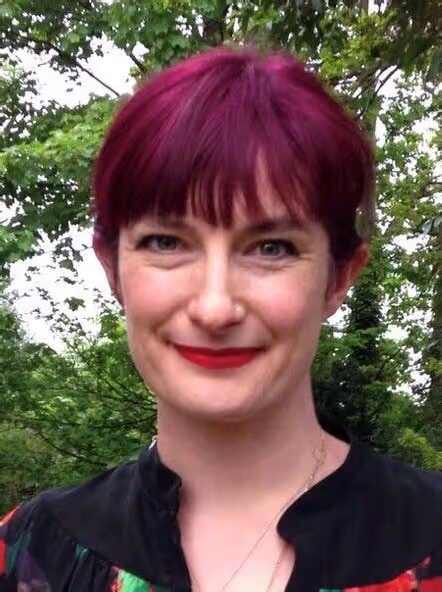
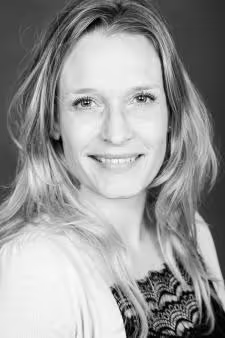
Cora Olsen
Episode Summary
Q1: Place
If we could do a flypast on any part of the world that is significant to you, which place, city or country would it be and why?
Ribe in Western Denmark
Q2: Life
Give us a glimpse into your life story so far with an emphasis on what you are doing currently?
Passionate about sustainability and justice from an early age with a special focus on animal and human rights. Eventually chose the corporate path to try to make an impact on the world. Working with sustainability making the transition into living regenerative lives and not just being sustainable. There is a lot of confusion in terms of sustainability so spend a lot of time speaking at conferences, engaging with organisations to try to facilitate that understanding. Now working with Better Energy.
Q3: Reset
Where on earth is your place or reset or re-charge?
A small apartment in Berlin
Q4: Wonder
What wonder of the natural world excites you the most?
Nature's system of equilibrium. It's amazing ability to readjust and recalibrate itself.
Q5: Hopefulness
What is your story of hopefulness (not your own) about a person, business or non-profit who are doing amazing things for the world?
The future fit foundation. It is the most amazing thing I have seen from a corporate perspective in terms of understanding and measuring and providing a management tool for sustainability and regeneration. In the terms of actually transforming the energy systems then Better Energy is the other story of hopefulness.
Q6: Insight
As we prepare to re-enter, what insight, wisdom or question would you like to share with us?
Be kind, be selfless and seek to create the change that you want to see. You can be small but mighty in your actions

Transcript
Speaker 0:
Welcome to the Wander Space podcast. It's great to have you on board. My name is Steve Cole and over the past 60 episodes I have been asking the same 6 questions to amazing people from around the world. The questions orbit around wonder and stories of hopefulness and the setting for each journey is a shared window on the space station from where we see everything from a different perspective. Before we introduce our guest this week, our friends at AskNature.org are going to help us to rewonder.
Speaker 1:
To avoid getting waterlogged in its marshy surroundings, Arrowgrass grows a shallow system of roots that spread outward near the surface of the surrounding water. As the arrowgrass dies and decomposes, it builds up a pile of nutrient-rich matter atop the roots. This porous structure allows salty water to drain out and oxygen to get in which enhances plant growth. As the roots continue to spread out the elevated ring expands and creates a tiny island of refuge for other plants and animals increasing biodiversity and reshaping the landscape over time.
Speaker 0:
Our orbit this week will take us over Scandinavia and to experience these views with us in this ultimate window seat we welcome Cora Olson. Cora is the director of sustainability and regeneration for better energy in Copenhagen. A business who are driving transition towards a green energy economy. With a panoramic view of earth I start by asking Cora if we could do a flypast on any part of the world that is significant to you, which place, city or country would it be and why?
Speaker 2:
I've seen a lot of the world, so it was actually, it started as being a really difficult question, but I was like, no, it's actually an easy 1, because it reminded me of my childhood. I used to spend every vacation with my aunts and uncles in the oldest town in Denmark called Ribe. And we didn't have a lot of money so I always spent my summers with them. So I have all these lovely, lovely memories of back then. And that was like, that would be my spot.
Speaker 2:
That would be Ribe. It's on this most western part of Denmark and it's just a beautiful beautiful place. We have lovely lovely memories and it's just like yeah it's actually a no-brainer compared to Costa Rica or you know all the other beautiful places but it had to be Ribe in Denmark.
Speaker 0:
Cora give us a glimpse into your life story so far with an emphasis on what you are doing currently.
Speaker 2:
Ever since I was a kid, I've always been very, very focused on sustainability. I didn't know what it was when I was a child, but I've always been very focused on sustainability. I didn't know what it was when I was a child, but I've always been very focused on animal welfare and human rights. I could have gone many ways in terms of where I ended up in terms of my professional career. I could have ended up tied to an oil rig in the North Sea somewhere.
Speaker 2:
But I chose the corporate way to try to make an impact on the world. So I really, really am passionate and ambitious around sustainability because I think If we do not get this right, we are in a really, really bad place. So for me, working with sustainability also privately and trying to live it as a private person and passing that on to my kids is just something that takes up a lot of space in me as a person professionally and privately and also making the transition into actually living regenerative lives and not just being sustainable because sustainability at the end of the day is about just the ability to sustain and I'm not sure that I would actually want to sustain what we have right now. We need to restore and regenerate so that our kids have a future that is actually at least as a high level of quality as the 1 that we've had. So I try to not be too frustrated with where we are and the pace at which we are going.
Speaker 2:
But I really think that this agenda must be front and center of everything that we do. I see that there's a lot of need for people really wanting the right change and we need pace. And I think that more and more companies are seeing that and I can feel that there's a huge pull for people with my competencies. The trouble with this space is that there's a lot of confusion in terms of sustainability. There's a lot of clutter, there's a lot of misuse of words, intended or unintended.
Speaker 2:
So a lot of people tend to just or corporations tend to translate sustainability into something where they just you know improve performance incrementally like they reduce co2 emissions or they reduce water consumption but at the end of the day if you want to be truly sustainable you cannot have any negative impact on society and on the planet. So I spent a lot of time engaging, speaking at conferences, engaging with organizations to try to facilitate that understanding and I don't come from that from an arrogant angle as if I know better. But I think it's just really important that we talk about what's actually sustainability, what's regeneration and what's just less bad behavior. We need to talk about best practice, which is what everyone talks about And stop talking about that and actually talk about what's the necessary practice, what's the actual bare minimum that we need to do and how do we actually get into a place where we can actually begin to restore and regenerate because That's the practice that we have to have, if everyone is to have a future where they can actually thrive. So that has to be the path forward.
Speaker 2:
But that's where I find the Future Fit Foundation. Now I'm skipping in your questions. A huge inspiration in terms of organizations and people that motivate me and that make me believe that we can actually get to where we need to be. We just need to be willing to shed history and past learnings and actually understand that we are part of a system and that's the approach that we have to take to measurement, to strategy, to business model it has to be ultimately regenerative.
Speaker 0:
Where on earth is your place of reset or recharge?
Speaker 2:
So I have a long lasting deep love for Berlin, where we actually have a place down there, so we go there a lot when we can. And it's a place that we had before we got kids. So there's just a lot of history there. It's a really small apartment. It's really cramped when we go there.
Speaker 2:
But when I go there, I just completely... I just check out. And even though it's in the middle of a really bustling city where there's a lot going on, it's just, you know, I just go into my bubble. And we have this, we call it the Wilderby Path. We always do the same things when we're there.
Speaker 2:
No expectations, I mean, the kids, they have their restaurants, You know, there's the museums that we go to. We always do the same thing. But it's just really nice. There's just no obligations. So Berlin is 1 of my favorite places in the world.
Speaker 2:
And the same thing goes for the country of Sweden. My husband is half Swedish, so there's a lot of close ties to that amazing country as well. So everything is luckily close to me so I can get there easily in terms of just being able to get away and reset and recharge.
Speaker 0:
What wonder of the natural world excites you the most?
Speaker 2:
To come sort of like full complete, full circle is actually nature's ability to have this system of equilibrium. It always finds, it always readjusts, it always recalibrates itself so that it actually is sustainable. It can always come back to this place where there's no waste, it's fully circular, it's just this most perfect system. And there's a lot we can learn in terms of behaviour, biomimicry, it's just that is just a wonder for me. It's just like this whole, it just keeps recalibrating just to be at this most optimal space and I think that's just a wonderful capability.
Speaker 2:
It's just fantastic.
Speaker 0:
Cora, what is your story of hopefulness that's not your own? About a person, business or non-profit who are doing amazing things for the world?
Speaker 2:
The Future Fit Foundation, I must say, that they should be on everyone's lips. I think what they have accomplished is absolutely mind-blowing. It is the most amazing thing I have seen working from a corporate perspective in terms of understanding and measuring and providing a management tool for sustainability and regeneration is absolutely the best thing out there currently. There's a lot of things going on, but in terms of what companies can actually take and run with in terms of measuring and managing their sustainability efforts, this is the absolute best thing out there. And they've done this thing with very few resources.
Speaker 2:
They deserve to be on everyone's lips and that's what I try to do. But they are absolutely amazing. So whatever they do, I am fully supportive and they should of course be leading the way in terms of how we understand and measure. And then in terms of a company, it's actually, this is going to sound maybe a bit silly, but it's actually the company that I just started working for because I really love what they have set out to do. It's a small company like I told you in the beginning, Better Energy, but they are really trying to reach scale quickly in terms of having solar energy available for all.
Speaker 2:
They actually just managed, or they have managed to actually make this whole business case subsidy free. It's actually now 1 of the cheapest energies as I understood it in Denmark, solar energy, because of the business model that they have. So it's highly competitive with coal, all the black energy out there, wind energy. And I really like their mindset. That's why they were founded.
Speaker 2:
Because they want to break away from this corporate approach and actually build something that was scalable and cheap in terms of actually transforming the energy systems. There are many challenges to that, but I really like the manifest that they have, the way of thinking, how they have no qualms in challenging the providers of financial capital. There's a lot of stuff going on. Many great people, many great organizations. But we need to come together to just force the systems change because I don't think it's going to come by itself unfortunately.
Speaker 2:
So we need, like you talk about collaboration and people, organizations and people coming together, we need to get that. And we need to be vocal.
Speaker 0:
Finally, as we prepare to re-enter, what insight, wisdom or question would you like to share with us?
Speaker 2:
It sounds Really basic, but it's just be kind, be selfless. I mean, seek to create the change that you want to see. I mean, it's just, it's really, really basic stuff. I mean, 1 of the frustrating things about working with sustainability is you just, there just seems no way out of it. So what I try to do to sort of like ground myself is yeah, there's small things you can do as a person.
Speaker 2:
You can be kind, you can be selfless, you know. I have to, you know, try to make an impact where I am. And what I can see from where the company that I currently work for is that you can be small but mighty in your actions. But you can also be mighty but really small in your actions. So that's what I sort of like try to keep as my mom tries.
Speaker 2:
I mean, I can still do something even though it feels, you know, uphill. You're fighting into a pillow. There's, you know, no 1 hears you or sees you. I believe that you can still, you know, be small but mighty.
Speaker 0:
To find out more about Better Energy and the FutureFit Foundation go to betterenergy.com and futurefitbusiness.org To engage with the previous 60 Wonderspace episodes go to our website ourwonder.space. I want to thank Cora for joining us on Wonderspace and I hope you can join us next week for more wonders and stories of hopefulness.