Episode #
59
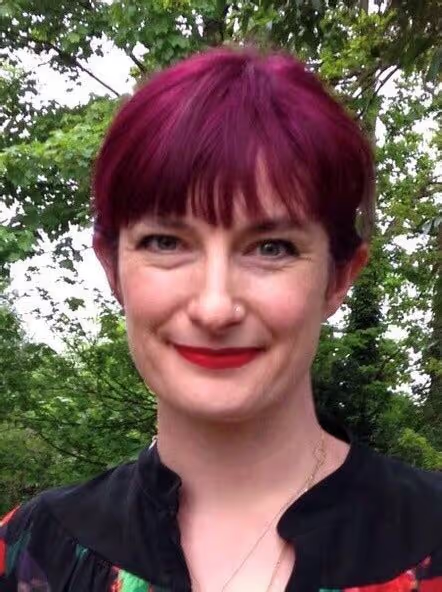
Elissa Freiha
Episode Summary
Q1: Place
If we could do a flypast on any part of the world that is significant to you, which place, city or country would it be and why?
Beirut in Lebanon
Q2: Life
Give us a glimpse into your life story so far with an emphasis on what you are doing currently?
Multiple identities as an Arab, American who grew up in Paris and now living in Egypt. Moved to UAE and built an angel investment business called Womena with a focus on teaching women financial literacy and inspiring women investors. This led to a passion for the feminist space and Womena evolved into a media platform aimed at feminist content that makes a positive impact on society.
Q3: Reset
Where on earth is your place or reset or re-charge?
Mothers apartment in the heart of Paris
Q4: Wonder
What wonder of the natural world excites you the most?
The Redwoods in California
Q5: Hopefulness
What is your story of hopefulness (not your own) about a person, business or non-profit who are doing amazing things for the world?
Rebecca Lolosoli is the founder and matriarch of the Umoja village in the Samburu County of Kenya. The village is a refuge for women fleeing sexual abuse and a place Elissa visited a few years back.
Q6: Insight
As we prepare to re-enter, what insight, wisdom or question would you like to share with us?
After Covid, I'm doing everything that I can to make sure that I don't get sucked back into a kind of artificially imposed, rushed pacing of things that makes me forget to really live and be present

Transcript
Speaker 0:
Welcome to the Wonderspace podcast, it's great to have you on board. My name is Steve Cole and over the past 58 episodes I have been asking the same 6 questions to amazing people from around the world. The questions orbit around wonder and stories of hopefulness and the setting for each journey is a shared window on the space station from where we see everything from a different perspective. Before we introduce our guest our friends at AskNature.org are going to help us to rewonder.
Speaker 1:
Kombucha is more than sour fermented tea, it's a thriving microbial metropolis. First, yeast use the sugars and nutrients in the tea to grow, producing alcohol. Bacteria feed on the alcohol and convert it into acids that inhibit the growth of competing microbes. The bacteria also use sugars to make long, thin fibers of cellulose that rise to the top of the brew, forming a multi-layered biofilm called a pellicle. The pellicle acts as a protective shield and a storehouse of material that the bacteria and yeast can convert back to sugar when needed.
Speaker 1:
When yeast die, they in turn release vitamins and nutrients that are recycled by the microbial community. It may sound like a tiny production line but in fact it's a miniature ecosystem with a balance and cycle of life all its own.
Speaker 0:
Our nighttime orbit this week will take us over Egypt and the Red Sea and to experience these views with us in this ultimate window seat we welcome Elisa Freya. Elisa is an Emirati, Lebanese, entrepreneur, producer, feminist, activist and the founder of Wemena which is a female focused media company which aims to inspire real change through storytelling and digital content. Elisa was nominated by our 24th guest on Wonderspace, Dave Erasmus.
Speaker 2:
I nominated Elisa for a ride in Wonderspace because she is an exciting, imaginative human who brings creativity to everything she touches and I wanted to see what would come out of this conversation together in space.
Speaker 0:
With a panoramic view of Earth I start by asking Elisa if we could do a fly past on any part of the world that is significant to you, which place, city or country would it be and why?
Speaker 3:
I think without a doubt for me that place that I would love to kind of see from an aerial perspective that just brings me a lot of happiness is Lebanon and Beirut in particular. The mountains with the snow and the beach with sunshine and we would see a bustling main city and then these beautiful trees that are kind of cradling and hugging the land. It's 1 of my favorite places. I haven't actually been back to Lebanon since Thawda, since the revolution in 2019, And I flew in to be part of the revolution and see the city. This is pre-explosion as well.
Speaker 3:
So I saw a city that was recognizable to me, but very much in turmoil and conflict. And since I haven't been back in 2 years I would love if I did a beautiful flyover and just to see the beauty of it from from above and maybe some heartbreak as well because of the changed landscape that happened after the explosion.
Speaker 0:
Alisa, give us a glimpse into your life story so far with an emphasis on what you are doing currently.
Speaker 3:
Life story so far is quite, I think, eclectic in terms of experiences. I have multiple identities, cultural identities. I'm Arab and American and grew up in Paris, but have been living in the Middle East for the better part of the last decade. And exciting times because I just moved out of Dubai and I'm trying to see where the next location is that's going to house me that I can set up roots in. Right now it's Egypt and specifically by the Red Sea in Egypt which is an absolutely incredible location.
Speaker 3:
So it's always been quite interesting to me to compare and contrast different perspectives and different kind of cultural values whether they're European or American or Middle Eastern. And when I first moved to the UAE, I saw it as this land of opportunity where you can kind of build whatever you want. And I was going to build a business at the time, which was an angel investment platform. We were going to be teaching financial literacy and managing investments and very early on we realized that most of our customers were going to be men and that as 23 year old women that was actually going to be a pretty big struggle. So we decided strategically to shift our focus towards women and teaching women financial literacy and inspiring women investors to kind of support the tech ecosystem as it grew and maybe shake up some of that liquidity.
Speaker 3:
But a few things happened in that first path. And essentially I had moved with a co-founder and then my relationship with the co-founder quickly deteriorated. The investment networks business model was not something that actually was viable in the long run so I had to think about how to pivot but most importantly I kind of fell in love with the feminist space and I really understood the true state of women in the world for the first time in my life. I understood that feminism in the 70s, the second wave feminism wasn't something that was done and dusted in the past but was something that very much was a starting point and actually there was a lot more work that needed to be done. So this is pre-MeToo and after the MeToo movement happened and the dialogue around women happened, that spread globally and it spread to the Middle East and the discussion and debate here became a lot richer.
Speaker 3:
And so I made it my life's purpose to work towards equality and gender equity in the world, not just in our region, but starting in our region with the community that I represent as an Arab woman. And so Wemina, which started as an investment network, I kept the brand name and the brand equity, but I completely shifted our business model to being a media company aimed at feminist content, change, making, storytelling that really has a measurable positive impact on society. And that's essentially what I've been really fostering and growing over the last 4 years is this platform that takes back ownership of the narrative around Arab women and makes it a much more authentic and nuanced voice that we can feel proud of and represented by.
Speaker 0:
Where on earth is your place of reset or recharge?
Speaker 3:
My place of reset is right in the heart of Paris. It's home for me and specifically on an island called Île Saint-Louis which is right in the middle of the Seine and is an island that neighbors another island that hosts the Notre Dame which everybody is familiar with but this 1 is much smaller and it's a beautiful island where my mom happens to have her apartment and you can sneak onto the rooftop in her house and get this beautiful 360 view of I think 1 of the most stunning cities in the world. And you get just this this ability to exhale and and just be inspired for me. That's where the world really stops and where I just feel at home the most.
Speaker 0:
What wonder of the natural world excites you the most?
Speaker 3:
Honestly for me the most wondrous and enchanting thing that I can encounter is like a really old tree and when I think about a natural wonder of the world I really think about the red woods in California in northern California that are massive they're larger than most of our apartments in Europe at least and they just, their presence is so powerful, they almost seem like omniscient, You know, they they know all the things and they carry wisdom of centuries in their You know bark and in their leaves and to me as long as I'm there like nothing else that has that is happening in the world exists anymore And these trees remind me that they will continue to exist beyond any of the bullshit that we have to deal with and believe is important every day. These trees are the only important things and they will outlive all of us. And to me, that is a wonder that's so humbling that excites me the most.
Speaker 0:
Elisa, what is your story of hopefulness that's not your own about a person, business or non-profit who are doing amazing things for the world?
Speaker 3:
My answer to the question of inspiring individuals or inspiring projects always goes back to this woman called Rebecca Lollansoli who is in Samburu, Kenya. Who is in Samburu, Kenya. She's the leader of the Umoja Women's Tribe, which is a subsect of the Maasai Mara. And what's amazing is that she's been the chief of this tribe since 1990, which first of all was the year I was born, but is specifically worth mentioning because it's such a long time ago. And the Masai Mara are famously patriarchal and famously kind of male dominating as a culture.
Speaker 3:
And what Umoja is, is a safe haven for women, specifically women that are either being given up to child marriage or women that are abused or women that are in situations of domestic violence for example. So it acts almost as a women's shelter but it is its own village and it's protected by women, run by women. Women are the financial providers of this village. They raise their children there. And if they raise sons, of course their sons are welcome, but once they're of age and they want to get married, they cannot be married in this village.
Speaker 3:
It's literally only for women and children. And the reason this village is so inspiring to me is because just in order to set it up, it took an insane amount of courage and strategic thinking in a place that's very difficult for that courage to be justified. But they were successful. And not only were they successful, it's that 30 years later they have this village. And for a culture like the Masai Mara that's nomadic, that tends to follow water and resources for their livestock, the Umoja women have been able to kind of formalize themselves and get themselves recognized by entities like the United Nations or other foreign nonprofits and receive enough donations to build a well so that they don't have to be nomadic which puts them at risk down the line.
Speaker 3:
So they now have a well they're in the same location which means that donors can find them or supporters can come visit them and I was lucky enough to be 1 of those people and they were able to build schools for children that are now there with them living with them and raise livestock on the property and actually protect themselves much better. So for me, that's a story that is continuously inspiring. And the woman who leads this, Rebecca Loloncelli, taught herself English and now travels the world telling these amazing women's stories and the women that she helps to support and protect from a potentially very dark experience in life.
Speaker 0:
Finally as we prepare to re-enter, what insight, wisdom or question would you like to share with us?
Speaker 3:
Nothing matters today like it used to matter before COVID. So There's no need for us to come back into this world with the same stressors, the same pressure, the same urgency to fulfill the desires of this pre-established consumerist society. It's really a time now for us to almost take the pause that we were on and extend that pacing into the future. Take our time with things. I think I really learned to sleep on it now.
Speaker 3:
Whenever there's a big question that needs to be answered or a big decision that needs to be made, it doesn't need to be made right now, you can take a day to sleep on it. If somebody is urgently waiting for, you know, a deadline, make sure you give them a paced deadline. Don't feel that same pressure to have to do everything yesterday because it's not worth it. It's not worth it. What we really saw was in those pauses, in that paced style of living, we're able to reconnect with ourselves and reconnect with the important things around us and the important relationships around us.
Speaker 3:
And I'm doing everything that I can to make sure that I don't get sucked back into an kind of artificially imposed, rushed pacing of things that make me forget to really live and be present.
Speaker 0:
To find out more about Elisa and the work of Wumina, go to elisafreya.com and wumina.co. Go to elisafreyer.com and wumina.co To engage with the previous 58 Wonderspace episodes go to our website ourwonder.space I want to thank Elisa for joining us on Wonderspace and I hope you can join us next week for more wonders and stories of hopefulness.