Episode #
58
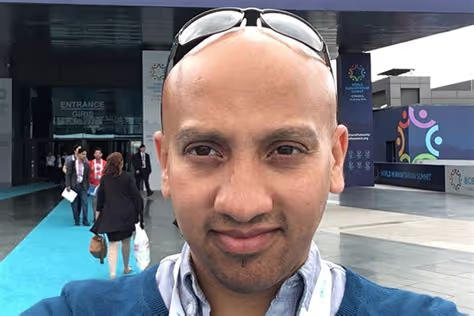
Ben Solanky
Episode Summary
Q1: Place
If we could do a flypast on any part of the world that is significant to you, which place, city or country would it be and why?
Kent in the UK
Q2: Life
Give us a glimpse into your life story so far with an emphasis on what you are doing currently?
Find out later in life that he should have been brought up in Jinja in Uganda, but the family chose to flea the country. A friendship and a promise led Ben to pursue work in various charities which led him to helping facilitate a simulation at the World Economic Forum in Davos enabling people to walk in the shoes of people experiencing displacement and poverty. This was a catalyst moment and led Ben to form Empathy Action which uses simulation and workshops to inspire empathy and action.
Q3: Reset
Where on earth is your place or reset or re-charge?
The vast mountains and seascapes that makes you feel so small
Q4: Wonder
What wonder of the natural world excites you the most?
The power of Tornados
Q5: Hopefulness
What is your story of hopefulness (not your own) about a person, business or non-profit who are doing amazing things for the world?
People who volunteer in Winter shelters and support, listen and share moments with people like Chris.
Q6: Insight
As we prepare to re-enter, what insight, wisdom or question would you like to share with us?
An Armenian phrase meaning 'allow me to take away some of your pain so that your pain is a bit less'

Transcript
Speaker 0:
Welcome to the Wonderspace podcast, it's great to have you on board. My name is Steve Cole and over the past 57 episodes I have been asking the same 6 questions to amazing people from around the world. The questions orbit around wonder and stories of hopefulness, and the setting for each journey is a shared window on the space station, from where we see everything from a different perspective. Before we introduce our guest, our friends at asknature.org are going to help us to rewonder.
Speaker 1:
Tunisian desert ants pay close attention to scents throughout their foraging expeditions. They create detailed odor-based mental maps of the whole terrain which they then can use to find their way back to their inconspicuous nest entrances. But it isn't like a dog sniffing the ground to follow a trail. The ants use their 2 antennae to give slightly different readings on the presence of scents in the air enabling them to smell in stereo.
Speaker 0:
Our orbit this week will take us over Western Europe and Northern Africa and to experience these views with us in this ultimate window seat We welcome Ben Salanke. Ben is the co-founder and director of Empathy Action who create immersive experiences and workshops that enables participants to walk in someone else's shoes. They believe that solving the world's biggest problems such as the refugee crisis, global poverty and the climate emergency starts with empathy. Ben was nominated by our 21st guest on Wonderspace, Reem Al Sayyar, from Damascus in Syria who told her powerful story as part of Empathy Action's latest immersive experience called Desperate Journeys.
Speaker 2:
I nominated Ben Salonke because he's a wonderful person who helped me and my family when we first arrived to the UK as refugees and for his great job raising empathy and helping people all around.
Speaker 0:
With a panoramic view of Earth I start by asking Ben if we could do a flypast on any part of the world that is significant to you which place city or country would it be and why?
Speaker 3:
I dreamt about being in space for a long time being a kid it was a real pastime of mine and it comes from possibly having ill health and respiratory issues, having asthma as a kid. So there's a lot of things I couldn't do. I remember on Mondays when my brothers go to scouts, I would get to sit on the couch and cuddle up to my mum and watch a bunch of sci-fi shows and it was always at 06:00 and I remember Star Trek being on and I used to love the planets seeing all the planets and seeing the space and moving around that was a real a real kind of like amazing moment, being like, gosh, what's out there? What's up in the skies? And I'd love to look at the planet.
Speaker 3:
I'd love to look at the stars. I'd love to look at the moon. I'd love to see that and get that sense of wonder that I had as a kid. The only thing I'd love to have is my mum cuddled up to me again, which would have been you know quite special and I look back and having her company was brilliant. But going back into space and looking at a planet, I think I'd like to look at where I'm right now in the southeast of England, in Kent, in Tunbridge Wells.
Speaker 3:
And I'd love to do 1 of those zoom outs, you know, where you can zoom slowly out, see the county, see where I am, see the city of London, and then slowly move into the country, to the continents of Europe. And I'd love to check out the contours of the mountains and the colour changes and go right the way over 1 of the poles, the south pole and see the white and I think that would be something to journey on in this space station.
Speaker 0:
Ben, give us a glimpse into your life story so far with an emphasis on what you're doing currently.
Speaker 3:
My life story revolves around curiosity and questioning. I grew up in quite an affluent part of the United Kingdom in a place called Sevenoaks. My parents were both keen for me and my brothers to fit in, to excel, to be part of a community. That really seemed like I was surrounded by people who were going places. The reality for us growing up was we were far from affluent.
Speaker 3:
My dad would often share some of those little moments later on. In particular, I remember him sharing, he said he was able to bring back 3 pieces of chicken to feed his family. And both he and my mum would often would not touch that. And then I learned a lot more about my parents and what they had sacrificed and done for us. And it turned out I should have really been growing up in another part of the world.
Speaker 3:
I should have grown up in a town called Ginger in Uganda, where my dad was born. And it really turned out that my grandfather moved us all in 1972, when Idi Amin gave the British Indians an ultimatum to either stay and face the consequences or take this time to leave. And my grandfather decided it was a time to live. And the real mystery for me is he left based on 2 things. 1 was a friendship with a couple that he made while he was a treasurer at a church.
Speaker 3:
And the other thing was a promise that this couple made to him. And that promise was we will look after you come to the United Kingdom and that promise that friendship led him to lead us all the way to 7 Oaks and I found myself just so curious about the friendship and the promise and that has led me into working into charity thinking that's where I'll find the answer to this, you know, finding out acts of charity, what people do to give and be generous. And it led me to another charity and another charity. And I found I was looking in the wrong place. And every time, you know, I was trying to find out why people do these things and what is this mystery of helping 1 another.
Speaker 3:
And the more I looked, I realized it's not so much acts as rather moments, moments that people have when they are allowed to empathize with each other and step into 1 another's situation and learn, live, listen to what the other is facing and to allow themselves to feel that and allow themselves to be there with the other person. And that was something I realised whilst I was doing this charity work in bringing businesses to understand issues of displacement. 1 of the charities I was working for was bringing an experience to Davos at the World Economic Forum, working with the UNHCR. And part of this project was an exercise inviting delegates to step into a simulated refugee experience to allow them to understand the refugee crisis. As I was involved in this particular project, I really had my eyes open to the moments that the delegates were having stepping into this experience, contrasted to where they were, what they were doing.
Speaker 3:
And as I was listening to them, I was realizing the power of empathy to understand global issues, to allow them to step into it. It was like an issue became a person, the person who was telling them about what it's like to be a refugee, the person who's telling them what it's like to feel desperate to make those choices. And that felt like a profound moment in this question. And that's what led us to start an organization called Empathy Action, which was to look at the practice of empathy and trying to build a culture of empathy through allowing people to step into those big issues like desperation, refugees, poverty and step into a simulation which tries to bring that alive and to ask a couple of quite key questions you know how do you feel, How would you feel being in there? And also, what would you want somebody else to do for you?
Speaker 3:
And that's what we're trying to do is inspire those acts, inspire people to challenge themselves and look at building a culture of empathy to turn issues into people and to choose to be with them.
Speaker 0:
Where on earth is your place of reset or recharge?
Speaker 3:
I get a lot of reset and recharge from a feeling and that feeling is generally when I'm arrested by the surroundings that I'm in. And It's usually this type of feeling where I'm dwarfed, I'm quite a small person, but you know, where I'm dwarfed by a mountain or a seascape or the surroundings that I'm in. And I've often loved that sensation and that has been that reverence. And 1 thing I have learned is that I've often found that sense when I'm in between. And that is when I usually have left wherever I have been to going to wherever I'm going to.
Speaker 3:
And somehow in between, I realized there's quite a sacred space of yeah, neither being fully where I was or fully where I am. And sometimes that is where those moments happened, that arresting moment and I have learned to do that more and more in the day to day to try and make the most of the in-between here and there.
Speaker 0:
What wonder of the natural world excites you the most?
Speaker 3:
I'm just going to say this because it feels a bit strange set but it is tornadoes. And I don't know what it is about tornadoes but there's something that I find mesmerizing. It's the ferocity of climate to, you know, the destructive path that you see that they take. It was when I first saw a dust devil on the plains of the Great Rift Valley. I remember seeing and thinking, what is that?
Speaker 3:
And somebody said, it's a dust devil. I thought, what is a dust devil? And then that vortex sense, seeing it in action. And I remember being in a vortex simulator as well in the museum and it really brought alive the amazing capacity of our climate, what it can do and remind us of its ferocity, remind us of its beauty and remind us of what its power is.
Speaker 0:
What is your story of hopefulness that's not your own about a person, business or non-profit who are doing amazing things for the world.
Speaker 3:
My story of hopefulness is a story about a chap called Chris. I met Chris as I was running a simulation in my hometown of Tunbridge Wells and it was working with a number of agencies where we were focusing on both poverty locally and globally And 1 of those partners was a winter shelter. These winter shelters happen up and down our country. Usually it's in January and it runs till about March and they bring places where homeless people can come in and there's a lot of listening, there's a lot of provision, there's a lot of trying to support homeless people. And I remember Chris quite specifically because he was quite a cheeky chap, you know, he had a bit of a swagger on him.
Speaker 3:
And we just run this immersive program called the Poverty Trap, which was based around an Indian slum, and he stepped in and he at the end, you know, asked to, you know, to have a word. And so we handed him the microphone, He opened his mouth and said, I'd just like to thank the winter shelter for helping me. I was there last night and I woke up this morning, I got these new boots and I got this jacket and he was showing it off very proudly and he said about 6 months ago I lost my job and my wife left me and I ended up on the streets And I'd just like to say thank you to The Winter Shelter for their help to me. And I remember this became more profound because years later I was at a meeting with the council and the lady who was there, I was speaking to, I was with an individual who needed help and the lady said to me, I remember you, and it turned out she was from the Winter Shelter project which Chris was from, And I said to him, I remember Chris, how's he doing?
Speaker 3:
You know, what's he up to? And it was quite tragic because she said, but she sadly Chris passed away quite recently. He struggled a lot with alcohol. But she did share this 1 real gem of a moment. The previous winter, he would find himself going into a church to sit in the warmth, and it was usually when the choir were practicing, when he could go in.
Speaker 3:
And being the cheeky chap he was, he would say, oh, I don't suppose you could do any Oasis. 1 particular time he was there, the choir just turned around and they turned to face him and they broke out into a rendition of Champagne Supernova. And as she said this, I could just see that smile afresh. I could see that swagger. I could see him really enjoying that moment.
Speaker 3:
And as I think back, that gratitude that he had, I want to share that idea of standing with people that happen up and down our country in these shelters, in these programs, but that act of sharing those moments and to listening, and I think they are quite extraordinary acts of hopefulness and in contrast to some of the outcomes that happen, but those acts of solidarity, those acts of being willing to be in the moment with Chris and others I think speak volumes and if I had 1 thing I'd love to say back to Chris I'd just love to say right back at you buddy, thank you.
Speaker 0:
Finally Ben as we prepare to re-enter what insight, wisdom or question would you like to share with us?
Speaker 3:
I heard this term last year, I think it's Armenian by the way, and it says Savet Tanem. My friend, his family was displaced in an area called Nagorni Karabakh in Artsakh, in a disputed area between Armenia and Azerbaijan. And during this period in September 2020, There was a communication blackout and he was sharing with me that he couldn't get hold of his family. And as I was listening to him, I was just in a corridor and he was sharing all this with me and I was saying, I'm really sorry. And he was able to go on and explain what had happened.
Speaker 3:
And later on, he was WhatsApping and he was continuing to keep me informed as I was just inquiring how has he heard. And eventually he did hear from his family. And he said there was this term that they were using, sabat tanem, with 1 another and it literally means allow me to take away some of your pain so that your pain is a bit less. I was really taken by the use of this with 1 another and how it allowed each 1 of those family members to stand and be with 1 another across the digital ways that we live in, and it allowed this incredible moment of people sharing. You know, allow me to take away some of your pain so that your pain is a bit less.
Speaker 3:
I think that wisdom in those 2 words, in that beautiful language of Armenian, I would love to leave as an insight.
Speaker 0:
To find out more about Empathy Action go to empathyaction.org To engage with the previous 57 Wonderspace episodes go to our website ourwonder.space I want to thank Ben for joining us on Wonderspace and I hope you