Episode #
56
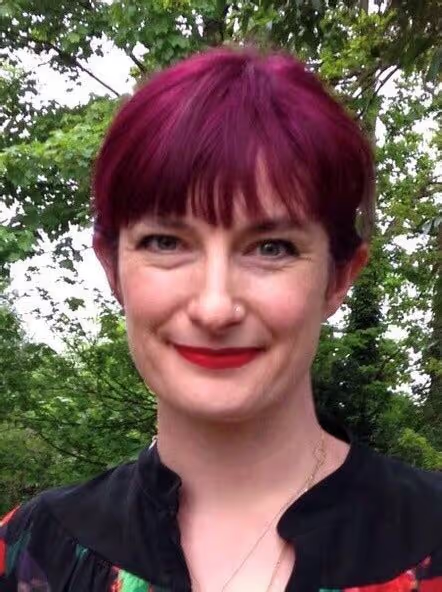
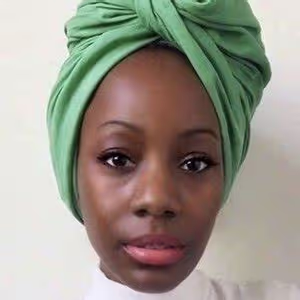
Samata Pattinson
Episode Summary
Q1: Place
If we could do a flypast on any part of the world that is significant to you, which place, city or country would it be and why?
Ghana in Africa
Q2: Life
Give us a glimpse into your life story so far with an emphasis on what you are doing currently?
Born in Cambridge and shaped by diverse cultures and experiences. Samata eventually studied economics, finance and management in London but her main draw and passion was the fashion industry where she was introduced to design and sustainability. After winning a design award Samata became the CEO of Red Carpet Green Dress which is now a global creative community working with brands delivering a 360 approach to sustainability and design solutions.
Q3: Reset
Where on earth is your place or reset or re-charge?
A large body of water
Q4: Wonder
What wonder of the natural world excites you the most?
"There is so much undiscovered biodiversity, we have so much yet to discover which blows my mind."
Q5: Hopefulness
What is your story of hopefulness (not your own) about a person, business or non-profit who are doing amazing things for the world?
Atlas of the Future. I think that so often the conversations we have centres around how bad things are and we aren't having enough conversations about what we're trying to build towards, the positive side. So Atlas of the future have all of these different ways to communicate a different type of future and they use media in a way that is, to me the future of media.
Q6: Insight
As we prepare to re-enter, what insight, wisdom or question would you like to share with us?
Pay attention to the small things. The little, often and steady wins the race and that's just a journey.


Transcript
Speaker 0:
Welcome to the first Wonderspace episode of 2022. My name is Steve Cole and over the past 55 episodes I have been asking the same 6 questions to amazing people from around the world. The questions orbit around wonder and stories of hopefulness and the setting for each journey is a shared window on the space station from where we see everything from a different perspective. Before we introduce our guest our friends at asknature.org are going to help us to rewonder.
Speaker 1:
At each stop as she flits among the coral an octopus Instantly changes color and pattern to disappear into the background. Her skin is covered in little sacks of red, yellow, or brown pigment, hundredths in every square centimeter. Muscles connect to them and by contracting or relaxing, either reveal or hide each tiny burst of color. Lower skin layers have the ability to isolate and reflect other colors from incoming light or to reflect the general quality of light all around. For this soft silent wonder beauty communication and survival are all gloriously skin deep.
Speaker 0:
Our orbit this week will take us over Western Europe and to experience these views with us in this ultimate window seat, we welcome Samatha Pattinson, who is a broadcaster, entrepreneur, award-winning designer and the CEO of Red Carpet Green Dress, which is an organization that brings sustainability to the forefront of conversation and action within the fashion industry. With a panoramic view of earth I start by asking Samata if we could do a flypast on any part of the world that is significant to you which place city or country would it be and why?
Speaker 2:
I think a place that's significant to me is always going to be Ghana. I mean it's where both of my parents were born, my mother in southern Ghana, my father in northern Ghana, and where they met, where they grew up and really where they departed from to travel over to the United Kingdom and kind of you know start their family and build their lives. So Ghana has always been the kind of beginning of my story and you know part of a very culture rich continent of Africa, Ghana to me is home to how I began understanding sustainability. It's something that I experienced from aunts and uncles, how they talked about the things we make and this kind of deference to nature and the unseen power that it possesses and the very tangible power it possesses at the same time across to just knowing that I was part of a culture that was so rich in heritage and symbolism all around me that as a child I always thought looked incredible but as I grew older understood that it held really powerful messages you know like the Odinqua symbols which say everything from proverbs about cherishing value to really respecting the power of nature so Ghana specifically is just a really important place for me to remember who I am remember where I came from and remember that there are lessons that I can always return to that will prepare me for my life wherever I am.
Speaker 0:
Samatha, give us a glimpse into your life story so far, with an emphasis on what you are doing currently.
Speaker 2:
So I would say a quick glimpse into my life story so far. So I'm a British born Ghanian who was born in Cambridge in the United Kingdom, grew up in Cambridge, went to an all girls school with my 2 other sisters and really saw my life in Cambridge as 1 where I blended cultures and experiences. You know, we had the West African community, a really strong-gunning community that always keep an eye on me if I was in town and let my mum know where I was. And then we had this kind of different European Western experience where I kind of saw how my friends interacted with their parents and families or you know just the expression of themselves through fashion like the culture and the the aesthetics of somewhere like Cambridge is so different to that of somewhere like Accra. So it was this kind of very blended pluralistic existence and it was fascinating and I didn't realize then But I'm so lucky to have grown up in some a place like Cambridge because it's obviously known for the university.
Speaker 2:
It's so multicultural, it's so diverse of people and experiences that you are automatically placed in a situation where you know that there's no single story, there's no monolithic view of how things are. You always are aware that well this person has a different experience, this person has a different food, this person has a different language, a different accent and it's as valid as this person who has a different voice, accent, food etc. And I moved to London for my university and I actually started in a degree in radiography, which was not for me. And then I moved over to economics, finance and management, which was also not for me, but I finished that degree. But I knew that when I was in London, I wanted to be immersed in the fashion industry.
Speaker 2:
So I kind of used to hang out like at boutiques and make friends with designers. And that kind of just was a natural journey. And to me, maybe try my own hand at designing and creating things and falling in love with fashion as a space to me, which was always about self-expression and identity and straddling this line of being creative but having a passion about business and kind of how things work and so yeah that's kind of me I bounced about in that for a while. And then, you know, at the end of 2010, beginning of 2011, I was kind of a young designer that entered a design competition just by chance. And that was my introduction to sustainability.
Speaker 2:
So even though I've always existed around sustainability, I just never used the language. Red Carpet Green Dress was a contest I entered. I won the contest and I started on a journey to understand how fashion and sustainability intersect. And that's been 1 of the most exciting kind of work journeys of my entire life. So yeah, now I'm deeply entrenched in that.
Speaker 2:
I'm the CEO of Red Carpet Green Dress, a campaign founded by Susie Amos Cameron and James Cameron, who are just really passionate about communicating sustainability in fresh and unique ways. It was started when Suzy and James Cameron were going to the Oscars and they wanted to have a meaningful conversation about the way that the fashion industry or the apparel industry impacts people and planet. And so the idea was let's challenge a global creative community to design a sustainable piece that Suzy herself would wear. And then when she was walking the carpet, she could talk about that piece and talk about what it meant, how it had impacts on people, how it had impact on planet and that was really really kind of the way that it started but since then it's really evolved to so many other things. We still have our partnership with the annual Academy Awards or the Academy, which we're really proud of.
Speaker 2:
And with that we work with global or independent brands, artisans, designers, delivering these sustainable design solutions. But we also have educational work with young minds or minds that are learning about sustainability. So that means you don't actually have to be young. You could be like a mature student, for example, but it's people who are on the journey to learn about sustainability. So that's really workshops, internships, work experience and things like that.
Speaker 2:
And our global design competition which people will know about as well. And then most recently we started an R&D division which focuses on regenerative materials as well because we felt that there was a missing kind of gap with our work. We're working with brands who are keen to deliver sustainable design solutions, but there's a shortfall when it comes to materials, especially in the luxury space. So we wanted to be part of bringing those solutions to people. So It's quite a nice varied existence.
Speaker 2:
We have lots of different types of projects and they're all really, really exciting. So it's pretty much a 360 approach to sustainability, not just environmental, but definitely social as well.
Speaker 0:
Where on earth is your place of reset or recharge?
Speaker 2:
I would say my place of reset or recharge is always by the water. So that could be an ocean, it could be a lake, it could be a river, but I've always just found that when I'm by kind of a large body of water, I just find it very, very soothing, I find it really relaxing and I also am reminded how small I am, which is actually really comforting. Your life feels like it's the entire world to you sometimes because it's your life. But really, it's like it's just a drop in the ocean. I'm a drop in the ocean.
Speaker 2:
And that humbles me. And it also helps me realize that I have lots of other drops to me. I have lots of other people to have the opportunity to meet. Lots of other people feel the way that I feel. And I think there is something about seeing water moving, especially you know, when I'm in Los Angeles where I am frequently I get the chance to just go and watch like the waves or you know when you go the Pacific Coast Highway there's something really really impressive about like nature just doing its thing like it's not it's not trying to be anything grand, it just is.
Speaker 0:
What wonder of the natural world excites you the most?
Speaker 2:
There is literally no single wonder because what I find as someone who's kind of quite excited by biodiversity and the fact that we literally we know there is so much undiscovered biodiversity right we we literally have so much more to discover that we don't even know is out there yet we don't know how it exists So that to me blows my mind all the time. And again, it's that concept of, gosh, don't you love to be reminded of how little you know? I do, I do, because it gives me hope that, okay, I might learn something tomorrow that will make me feel better, will help me be more of a kind of a benefit or assistance to somebody else right but when it comes to wonders of the natural world I think it's just the way that nature always has a solution for its own problems that don't involve imploding or like devastating entire continents you know It's just that smart biological strategy that nature has. Like you have, you know, the sea creatures that sense electricity or you've got the fish that see in the dark or how fruit flies follow a scent, like it's these things that are just completely to nature, just like non-things to celebrate.
Speaker 2:
But when you study them, they give you solutions for how we can survive. Like if you think about now, you know, you've got things like these kind of pigment molecules in leaves that absorb and transfer solar energy, or you have the really pure distilled water that's inspired by the evaporation process of a surface of a leaf. You've got iguanas that change size based on the available resources. Like nature is incredibly smart and it also is able to work together. Like I remember reading an article about how some wild dogs in the continent of Africa, they're able, they have their own voting system and how they make group decisions about whether they're going to stay or whether they're going to go.
Speaker 2:
And that is, to me, almost the auditorium we should be sitting in a lot more because I think we still think we have all the answers, we still think we're innovating, we still think we're discovering new things and in a way we're Discovering things but just because we've discovered them doesn't mean we brought them into existence. They actually were always there So I apologize that this isn't a succinct answer, but nature to me is 1 of the most incredible Things that we've been privileged enough to be able to be around and I just wish we had a lot more like deference and humility to it.
Speaker 0:
Samata, what is your story of hopefulness that's not your own? About a person, business or nonprofit who are doing amazing things for the world.
Speaker 2:
My story of hopefulness for the future, for the world, is there's an organisation I really love called Atlas of the Future and the reason I love what they're doing is because first of all it's this concept of a global spotlight. I feel very strongly that a lot of the work in the sustainability realm has really centered specific parts of the world more kind of predominantly. It's heavily celebrated the thoughts and actions kind of coming out of these spaces and in a way it's pushed away or subordinated thoughts, concepts, pioneers, people, communities from other parts of the world. So the fact that Atlas of the Future look for you know people from around the world to solve our problems and also just to celebrate what they do. It's really, really important.
Speaker 2:
We can't have a kind of a sustainable future if we've only ever listened to a tiny percentage of the population. It's just who's that sustainable for? And then the bit, you know, where they say, it's the future, right? And I think that so often the conversations we have focus on how bad things are, where we are right now, and we aren't having enough conversations about what we're trying to build towards. And when I say that, I mean the positive side.
Speaker 2:
We know what we're running away from, okay, at this point. We really do. But where are we running towards? So Atlas of the Future have all of these different ways to communicate a different type of future. They use media in a way that is to me the future of media.
Speaker 2:
It's interactive, it's interpreting figures and data in a very visual way. They bring in things like comics, they bring in this idea of a new media, what that looks like, local stories, being able to translate the content into different languages, these things that show a more global view and cultural view of sustainability. And I really, really love that. They've just kind of never failed to inspire. And even when they're kind of presenting something, which is just not great, you know, this is not something we have a great deal of kind of joy when we hear these statistics.
Speaker 2:
It's always solution focused. It's like, this is a problem, how are we going to tackle this? And for me, being someone that really feels deeply about the environment and about people, this approach works for me because it makes me feel hopeful and it also deals with my anxiety about things as well so I think Atlas of the Future are really incredible.
Speaker 0:
Finally as we prepare to re-enter what insight wisdom or question would you like to share with us?
Speaker 2:
The wisdom I would have is listen to the smaller things. I think we're in a space right now where there's a lot of noise, There are lots of different kind of big data, movements, thoughts, concepts, sentiments, etc. Just coming in at all directions towards you. And it can feel overwhelming and sometimes it can kind of cripple you to an inability to act or an inability to do anything. You just think, oh my gosh, this is too much, I'm gonna shut down.
Speaker 2:
And my thing is just really just pay attention to the small things like little and often steady wins the race, you know, and and that's just a journey you're in with yourself by the way. That isn't a race against other people or with other people, it's just your own personal tiny journey to just try and exist as best you can, knowing that there is no perfect, i.e. 1 solution for 1 person is not a solution for another. So I think it's just the kind of celebration of the tour, the small, tiny winds that as they accumulate, a part of your bigger picture. That would be what I would like to share.
Speaker 0:
To find out more about Samatta go to samattahome.com Red carpet green dress can be found at rcgdglobal.com In her story of hopefulness Samatta spoke about Atlas of the Future who in December were forced to postpone their Fixing the Future festival in Barcelona. Samata was 1 of the 50 speakers and we were also going to be there to record an episode of Wonderspace. The good news is that the event has been rearranged for September 16th and 17th and You can find out more at fixingthefuture.atlasofthefuture.org To engage with the previous 55 Wonderspace episodes go to our website ourwonder.space I want to thank Samatha for joining us on Wonderspace and I hope you