Episode #
149
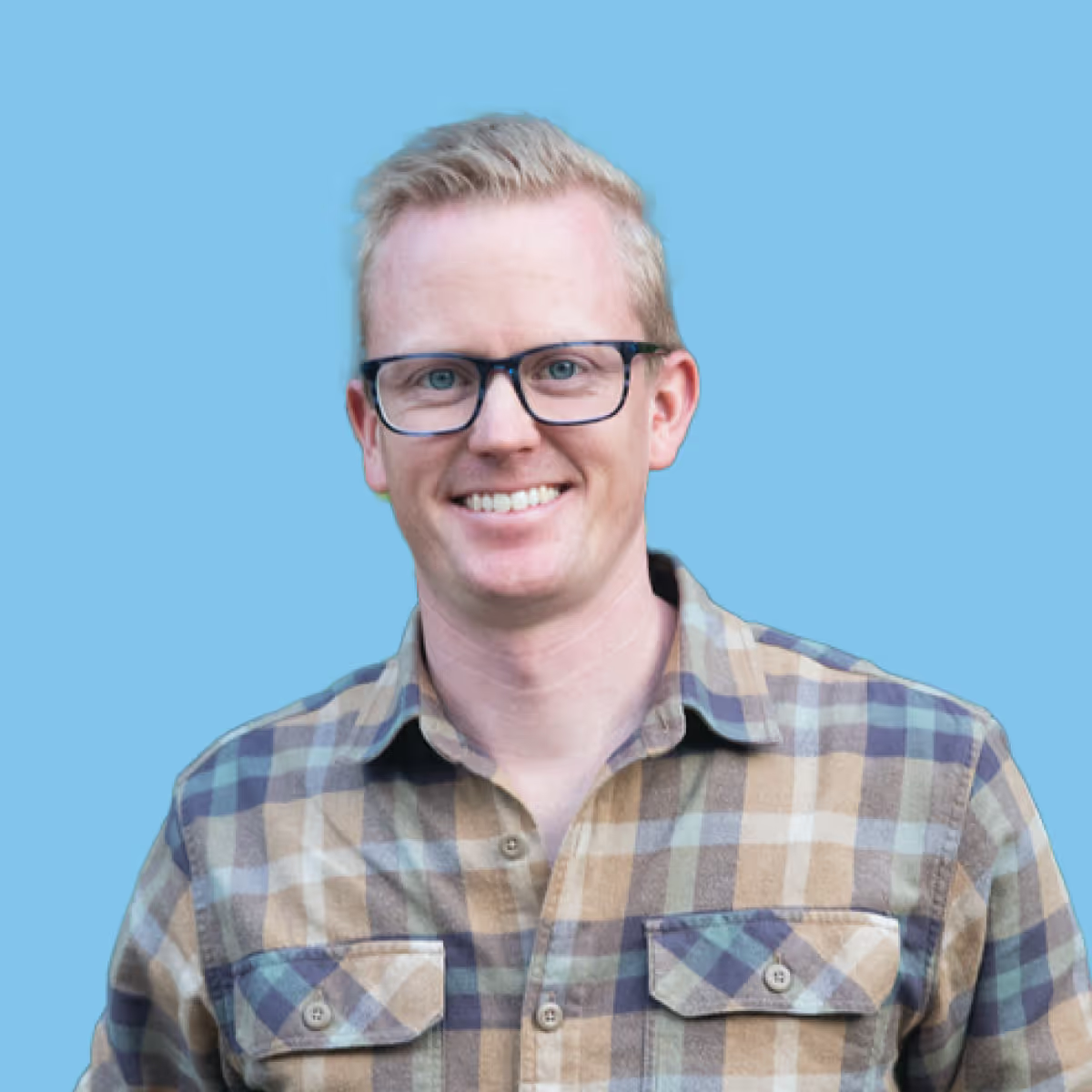
Kaj Lofgren
Episode Summary
Q1: Place
If we could do a flypast on any part of the world that is significant to you, which place, city or country would it be and why?
Q3: Reset
Where on earth is your place or reset or re-charge?
Q4: Wonder
What wonder of the natural world excites you the most?
Q5: Hopefulness
What is your story of hopefulness (not your own) about a person, business or non-profit who are doing amazing things for the world?
Q6: Insight
As we prepare to re-enter, what insight, wisdom or question would you like to share with us?


Transcript
Kaj:
We spent a lot of time thinking about, well, how do you start to activate people in pursuit of an ambitious goal? And what we landed on was that Melbourne needed a series of earthshots for wildly ambitious projects that could raise the ambition so that it is commensurate with the risks that we face as a city. So that we stop doing just what's possible and start thinking about what could be done if systems were to change around us.
Intro:
Orbiting two fifty miles above, the space station provides us with the ultimate view of planet Earth. From this perspective, we ask our guests to engage with six questions that orbit around wonder and stories of hopefulness. For the next few minutes, this is our wonder space.
Steve (host):
Welcome to the one hundred and forty ninth episode of the Wonder Space Podcast. My name is Steve Cole. And over the past four and a half years, I have asked the same six questions to inspiring people from around the world. Questions that orbit around wonder and stories of hopefulness. Before I introduce our guest this week, here is another one minute wonder from our friends at Ask Nature, who are part of the Biomimicry Institute. Andrew from
Ask Nature:
As a bee approaches a flower to drink up sugary nectar and collect protein rich pollen, unseen forces are also at work. As the bee gets closer, pollen seems to leap enthusiastically through the air to catch a ride. What's going on? When a bee flies through the air, it generates a positive electrostatic charge. This charge arises due to the friction between the bee and positively charged particles in the atmosphere. Andrew from Ask Nature: Flowers, on the other hand, function as part of the Earth's surface and typically hold a slight negative charge. Before the bee even lands, the electric attraction pulls the pollen and electrons through the air, landing on and sticking to the bee, and weakening the flower's negative charge. The next bee that comes by can detect difference from a distance by sensing a weaker fluttering of its hairs or antennae. This helps the bees to identify which flowers are more likely to still have pollen and nectar, optimizing their foraging efforts. This strategy is a remarkable example of energy efficiency and resource optimization in nature. Andrew from
Ask Nature:
It requires no external energy inputs and relies on the inherent physical properties of the organisms involved.
Steve (host):
For this Wonderspace episode, we orbit over Melbourne, Australia, which is the home to our guest, Kai Lofgren. Kai is the CEO of Regen Melbourne, an alliance of more than 200 organizations that exist to drive ambitious, systemic, and collaborative projects towards a regenerative future. He is also the director of labs at Small Giants Academy, where he co created the Mastery of Business and Empathy, and Impact Safari. Kai was nominated by our one hundred and sixteenth guest, Ollie Pelling, from the Good and Proper Creative Agency, also in Melbourne. I hope you enjoy this orbit with myself and Kai.
Steve (host):
Kai, it is great to have you onboard a Wonderspace Orbit today. Back in June 2021, I asked our six questions to superstar Tamsin Jones before she selfishly left us here in The UK to work for Small Giants in Melbourne. And, Tamsin then raved about this guy, Ollie Pelling, from the Good and Proper Creative Agency in Melbourne, who I ended up meeting in London, actually, and he completed a a WonderSpace Orbit in June 23. So then two years on, Ollie nominated you, Kai, as someone who massively inspires him. So what started with Tamzin four years ago brings us to this moment, which I'm excited about.
Steve (host):
So thanks for being here.
Kaj:
So good to be here. Thanks for having me.
Steve (host):
Brilliant. So, Kai, first question, we're gonna dive straight in from this imaginary window seat on the Space Station 250 miles above Earth. Our first question is if we could do a fly past over any part of the world that is significant to you, which place, city, or country would you choose and why?
Kaj:
It's a it's a magnificent question. It gives me gives me goosebumps actually thinking about this. And there were a number of places that were kind of obvious like top five. And so I took a little while to just work through exactly where it would land. But for me, I'm from Melbourne, the wonderful city of Melbourne.
Kaj:
And so my choice would be a place in the Inner West Of Melbourne in a place called Newport which is only sort of twenty minutes on the train to the CBD. But in Newport there is a little place called the Newport Lakes. And the Newport Lakes has an extraordinary community story where up until the 1970s it was a stone quarry. And in the 1970s there was a decision to close the quarry and work out what to do with that land next. Through an incredible community campaign that was fought over twenty, twenty five years, the land was effectively handed over to the community and converted into I think what is probably Melbourne's best example of urban regeneration.
Kaj:
To the point now where the Newport Lakes is a small site sunken into the landscape by virtue of the fact that it was a quarry that has two beautiful lakes, extraordinary native plantings and is now a little oasis in the middle of a very busy part of the city. And for me, I lived in very close to there for about ten years in Melbourne. And that was where my two kids spent a lot of time in their very, very early years. It's where my wife did laps while heavily pregnant walking around these little lakes. So it has a of personal significance to me.
Kaj:
But ultimately I think we just need lots of these stories. How did urban landscapes cope with the crises that we face in ways that are creative, constructive, building new landscapes that can help us navigate what's to come.
Steve (host):
Yeah, brilliant. So where in Melbourne are you now?
Kaj:
So I spend a lot of time just outside of sort of more on the South Eastern Side Of Melbourne. I live down at the beach which is a great privilege. So I get to spend bursts of energy in the hustle and bustle of the CBD and the big city of Melbourne. I get to come and breathe a little bit in nature.
Steve (host):
Brilliant, great start. Our second question is the only question that focuses in on you and your own story. So give us a glimpse into your life story so far with an emphasis on what you're doing currently.
Kaj:
Yes. I mean, I was born to activist parents, and I had a wonderful social justice upbringing. I have fond memories as a kid of being taken out of primary school to protest the Grand Prix being dropped in the middle of Melbourne and the felling of felling of lots of trees. Then I I went and studied engineering and history. So I had a sort of split personality at university and and reconciled my social justice upbringing, my interest in history and my engineering by working at Engineers Without Borders for a number of years when that was getting started in Australia.
Kaj:
So really thinking about how engineering really needs a humanitarian heartbeat in the current economic landscape. So that was my formative experience at the start of my career. And then I spent about ten years with small giants in social finance, impact investing, thinking about how portfolios of work can be effective. And then we hit the black summer in Melbourne. So we hit this, or in Australia I should say, these epic fires up and down the East Coast at the 2019.
Kaj:
And very quickly after that where we were still reeling as a country, we of course went into the COVID lockdowns which in Melbourne were especially long. We had these basically all of 2020 in lockdown. And it was in that heightened pressurized environment that the very early seeds of Regen Melbourne formed which is the organization that I now run. And it was really formed out of this idea that with these significant disruptions there was an opportunity to think about a new long term vision for the city. And so we conducted a big six month research project about what our vision for regenerative place would be.
Kaj:
Out of that we produced a vision. We used the Doughnut Economics model to downscale that macro model for the world to Melbourne. And then we produced a roadmap. And since then we've been working diligently and patiently building a wide network of actors who exist to serve the city. And we describe ourselves now as an engine for collaboration and service So in that's I guess a bit of a glimpse.
Kaj:
I kind of got a social justice thing, engineering thing, moving money differently thing. But the bit that I guess brings it all together to some extent is this increasing interest in the idea that single projects don't change systems. So Regent Melbourne really just exists to try and support a place to grapple with that reality. That we need better collaboration, we need more coherence, and we need better systems in order for us all to do the work that we wanna do.
Steve (host):
Brilliant. What you're doing is amazing. In a 150 or so episodes of WonderSpace, I don't think I've ever recommended that people download an organizational annual report. But, mate, I've gotta raise a mug to this piece of work. I think it's an amazing blueprint that I think imaginators in other cities should be looking at.
Kaj:
Thank you. That's very kind.
Steve (host):
It's really beautifully done. But Kai, excite us as to, you know, some of the nitty gritty of what you're talking about. What does a regenerative Melbourne look like?
Kaj:
So we started with this big vision and there was lots of really interesting community visioning going on in 2020 2021, not just in Melbourne but all over the world. There was a moment where everybody felt like because the systems are breaking down around us, there's an opportunity here to think about what could be next. And we were one of those places. So that wasn't particularly unique. I think what was interesting about what happened after that was that we spent a whole bunch of time due to the generosity of a bunch of philanthropists in Melbourne who wanted to see something happen here.
Kaj:
We spent a lot of time thinking about, well, how do you start to activate people in pursuit of an ambitious goal? And what we landed on was that Melbourne needed a series of earthshots for wildly ambitious projects that could raise the ambition so that it is commensurate with the risks that we face as a city. So that we stop doing just what's possible and start thinking about what could be done if systems were to change around us. And so the three big projects that we we landed on, which has all taken a lot of time, working with lots of people to determine what are the projects and how do you frame them and what are the transition pathways within those projects. So it's very complex nitty gritty work and highly relational.
Kaj:
But ultimately, what we've landed on is three big projects. One is making the major waterway in Melbourne, the Birrarung, the Yarra River, is to make that waterway swimmable again. Nice. Which is a huge urban transformation project. On the one hand, it's a exciting, inspiring, joyful project.
Kaj:
And on the other hand, 70% of our water comes out of that river system. And so if that river system isn't thriving and healthy, then the city doesn't thrive and can't be healthy. And so we frame it as an essential infrastructure project as well as an inspiring one. So that's the first one. The second one is around how do we regenerate our food system.
Kaj:
Because Melbourne, like all places, is incredibly not resilient in the way we get at we serve our food in in this city. And so we need to think about how do we ensure that our food is coming from the food bowl upon which Melbourne sits. And also from the regions in and around that food bowl so that we can support the economic development of those places as well. And at the moment, that's just not how our food system works. It's not how it's incentivized.
Kaj:
Our food comes from all sorts of places with lots of transport risks and other risks that are associated with the distributed food system in that way. So food regenerating our food system is a huge one for us too. And then the last one is around our neighborhoods. Because what is a city if it isn't just a woven network of neighborhoods? And so how do we support local scale regeneration to be woven together, almost like a tapestry across the city?
Kaj:
And so we think about river, which is the water system, the food system, and then a street system as the three kind of intervention points that we can take as a as an engine for collaboration. And of course, there could be more. You know, we could be thinking about energy. We could be thinking about health. We could be thinking about other other other levers as well.
Kaj:
But to start with, they're the three ones that we're focusing on. Yeah. Amazing. You know, we act as a convener and an orchestrator within those three projects.
Steve (host):
So good. And for people at the starting line of becoming a regen city, is there anything in hindsight that you would do differently if you could start again?
Kaj:
I think the world has changed since we started. I think there is an increased understanding and appetite for what we describe as systems work. And and maybe the the main the main perhaps simple analogy that I could use is that in any kind of natural environment, say just take a large gum tree that's just outside of my window here. What we see above ground of course is the product of what's happening underground. It's what's happening in the layers under the soil.
Kaj:
And it's how the nutrients are flowing. It's how the mycelium networks connect to it. It's how the trees serve other plants in the system and the plants serve the tree. There's this reciprocity that happens that we don't see. It's all underground.
Kaj:
And that's where the change needs to happen. And so while we are often taken by, inspired by stuff that we can see above ground, the next social enterprise, the next impact investment fund, the next nonprofit campaign, that's all a product of the system and the soil that we sit on. And so I think that's more intuitively understood now than it was even five years ago
Steve (host):
Here we go.
Kaj:
By many actors. And therefore, I think we can be more overt that that's the work that we need to do. We had to take quite a bit of time convincing people and making people understand. So if I was to do it now, I think you could just be much more direct. We are here to work in the soil.
Kaj:
We are here to change the conditions. And we have models and processes and, you know, lots of beautiful illustrations that show people how we do that. But put simply, we work in the soil.
Steve (host):
Yeah. Brilliant. And you've got a key role at Small Giants Academy Action Labs where you lead the incubation and development of new projects and new initiatives. And, I believe you also played a role in helping to start the masters in business and empathy. So with all these things in the mix, tell us about what you see brewing and emerging and crackling right now in these extraordinary spaces that you find yourselves in.
Kaj:
Yeah. So, I mean, as as I said before, I spent ten years at Small Giants and and Small Giants is a an extraordinary pioneering impact investment family office. It was one of the first in Australia. It's one of the only ones that has been 100% all in on impact for a long time. And very proud of all the work that we did and are doing at Small Giants.
Kaj:
We then got to a point where it felt like we needed to do just as much interesting strategic and pioneering work when it comes to how do you move hearts and minds, not just how do you move money. And so Small Giants set up something we call the Small Giants Academy, which is a nonprofit media and education initiative, which looks at how do you create a different type of leadership for a time like this. And so the first program we put out was this mastery of business and empathy, which was, I guess, our response to the brokenness of the NBA. You know, the NBA has served a twentieth century economic model for for a long time. And it did that really well based on what the twentieth century economic model was trying to produce, was growth and profit and growth.
Kaj:
And so that it did it beautifully. But like if we're saying now that that model doesn't serve us anymore, then we need new forms of leadership development. And the mastery of business empathy was our response to that. So I was part of the process of developing that with a bunch of other legends and there's five or six cohorts of people that have been through that program now which is amazing. And so I spent a bit of time still in the academy teaching and supporting the development of your programs as you said.
Kaj:
And maybe the most interesting one that's bubbling up now is the next mastery program. So we're developing something called the Masters or the Mastery of Systems Leadership, which is taking all of these ideas that I was just riffing on around Regen Melbourne And bringing all the global legends who have led this work for a long time, the elders of the field together to try and develop a ten month program that can really walk people through how to shift the mindset towards a systems lens. So I'm really really inspired by that. I think that'll be launching later this year, which is excellent. And then maybe the other one which is a bit left field, which is also being incubated inside the Small Giants Academy is the Gross National Happiness Centre here in Australia.
Kaj:
And so we've had a long relationship with the incredible work that happens in Bhutan. The Kingdom Of Bhutan has had an alternative measurement system around gross national happiness for a long time which is way more sophisticated and mature and nuanced than the word happiness is interpreted in the West. There's an incredible framework of metrics and processes that integrate that model throughout all of Bhutanese society. And so because of our relationship there, we've got an incredible Bhutanese woman, Wessel, who works with the Small Giants Academy team who lives in Victoria and is passionate about Australia. And she's bringing to life this Gross National Happiness Centre in Australia, thinking about how these ideas can be translated into the Australian context.
Kaj:
That's incredibly inspiring.
Steve (host):
So good. With so many layers, responsibilities, possibilities, where Kai is your place of reset and recharge?
Kaj:
So this one was pretty easy. This one was pretty straightforward. So my father was Swedish, and I spent a lot of time in in Southern Sweden growing up and spoke Swedish and was sent there when I was 15 to live with my grandparents for six months and have this sort of very, very fond relationship with Sweden. I studied my masters in economic history in Southern Sweden just feel very much at home. And so for me, the sort of flying on an airplane or a spaceship and flying across the channel between Sweden and Denmark, landing in Copenhagen, taking that beautiful bridge crossing back to Sweden is one of my most warm experiences and I try and do it as often as I can.
Kaj:
And so the specific answer to the question is the village where my grandparents lived when I was when I was young, which is a little village on the Southwest Coast Of Sweden. It's a beautiful, very old fishing village. And, if you could put me there once a week, I'd be a very happy person.
Steve (host):
Brilliant. And Kyiv, what wonder of the natural world excites you the most?
Kaj:
So I mean I mentioned earlier, I'm very lucky to live by the beach. And so for me, the natural wonder that I find the most both thrilling and soothing is quite simply the waves and being able to jump through them. I'm not really a surfer but I body surf quite a lot. But really to be honest if I'm feeling stressed, anxious, buffeted by the chaos of the world, standing there and getting smashed by some waves puts everything in perspective.
Steve (host):
Yeah. Here we go. Brilliant. Kobe, we have two more questions. Our fifth question takes the focus onto someone else and asks, what is your hopeful story that's not your own about a person, business or nonprofit who are doing amazing things for the world?
Steve (host):
So who would you love to give a shout out to today?
Kaj:
So I have two. And you're more than welcome to choose. My first The first person that I find deeply inspiring is a man called Rob Shorter, who is the community's lead at the Donut Economics Action Lab in London. And Rob and I go back a fair way because he has been the sort of central figure in the Donut Economics Action Lab team who works with all of the cities and places who are trying to bring that idea to life in practical, real ways, in all the messy complexity of place. So taking conceptual ideas and models and trying to land them is always really challenging.
Kaj:
And so he does this extraordinary job of weaving those places together, of glenning the learnings from them, of supporting them. And it's always been deeply inspiring to me. There are a whole bunch of inspiring people at the Donut Economics Action Lab, of course, led by Kate Rayworth and Carlotta, who are the co founders. But in particular just for this conversation, thinking about all the people out there who are doing the weaving and the connecting, Rob is an absolute legend. And the second one is the woman I mentioned earlier, Wessel, who is a young Bhutanese woman who lives in Victoria and he's leading this work around Gross National Happiness.
Kaj:
Which is a radical crazy idea in a Western economic context. But the way that she holds herself in a foreign environment bringing all the wisdom that she has into a foreign context with grace, with love, with complexity, with just the right level of challenge is a sight to behold. And so I think Wessel is equally as inspiring.
Steve (host):
So good. Brilliant. This has been such an inspiring orbit. But as we draw our time to a close and prepare to reenter the Earth's atmosphere, what insight, wisdom, or question would you like to leave with us?
Kaj:
We are living in moment particularly where it feels like we are constantly getting punched in the face and there is a kind of almost predictable nature to the shocks that we are seeing coming again and again and again. And every week there is another thing. As we are talking a cyclone is coming further south in Australia than it has in fifty years. And the big city of Brisbane and surrounding areas will be inundated over the next twenty four hours. And so the reality of the chaos is very real and very painful.
Kaj:
And my sense is that there is a need to remain, to do two things simultaneously which I think is really challenging but that's the challenge. One is to remain intimately connected to the reality of that pain right now and not allow ourselves to be numbed by that. The human impact is severe, it's real and it's hurting people. So that's true. We to do that, we can't be numb.
Kaj:
And we also have to find ways to zoom out. Those of us who are doing the privileged work of thinking about change, which is an ultimate privilege at a time like this, have to be able to zoom out to a longer time scale. Because anybody who's done any thinking around economic history or economic transition knows that these things happen over decades not over days. And so the work that we're doing now isn't gonna result in change tomorrow or next week or the week after that. It's building patterns and constellations which might create the right conditions for change in twenty and thirty and forty and fifty years.
Kaj:
And we have to be able to stay at that altitude as well. And I don't know how I don't have any wisdom on how we do that. But when I find myself disheartened by the realities of the world and how hard it is to create change, I try and zoom back out again. We're doing this work for our kids and for our grandkids and for their kids. And if we're lucky, we'll play some small role in nurturing what is a massive period of change towards something slightly better.
Steve (host):
Yeah, brilliant. I had a coffee with a Japanese artist last week who asked me what my five hundred year vision was. And he said, you know, Steve, when I think about all the artists that have influenced me the most, they all lived five hundred years ago. You know? And again, just that perspective, so vital and important.
Kaj:
Wonderful philosopher, Robin Krasnarek, who you would know has written some wonderful work on being a good ancestor. And a lot of that we see is very resonant. And again, I think we it's not just a nice philosophy, it's also actually how economic transformation happens. So it's not just a it's sort of ease thinking about the relationships that can be built, the ideas that can be developed that will be lying around for the right moment.
Steve (host):
Yeah. So good. Thanks, Kai, for engaging with our six questions in such a brilliant way. Is there anything else that you would like to say before we end our time?
Kaj:
No. This has been great, Steve. Thanks so much for the opportunity. And, yeah. Here's to zooming out.
Steve (host):
Here we go. Thanks, Kai, for all you do and for the way that you do it. Absolutely brilliant. Thank you.
Kaj:
Cheers, mate. Bye.
Steve (host):
I hope you enjoyed this orbit with Kai. The transcript, together with all the organizational links, can be found on Kai's episode page at ourwonder.space. Finally, I would love to draw your attention to a new network and storytelling platform that we have launched to enable everyone to engage with our fifth question on Wonderspace. A networking platform called Someone Else that connects us through the way that we share hopeful stories about others. Go to someoneelse.space, create a simple profile, and upload your hopeful story.
Steve (host):
Thanks again to Kai, and thanks to you for listening.