Episode #
101
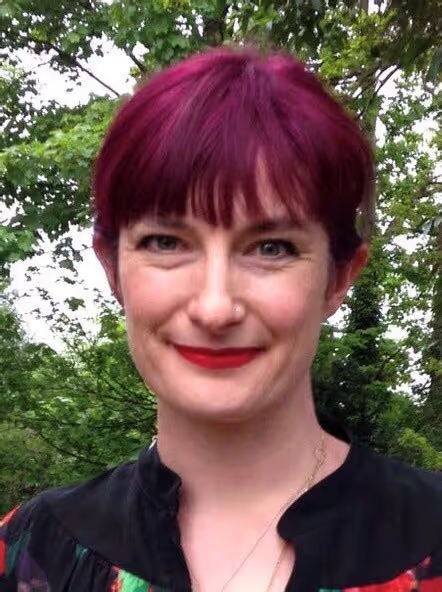
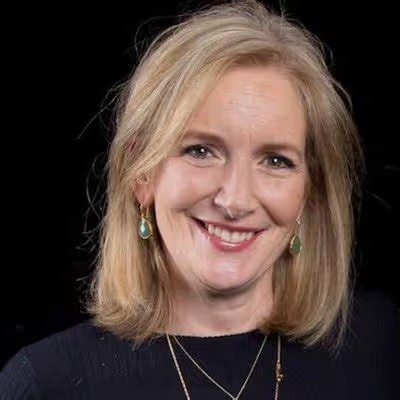
Jennifer Nadel
Episode Summary
Q1: Place
If we could do a flypast on any part of the world that is significant to you, which place, city or country would it be and why?
When I'm connected to my innermost self, my geographical location matters far less.
Q2: Life
Give us a glimpse into your life story so far with an emphasis on what you are doing currently?
So compassion is the space that I'm working in and it was quite a journey to get to this space because I have been a campaigner, activist and a journalist. I've run for parliament a couple of times and I've been a lawyer and in all of those worlds, I was in a very binary world of right or wrong, and developed quite an addiction to being right, to thinking what I knew the right thing was. My belief is that we shouldn't other and part of the problem with many government policies in my view is that we other those that we should be including. I've campaigned in lots of different areas, refugees, homelessness, climate and all of them have the same underlying cause, which is the absence of compassion. They're all symptoms of the same thing. And so, I took a step back and asked, what is the thing I could do that would really make a difference? There was such a hunger, for value for things that people could believe in and now through Compassion in Politics, we've got active engagement from over 100 MPs and we've got groups springing up across the world, all of whom want to prioritise compassion.
Q3: Reset
Where on earth is your place or reset or re-charge?
An island called Mount desert island in Acadia National Park in Maine
Q4: Wonder
What wonder of the natural world excites you the most?
When you look under the water and and see what's there, you realise how little you know and also just how creative the universe is. The shocking colours that when you see them on a palette, in a shop or in an art gallery, you think those are so fake those colours but you realise they all exist in nature.
Q5: Hopefulness
What is your story of hopefulness (not your own) about a person, business or non-profit who are doing amazing things for the world?
My aunt Elsa who just died at 102 who had escaped the Holocaust and was the most loving, positive person I've ever met in my life. I would ask, how can you be so positive? she said, 'Because of Love, I've lived my life, full of love and there's nothing that makes you happier'. The other person is Rev Paul Nicholson who devoted himself to the service of the poorest of the poor. And it was him who started the movement for a living wage. The only thing he cared about was compassion.
Q6: Insight
As we prepare to re-enter, what insight, wisdom or question would you like to share with us?
There's so many wounds and scars and wrongs and disappointments that happen during life. If we can be in a place of unconditional love and look at those that do wrong or hurt us as hurting humans, who were also doing the best they can, then we feel part of something which is extraordinary and we can transcend to some extent the woundedness of what it is to be human. That's a lifetime's journey.

Transcript
Intro:
Orbiting 250 miles above, the space station provides us with the ultimate view of planet Earth. From this perspective, we ask our guests to engage with six questions that orbit around wonder and stories of hopefulness. For the next few minutes, this is our wonder space.
Steve:
Welcome to the one hundred and first episode of the WonderSpace podcast, which is an expression of a family trust called Panapur. My name is Steve Cole. And since September 2020, I have asked the same six questions to over 100 people from around the world. People like Kanini Mutuni from the DRK Foundation in Kenya, who in episode 22 talked about the amazing work of the People's Pension Trust in Ghana, who are providing a solution for informal workers who do not have a fixed wage or a pension. We are thrilled once again to be drawing from the wonder of Ask Nature, who look to nature for inspiration to solve design problems in a regenerative way.
Steve:
Here is another moment to help us re wonder.
Ask Nature:
Members of the Disco Soma genus of corals may not look like much from their pancake like shape, but when they take the spotlight, their colors dazzle. Around their mouths are spots that glow in various vibrant colors, depending on the species, after being exposed to light. Behind this ability are extremely long molecules known as fluorescent proteins that are folded into a tangle like a plate of spaghetti with two tube like sections called beta barrels, sitting on top. Inside each of the beta barrels is a special stretch of protein called a chromophore that's able to absorb photons from light and use that energy to produce a pulse of slightly lower wavelength light. Ultraviolet light, for example, may cause it to fluoresce green.
Ask Nature:
The beta barrels act like hurricane lamps that protect candles from the wind, only they're preventing other molecules from absorbing the energy before the chromophore can fluoresce. In this way, these molecular barrels ensure that the chromophores always have time to shine.
Steve:
This week on Wonderspace, we orbit with Jennifer Nadal, who is a qualified barrister, author, activist, and award winning television journalist. Jennifer also founded Compassion in Politics, which has inspired active engagement from over 100 MPs, and interest from other parliaments and businesses who want to prioritize compassion. With this expansive overview of Earth, I start by asking Jennifer, if we could do a fly past over any part of the world that is significant to you, which place, city or country would it be and why?
Jennifer:
I spent a lot of my life wanting to be somewhere else, thinking that there is this place where I am gonna feel completely at home. I've always felt like an outsider, like I don't really belong. And so I've always had this fantasy that if I was there, everything would be better. As I've got older, I've realized that I just have to be where I am, that there isn't a place outside myself, that it's a place within myself that I need to be. And when I'm connected to my innermost self, my geographical location matters far less.
Jennifer:
I mean, love mountains, I love sea. I think we live on an extraordinary planet. But for me, I have to plant myself where I am and try and blossom where I'm planted.
Steve:
Jennifer, give us a glimpse into your life story so far with an emphasis on what you're doing currently.
Jennifer:
Well, right now I'm the co director of Compassion in Politics and also the chair of the Global Compassion Coalition. So compassion is the space that I'm working in. And it was quite a journey to get to this space because I have been a campaigner, an activist, a journalist. I've run for parliament a couple of times and I've been a lawyer. And in all of those worlds, I was in a very binary world of right or wrong.
Jennifer:
And I developed quite an addiction to being right, thinking what I knew the right thing was. And really it was post Brexit looking at our world at the divisions that I really began to see how my own attachment to Reitner's could build its own walls. Obviously, America had a president that was trying to build a concrete wall. And I think many of those who have similar beliefs to me are capable of building our own internal walls which creates division, which creates rightness. And the more we tell ourselves how right we are, the more wrong the other person becomes and the greater the chasm between us.
Jennifer:
And we lose our humanity and it then becomes a tug of war between two different ideologies or two different groups. So although my belief is that we shouldn't other and part of the problem with many government policies in my view is that we other those that we should be including. I myself was practicing othering. And the other thing was just, I've campaigned in lots of different areas, refugees, homelessness, climate, and all of them have the same underlying cause, which is the absence of compassion. They're all symptoms of the same thing.
Jennifer:
And so I really took a step back and thought, what is the thing I could do that would really make a difference? And I felt that if we could put compassion back in the political space, if we could have it once again seen as a legitimate political driver, if we could amplify those who are calling for compassionate outcomes, then that in turn would fertilize the soil in which so many other social justice campaigns with fantastic goals and aims are trying to grow. So we've been amazed by the response that we've had. To begin with, there was a bit of cynicism and a bit of compassion in politics. Well, there's an oxymoron.
Jennifer:
But actually what we found once people had got over themselves was that there was such a hunger for value, for things that people could believe in. And we've now got active engagement from over 100 MPs and we've got groups bringing up across the world, all of whom want to prioritize compassion. And I was just recently in Spain speaking to a regional parliament where they want to make themselves a compassionate parliament. So there is so much we can be doing and I'm incredibly excited about what's possible because we need values. We need values.
Jennifer:
We need to have our moral compass back. And I really believe that compassion is the magnetic north by which we can set our compasses.
Steve:
Where on earth is your place of reset or recharge?
Jennifer:
I was born in The United States and I moved to The UK when I was two. So I've always had this hunger for the place that I returned to in The United States which is on a granite island in Maine pine trees. It's what I think heaven might smell like, you know, the scent of pine trees and blueberries and huge mountains that really dwarf me as a human and put everything into perspective. It's so easy. I live in the center of a city and it's so easy to be so preoccupied by the human condition and human relationships, all of which do matter hugely.
Jennifer:
But when I step into what I call God's country, all of that slips away and I find it much easier just to be and to realize that I'm just part of a long chain of beings and not that important.
Steve:
What wonder of the natural world excites you the most?
Jennifer:
I think the ocean, the limitless ocean. I love the pattern of the waves. I feel it calling to me whenever I'm nearby. You know, I've had the opportunity a couple of times to snorkel and I've just been blown away by the extraordinary colors and shapes and beings that exist. We think in our human centric lives that we know so much and yet when you look under the water and see what's there, you realize how little you know and also just how creative the universe is.
Jennifer:
The shocking colors that when you see them on a palette in a shop or in an art gallery, you think those are so fake those colors but you realize they all exist in nature and that we are part of nature, not separate from it.
Steve:
Jennifer, what is your story of hopefulness that's not your own about a person, business or nonprofit who are doing amazing things for the world?
Jennifer:
Oh, I've got two actually. I've got one personal one, which is my aunt Ilse who just died at 102 and she had escaped the Holocaust and she was the most loving, positive person I have ever met in my life. She fled from Austria as a teenager, came to The UK, knew no one except that she was in love with someone she'd met in the Austrian opera called Henry and she knew that he had fled to Paris. So in the middle of the night, she ran away from her home in The UK, barely speaking English, barely speaking French and in the middle of war made her way to Paris where she found her Henry. And then she eventually got papers to go to America and she refused to go to America because Henry couldn't have gone with her.
Jennifer:
So she stayed in occupied France as a Jewish girl to be near her love and she ended up having a huge extended family and being the most positive person. Whenever I would say to her, Ilse, those terrible things that you witnessed that you lived through, that you escaped, how can you be so positive? And she said, because of love, I've lived my life full of love and there's nothing that makes you happier. So she's one. The other is a man called the Reverend Paul Nicholson.
Jennifer:
He began life as a wine merchant and then became a priest. In fact, he featured as the vicar of Dibley. And he then moved to Tottenham where he devoted himself to service of the poorest of the poor. And it was him who started the movement for a living wage. He did a research on the minimum wage and realized that it wasn't enough to live on.
Jennifer:
He commissioned research on benefits that they weren't enough to live on. And so he started this extraordinary campaign which so many of us know about now, which was the living wage movement and in fact persuaded Ken Livingston to do it, to take it up. He went to court and represented people who were going to be imprisoned because they hadn't paid their television license. He refused to pay his poll tax during the poll tax riots because he wanted to experience what those who weren't paying the poll tax were also experiencing. And he died last year at the age of 87 and I spoke to him the week before he died and he was heading to Downing Street and he was gonna beg sitting outside Downing Street to really experience what it was to have nothing and to sit on a pavement ignored by those who passed by.
Jennifer:
And I said to him, I'll come and sit with you. I was quite worried about him. You know, he's a very elderly man who'd been in hospital a lot of late and he was gonna sit in in the freezing weather outside Downing Street and he said, no, I have to go alone. I have to go alone because otherwise I won't experience what those I'm fighting for experience. And he lived an incredibly humble life in one room in Tottenham and the only thing he cared about was compassion.
Jennifer:
And he ran a brilliant organization called Taxpayers Against Poverty which is what it says on the tin and set up the Zacchaeus Foundation which works with homeless people and also fights for the rights of benefit claimants. And he's my hero really.
Steve:
Finally, as we prepare to re enter the earth's atmosphere, what insight, wisdom or question would you like to leave with us?
Jennifer:
I think that really the only place to be and I certainly can't be there most of the time is a place of unconditional love that so many things hurt us. There's so many wounds and scars and wrongs and disappointments that happen during life. And if we can just be in a place of unconditional love and look at those that do wrong or hurt us as hurting humans who are also doing the best they can, then we feel part of something which is extraordinary and we can transcend to some extent the woundedness of what it is to be human. So that's a lifetime's journey but I constantly try to shift into that and hate is so much easier. It's like you get an immediate high from feeling outraged or from attacking someone else.
Jennifer:
You feel so good because every time you tell the story of how bad they are, you feel a little bit better yourself. But it's an addictive process. It's just like eating sugar. You get this high and then you crash afterwards because I think we're made to love and I think that life's experiences divorce us from our capacity to love. And the more we can clear away the scar tissue and reconnect with our capacity for unconditional love, the better the world will be and the easier each of us on our journey as a human being will find it.
Steve:
You can find out more at jennifarnadahl.com and compassioninpolitics.com. What is your story of hopefulness that's not your own? About a person, business, or nonprofit who are doing amazing things for the world? We would love you to consider recording yourself in under thirty seconds, sharing your story on your phone through your video or the voice memo or recorder app. You can then simply upload the recording to the link on our website, ourwonder.space, and we will look to include them in future episodes.
Steve:
I want to thank Jennifer for joining us on Wonderspace. Let's continue to share our stories of hopefulness that makes a name for someone else. We need them like never before. Thanks for listening.