Episode #
6
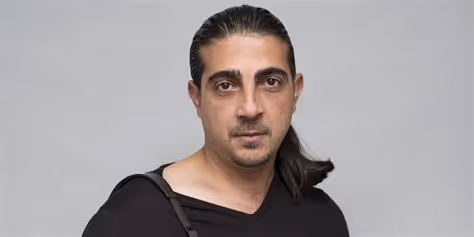
Muhammed Muheisen
Episode Summary
Q1: Place
If we could do a flypast on any part of the world that is significant to you, which place, city or country would it be and why?
Pakistan
Q2: Life
Give us a glimpse into your life story so far with an emphasis on what you are doing currently?
Jerusalem, photography, Israel Palestine conflict, AP, National Geographic, untold stories, refugee crisis
Q3: Reset
Where on earth is your place or reset or re-charge?
Amsterdam
Q4: Wonder
What wonder of the natural world excites you the most?
Petra in Jordan
Q5: Hopefulness
What is your story of hopefulness (not your own) about a person, business or non-profit who are doing amazing things for the world?
Everyday Refugee Foundation
Q6: Insight
As we prepare to re-enter, what insight, wisdom or question would you like to share with us?
Be the first to make the first move

Transcript
Steve:
Welcome to the sixth edition of Wonderspace which was originally released as a video orbit on September the 28th 2020. Since then we've been asking the same 6 questions to people from around the world. Our questions revolve around life and wonder, places of reset and stories of hopefulness, which I think we need more than ever. The setting for all of our interviews is a virtual window seat on the space station from where we see everything from a different perspective. This week our night time orbit takes us from the Iberian Peninsula to the Red Sea and joining us in this ultimate window seat we welcome Mohammed Maheisen.
Steve:
Mohammed is a world-renowned photographer who has documented major events around the world since 2001. He is a National Geographic photographer, a two-time Pulitzer Prize winner, and founder and chairman of the Dutch non-profit Everyday Refugees. I start by asking Mohammed, from this window seat 250 miles above Earth, which place, city or country would you want us to fly over and why?
Muhammed:
A place that I would love to go back to or fly above is significant to me actually would be Pakistan to be more particular Islamabad. It's a country that I spent 4 years and a half in, you know Documenting stories in and when I left I felt I didn't give enough justice to the story and to the people there. Before going to Pakistan, I was a little bit nervous. I had this image of this place that I judged from the cover, but the moment I got into the country, I was amazed from the people, the hospitality, the kindness, how I was embraced by the people, I was treated very kindly, and also I found a lot of untold stories that the world needs to know, needs to hear about it. And this is where actually I believe I became a better photographer.
Muhammed:
After 10 years of being professional photographer, I thought I'm in a level where I'm a fine photographer, but the moment I arrived to Pakistan, I learned everything again. So this country has a special spot in my heart. The only thing you hear about Pakistan is tension, violence, stereotype. And I had this, the same image in my head, but the moment I went in, everything changed. That's where I learned never to judge from the cover always give anything a chance to know it better
Steve:
Mohammed give us a glimpse into your life story so far with an emphasis on what you're doing currently.
Muhammed:
My life story, or I call it my journey, actually began when I was a very young boy. I was around 9 years old and I met my grandmother as Polaroid. This magical box that when you press a button, a piece of paper comes out and we keep with us our whole life became my hobby, my passion. I fell in love with photography. I was born and raised in Jerusalem amid the Israeli-Palestinian conflicts.
Muhammed:
So news was everything surrounding me. I decided to study journalism to combine my passion with my education and be a better storyteller. I started traveling the world. I went from conflict to another, from war to another. And in the middle of that journey, I realized this is not exactly what I want to do.
Muhammed:
I want to make a difference. So I started to focus on people. I started to focus on the voiceless 1, the untold stories, and I wanted to share it with the world. And nowadays, in 2020, I managed through photography to make a foundation that makes a difference, that helps refugees, local communities, in turn, displaced people in different part of the world. I'm a National Geographic Photographer, and I'm proudly the chairman and the founder of Everyday Refugees Foundation, where simply through passion, through photography, we managed to make a difference.
Muhammed:
I mean, I began as a young boy who wanted to do art photography. I fell in love with nature, with colors, with the surroundings, but the environment shaped my path, put me on the road to cover conflicts photography, which was important to document to share with the world what's happening around him. But also I realized in the middle of this journey that there is a lot to be done by using this passion in a way to make a difference. Big or small, at least we start somewhere.
Steve:
Where on earth is your place of reset or recharge?
Muhammed:
It's usually a very classic answer where my heart is which is Amsterdam. I love this city. It's a place where I get recharged whenever I cover a story or I travel around the world, I come back to cycle around the canals, to walk with my camera, to show the beauty of our world through pictures. At the end of the day, we are all humans, you know? So whatever we meet through this journey, we have to put it out in a different way.
Muhammed:
And for me, it's through capturing pictures. But this is a different kind of picture, pictures of hope, a picture of beauty that reminds us how beautiful our planet is. And Amsterdam is 1 of those cities that I always land back to just to feel relaxed. You know, it's a therapy for me cycling and walking around the water.
Steve:
What wonder of the natural world excites you the most?
Muhammed:
There is a place that I always end back to. It's the ancient city of Petra in Jordan. This historical, mystical city that I've visited actually many times and every time that I step in, I see something new. It's just a reminder, we are very small in these historical places. History lies above and beneath this place, the energy of this place, the feelings you get when you walk in.
Muhammed:
It's like civilization where there are tens of thousands years ago and it's and we're in 2020 we hardly can compete with so the ancient city of Petra in Jordan is a wonder by itself and It's a place of motivation for me. Whatever I walk in. I believe that there is nothing impossible
Steve:
What is your story of hopefulness that's not your own about a person business or nonprofit who are doing amazing things for the world?
Muhammed:
We all can make a difference so simply in 2015 you know I was covering the refugee crisis in Europe and I started to receive a lot of messages from people in different parts of the world, how we can help. And there was only 1 way for me is to create a foundation. And This foundation right now is run by a passionate, talented people from different parts of the world who believe in making a difference is the best way to create a change. So to be honest with you, Everyday Refugees Foundation right now, it's a humble home where people who want to make a difference land in and we manage to create, to ease the life of thousands of people simply through passion, through photography, through visuals, through paintings, through art. So it's just a hope that anybody who can follow their hearts and use their passion in a good way, a difference can be made.
Steve:
Finally, Muhammad, as we prepare to re-enter, What insight, wisdom or question would you like to share with us?
Muhammed:
There is no better way to make a difference than believing in yourself as a person who can make a difference. I always say if we put hand in hand together we're stronger and if we always wait the others to make the difference, a difference will never be made. Start with yourself, think with others, Be the 1 who makes the first move. Follow your heart and work hard. And this is where you can reach the point where everything is possible.
Steve:
To find out more about the work of Mohammed and to see some of his award-winning photography, go to mohammedmahison.com and everydayrefugees.org Some of his work can also be seen at the end of the Wonderspace video orbit which you can find at ourwonder.space together with all the previous episodes. I want to thank Mohammed for joining us on Wonderspace and I hope you can Join us again next week for more wonders and stories of hopefulness.