Episode #
3
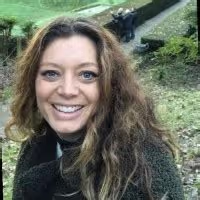
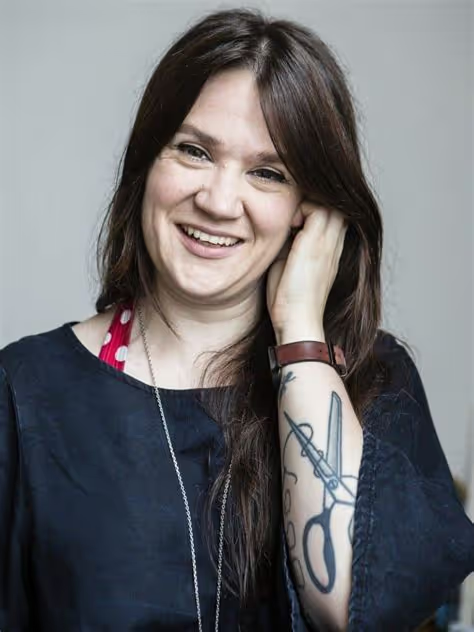
Sarah Corbett
Episode Summary
Q1: Place
If we could do a flypast on any part of the world that is significant to you, which place, city or country would it be and why?
London
Q2: Life
Give us a glimpse into your life story so far with an emphasis on what you are doing currently?
Liverpool, introvert who loves creating, a gap in activism, formed a global collective using craft as a tool for kind, beautiful and gentle protest.
Q3: Reset
Where on earth is your place or reset or re-charge?
The Shetland Isles in Scotland
Q4: Wonder
What wonder of the natural world excites you the most?
The Human Brain
Q5: Hopefulness
What is your story of hopefulness (not your own) about a person, business or non-profit who are doing amazing things for the world?
A million realities fellowship
Q6: Insight
As we prepare to re-enter, what insight, wisdom or question would you like to share with us?
People will never forget how you made them feel

Transcript
Steve:
Welcome to the third edition of Wonderspace which was originally released as a video orbit on September the 14th 2020. Since then we've been asking the same 6 questions to people from around the world. Our questions revolve around life and wonder, places of reset and stories of hopefulness, which I think we need more than ever. The setting for all of our interviews is a virtual window seat on the space station from where we see everything from a different perspective. This week our night time orbit takes us over Europe and northern Africa and joining us in this ultimate window seat we welcome Sarah Corbett who is a writer, broadcaster and the founder of the Craft Visc collective, a global movement of activists who use craft as a slow and gentle form of protest.
Steve:
I start by asking Sarah, from this window seat 250 miles above earth, which place, city or country would you want us to fly over and why?
Sarah:
So the city that's significant to me is London, which I've lived in for 12 years. And I just find it fascinating because it's so densely populated, so diverse in the people, in the different areas, really creative, which I love. It definitely, like, helps me be more creative. But there's also extreme inequality that you can visibly see. I just feel like it's a, it is this melting pot of so much going on that I find fascinating from this view and motivates me, I think, in all of what I do really.
Sarah:
The good and the bad fuels me. So I find London fascinating.
Steve:
Sarah, give us a glimpse into your life story so far with an emphasis on what you are doing currently.
Sarah:
My life story so far has been a surprising 1. Growing up in West Everton, which is a low-income area of Liverpool, with my dad as a vicar and my mom as a local politician, we grew up seeing that activism could work, but also where it doesn't work. And I, yeah, have been an activist since I was 3 and very much believe in activism and then ended up working in the charity sector as an activist manager, as well as doing it in my free time with different groups. And as an introvert and someone that loves creating things, I thought there was a real gap in activism, in the Activism Toolkit, where I do believe that if we want to make our world a more beautiful, kind and just place, then our activism can absolutely be more beautiful, kind and just, and we're not really using those incredible colors and senses and smells and all of the stuff I learned from neuroscience about how to connect people with social change, how people change their minds, how we change laws. I felt like there was a gap in activism where craft could be an incredible tool to use the process, to think more deeply and critically and mindfully, use the objects as gifts for power holders to be critical friends rather than aggressive enemies with them, and also use the small objects we do as street art or as provocative imagery online to help people think and engage in their own way.
Sarah:
So for me, my life journey has definitely gone in places I never expected to be a full-time craftivist running this global collective where we use craft as a tool for gentle protest which completely fits in with my values of treating people how you want to be treated and trying to do activism in a really beautiful, curious, sensory, hopeful and solution-focused way.
Steve:
Where on earth is your place of reset or recharge?
Sarah:
My physical place of reset is Shetland, which is where my granddad was before he passed away and my grandmother still is and I'm an absolute city girl growing up in an inner city area But when I take that quite long journey to Shetland and stay with my grandmother where there's no internet and no 4G and actually not much phone signal. And It's a place where there's no trees because it's so windy and it's a collection of islands and we're surrounded by wild mackerels. I find it an incredible place to be still, be with hair, look at the views, enjoy laughing at the seals entertaining me and just see how close nature is and how fragile it is but also how powerful it is. The wonder in the natural world that causes my heart to miss a beat is the human brain. The more I read about neuroscience and positive psychology and the power of the senses and non-violent communication and how people change their minds or think differently or engage with the world that we're in with all senses, the more I'm just in absolute awe of our complex brain with all its different neuro pathways and how they can change and how we connect to everything from visuals to smell and sound.
Sarah:
I find it fascinating how as humans we interact with this world and with each other and how that impacts and shapes our brain.
Steve:
Sarah, what is your story of hopefulness that's not your own? About a person, business or non-profit who are doing amazing things for the world.
Sarah:
There's so many stories of hopefulness of different people and organizations, it's hard to pick 1. But today, I wanna pick an incredible fellowship called A Million Realities. It's doing incredible work of helping change makers to change the world for the better, but not fueled by ego or individualism or status. Questioning everything of what is the impact you can have. When can you control things?
Sarah:
When can you not? How a lot of positive change in the world can actually be done in unhelpful frameworks. So how we can be stuck in the drama triangle of talking about victims and perpetrators and rescuers. It's an incredible fellowship that gets you to question the way you do everything and whether it's rooted in sustainability and rooted in kindness and being as healthy of a changemaker you can be without being an out. Even though it's very small, I think it is already having ripple effects around the world, and especially with the fellows that are on it.
Sarah:
I think it's a game changer, actually.
Steve:
Finally, as we prepare to re-enter, what insight, wisdom or question would you like to share with us?
Sarah:
The piece of wisdom I'd love to share is a quote from Maya Angelou that's really shaped the work and my life in general at the moment and it's a quote that says I've learned that people will forget what you said, people will forget what you did, but people will never forget how you made them feel. And for me, I think that's really useful for my work to think about, okay, every craftivism and activism and gentle protest action I do and I tell others to do, if we immediately think about how will this possibly make people feel because we're feeling people that think rather than thinking people that feel, I think starting from there and working backwards and crafting our activism to think about how people feel through our actions is something that we should really do much more of. And I think we forget about how people feel. So I find it incredibly useful and I hope listeners do too.
Steve:
To find out more about the work of Sarah, You can go to craftvist-collective.com If you want to find out more about Wonderspace, join the community or listen to previous episodes. The website is ourwonder.space. I want to thank Sarah for joining us on Wonderspace and I hope
Sarah:
you