Episode #
47
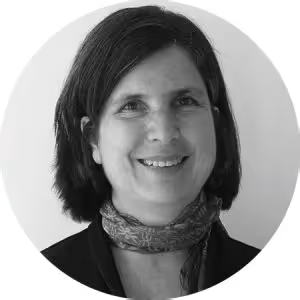
Claudia Martinez
Episode Summary
Q1: Place
If we could do a flypast on any part of the world that is significant to you, which place, city or country would it be and why?
Colombia
Q2: Life
Give us a glimpse into your life story so far with an emphasis on what you are doing currently?
Grew up on a farm and became a tour conductor for mothers company called Learn by Travelling. Opened up the first Sustainable Development Division at the Latin American Development Bank. Known as the Green Lady ended up being the first Deputy Minister of the Environment in Colombia. Created E3 to orchestrate changes, working with communities, driving a vision of change in their own territories. Dedicated the last three years to coordinate the food and land use coalition in Colombia, supporting actions to transform food systems into powerful engines of regenerative growth and recovery.
Q3: Reset
Where on earth is your place or reset or re-charge?
The Páramos of Colombia. 'Where I am able to think of the universe in a more profound manner'
Q4: Wonder
What wonder of the natural world excites you the most?
The Páramos of Colombia in the Andean Mountains from Venezuala to Northern Peru
Q5: Hopefulness
What is your story of hopefulness (not your own) about a person, business or non-profit who are doing amazing things for the world?
Indigenous communities coming together to form an association of 96 community-based organisations with the vision to create a unique sustainable development and regeneration model.
Q6: Insight
As we prepare to re-enter, what insight, wisdom or question would you like to share with us?
The world has a unique opportunity to transform food systems into powerful engines of recovery and equity.

Transcript
Steve (host):
Welcome to episode 47 of Wonderspace. It's great to have you on board. My name is Steve Cole and over the past year I have been asking the same 6 questions to amazing people from around the world. The questions orbit around wonder and hopefulness and the setting for each journey is this shared window on the space station from where we see everything from a different perspective. Before we introduce our guest, our friends at asknature.org are going to help us to rewonder.
Ask Nature:
Cicada's sounds are designed to draw attention, So it may seem surprising that their wings are designed to disappear. How do they do it? Their surface is textured with countless tiny bumps, 4, 000 times shorter than the thickness of a human hair. To light, these nanopillars and the spaces between them are just the right size to get lost in, preventing the light from bouncing towards the eyes of hungry predators and buying the cicada more time for finding a mate.
Steve (host):
Our orbit this week will take us over the Andes Mountains in South America and to experience these views with us in this ultimate window seat we welcome Claudia Martinez. Claudia is the director of E3 in Bogotá in Colombia. She is also the country leader for the climate and development knowledge network and the co-founder of Sistema B. Our interview was a few days before the United Nations Food Systems Summit in New York where Claudia also had a key role. Claudia was nominated by our fifth guest on Wonderspace, Maria Amelia Carrillo.
Steve (host):
Here is Maria Amelia telling us why.
Claudia:
I nominated Claudio Martinez to Wonderspace because she is fascinated with Colombia, its nature and its people and I am so happy that she's able to share that feeling with everyone around the world.
Steve (host):
With a panoramic view of Earth I start by asking Claudia if we could do a flypast on any part of the world that is significant to you, which place, city or country would it be and why?
Claudia:
If I could fly pass on any part of the world, I would select Colombia, the country I was born. I was blessed to be born in this amazing country that is the richest country in terms of biodiversity. There are more birds, amphibians, butterflies, frog species than any other place in the world. Every time I go to a region in Colombia, I see beauty, the cultures, the possibilities, and I love the warmth of the people. And when I fly, I always sit in the window seat and wonder about the magical ecosystems and how they are all so different and yet so interconnected.
Claudia:
I see the vast Amazon, the astonishing Andes, the open savannas, the Orinoco River Basin, the Chocó rainforest. I would love to be able to have a super binocular to see all the amazing birds flying around reminding us that they live in Colombia because they have preserved some patches of forests. When I see areas of deforestation, contaminating rivers, I would like to have a megaphone and tell the communities down below to preserve our amazing richness, not only for the 50 million Colombians, but for the planet, as we have the potential to provide food, medicines and to nourish and heal the world community.
Steve (host):
Claudia, give us a glimpse into your life story so far with an emphasis on what you were doing currently.
Claudia:
Well, I am the youngest 1 in a family of 8 that was lucky to be raising a farm in the outskirts of Bogota. I grew up with a strong connection to nature and people. When I was 12, my mother was the principal of a school and she decided to create a company called Learn by Traveling because she thought that it was crazy to educate children in a closed classroom when you can travel and learn in person about geography, history, environment, cultures and all the subjects that make you a more humanitarian person. I ended up being a young tour conductor, traveling with children and youth in my country and around the world. I was always pushing to be an environmentalist in a world that was slowly understanding the meaning of the word.
Claudia:
After undergrad studies in Colombia, I applied to the Bank of the Republic scholarship to study environment with an astonishing reply that they could not waste their resources in gardeners having to add economy as a degree. I won and used the scholarship to do both degrees, learning that a good economist ends up being a great environmentalist or the opposite. A good environmentalist ends up being a good economist. I worked as 1 of the first young professionals at UNDP, merging, developing an environment, later opening up the first sustainable development division at the Latin American Development Bank. I was called the green lady at the time.
Claudia:
And then I ended up being the first Deputy Minister of Environment of Colombia, always pushing the environmental subject to the front line. I learned that between economics and environment there is always an ethical dilemma and created E3, economy, ecology and ethics, 10 years ago, to orchestrate changes with an emphasis to work with communities driving a vision of change of their own territories. I do believe that feeding the growing population without disfroring the planet is 1 of the most pressing challenges of our planet and have dedicated the last 3 years to coordinate the food and land use coalition in Colombia, supporting actions to transform food systems into powerful engines of regenerative growth and recovery. And I have focused my work in really working with communities in the territories. Just in the last week, I was with a group of regenerators, for example, in Quindio in Colombia, dreaming to scale their amazing models.
Claudia:
For example, coffee growers planting flowers to feed pollinators, women that are producing more than a hundred food species in an organic manner, farmer markets and restaurants that are inviting farmers to their local as their local heroes so that consumers understand the value of what they're doing. I think we have a unique opportunity to unite actors and dream and shape regeneration models for a better world.
Steve (host):
What wonder of the natural world excites you the most?
Claudia:
1 of the wonders of the natural world is the Paramo ecosystems in Colombia. The Paramos are grasslands, shrublands ecosystems found between 3, 000 to 5, 000 meters above sea level and are only found in the Andean mountains from Venezuela to northern Peru. They play a fundamental role in sustaining the lives of millions of people by being the factories of water that feed streams, rivers, aquifers and water catchment areas. In Colombia, Paramos account for 2% of the territory and produce 70% of the water. They store water through its vegetation, including incredible species that are called frailejones that capture the mist of water.
Claudia:
They grow 1 centimeter per year, but they can live up to 300 years with altitudes of 3 meters creating a majestic senior of like grandfathers of the paramos standing vividly holding up 25 times their weight in water
Steve (host):
Where on earth is your place of reset or recharge?
Claudia:
My place of reset is the Joaquin de Paramos in Colombia, obviously. Sensing the water in the clouds, the sounds of the wind, the silence of the air. There I feel as a bird flying above the skies and I am able to breathe and to think of the universe in a much more profound manner.
Steve (host):
Claudia, what is your story of hopefulness that's not your own about a person, business or non-profit who are doing amazing things for the world?
Claudia:
My story of hopefulness I would like to share is a community association called Asprosic, composed of indigenous communities, black communities and peasant communities along the Sino River in Columbia. They were impacted by the construction of a dam 20 years ago, and At the beginning, they responded with strikes and anger, but eventually they understood that they had to be organized to restore their livelihoods and created an association of 96 community-based organizations with the aim to create a unique sustainable development model under agroecological principles with a unique governance system. In each of the family orchards, they cultivate more than 80 food species, avoiding chemicals, pesticides and fertilizers, and being able not only to have healthy diets, but to support communities around them with first secrets of trade and local stores where they sell their products. They also jointly decided to restore the river basin. They planted diverse tree species to protect the mangrove forests, with a joint action to stop the destruction by large shrimp companies with success.
Claudia:
They devoted a system to ensure clean, drinkable water in every household with solar energy and traditional water filters, solving a health problem. They also restored the water irrigation system developed by the Sino-Indigenous communities, ensuring regenerative and productive food systems. They used the earnings from the agricultural production in education and have been able to ensure that the young leaders of the community return to the community to sort of ensure the vision of change that they have. They have proven that it is possible to regenerate ecosystems and societies and to live in peace, even in an area that has been impacted by the armed conflict in Colombia. This is a true regeneration model that has developed a unique model to restore ecosystems and societies.
Steve (host):
Finally, as we prepare to re-enter, what insight, wisdom or question would you like to share with us?
Claudia:
As we prepare to re-enter our planet Earth, I would like to remind people that the world has a unique opportunity to transform food and land use systems into powerful engines of recovery and equity. The Food Systems Summit is happening just this week. It only happens every 20 years. This is a unique opportunity to join and rethink our partner of growth and survival. Rural areas can be transformed into places of hope and opportunity where thriving communities can adapt to new challenges, protect and regenerate natural capital and invest in a better future with women playing a central role.
Claudia:
We need to ensure wider choices and more options to supply food. If there are 14, 000 edible species, why are we eating only 150 with maize, rice and wheat providing 60% of the world's food energy intake, we need to focus back on our seeds for change. We lose or waste approximately one-third of what is produced. Producing food that is never eaten requires farming almost the area of the United States. Imagine, we can tackle food loss and waste.
Claudia:
We will certainly support human diets and we can feed the hungry communities of the world. We really need to think about nature-based solutions. This is key for the world. We need to produce more using less land. We have the means to stop hunger and at the same time to regenerate the planet.
Claudia:
There are good examples of regeneration all over the world. We can scale these models. We can really make the planet work for nature, for people and for climate change.
Steve (host):
More information and links to Claudia's work, together with links to the previous 46 Wonderspace episodes, can be found at ourwonder.space. I want to thank Claudia for joining us on this Wonderspace and I hope
Claudia:
you