Episode #
45
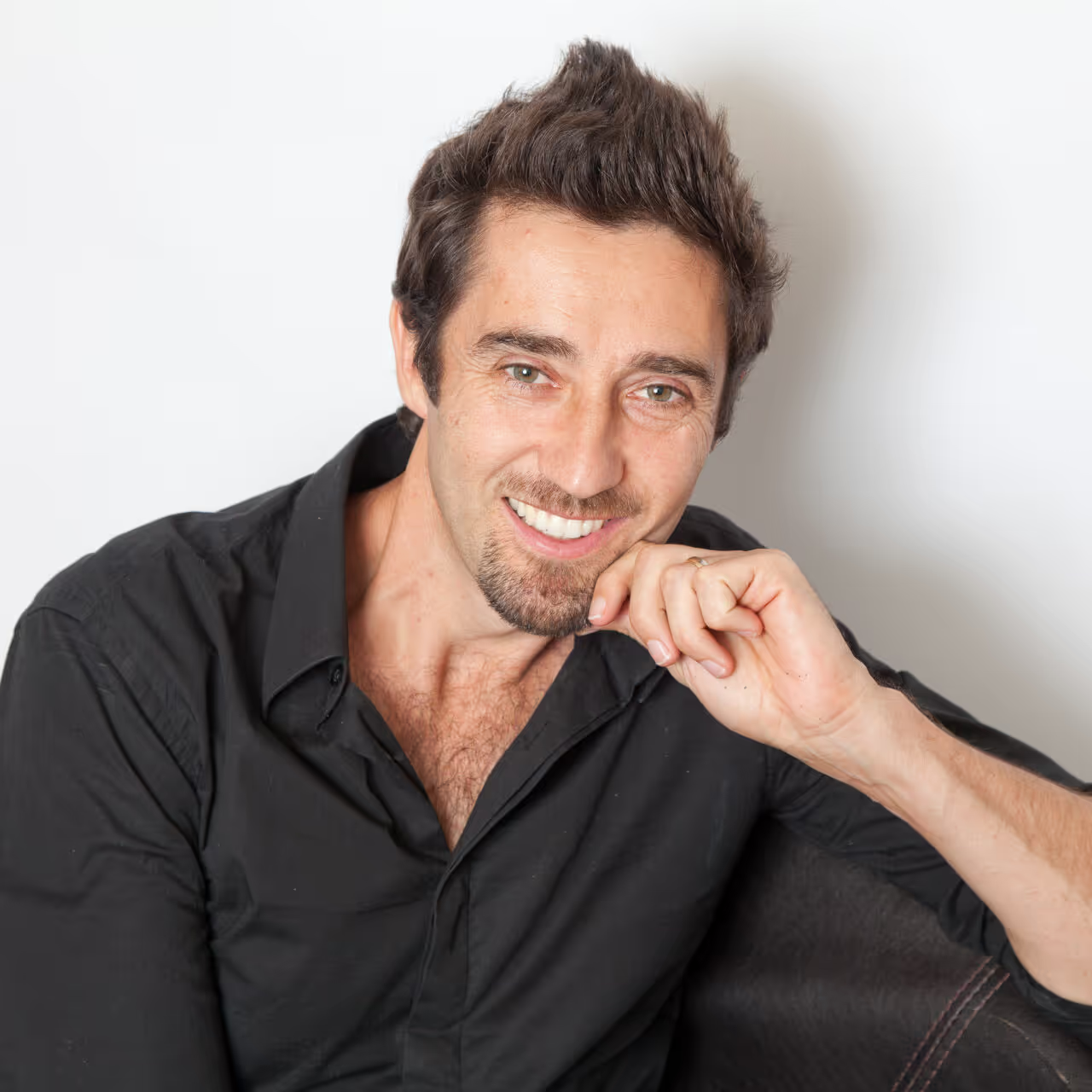
Pete Russell
Episode Summary
Q1: Place
If we could do a flypast on any part of the world that is significant to you, which place, city or country would it be and why?
Waiheke Island in New Zealand
Q2: Life
Give us a glimpse into your life story so far with an emphasis on what you are doing currently?
Grew up in a military family, spent 15 years in a lucrative business that crashed and led to a desire to be 'part of the solution' in re-imagining and disrupting food systems. Founded Ooooby in 2008 which now has hubs around the world.
Q3: Reset
Where on earth is your place or reset or re-charge?
At home with the family
Q4: Wonder
What wonder of the natural world excites you the most?
People and the potential of conversations that leads to change.
Q5: Hopefulness
What is your story of hopefulness (not your own) about a person, business or non-profit who are doing amazing things for the world?
Farmer Craig Hubbard who is the founder of the Shambhala farm in Australia and Tolly who runs Tolhurst Organic in Oxfordshire (UK)
Q6: Insight
As we prepare to re-enter, what insight, wisdom or question would you like to share with us?
How do we choose to perceive people, society and the future?

Transcript
Steve (host):
Welcome to episode 45 of Wonderspace. It's great to have you on board. My name is Steve Cole and over the past year I have been asking the same 6 questions to amazing people from around the world. The questions orbit around wonder and hopefulness and the setting for each journey is a shared window on the space station from where we see everything from a different perspective. Before we introduce our guest our friends at AskNature.org are going to help us to rewonder.
Ask Nature:
When food is scarce, many animals lose weight, But marine iguanas go further. They lose length, up to 20% of it. Since soft tissues only account for about 10% of their overall body length, it appears some of that shrinking is in the bones themselves. Then, when the food supply increases again, the iguanas build right back up to their full size. How do they manage such a large-scale change to such a fundamental aspect of their makeup?
Ask Nature:
That remains a mystery.
Steve (host):
Our orbit this week will take us over the coastline of northwestern Australia and to experience these views with us in this ultimate window seat we welcome Pete Russell. Pete is the founder of a business called OOBE which stands for out of our own backyard. Their mission is to put local small-scale sustainable farming back at the heart of the food system that we all depend on. With a panoramic view of earth from this window seat I start by asking Pete if we could do a fly-past on any part of the world that is significant to you, which place, city or country would it be and why?
Peter:
I grew up in Australia, but I'd have to say it would be why Heke Island in New Zealand is the place that's most significant to me, because that's where we moved to in 2008, and it was a place where I guess my life didn't about face and I started working in a completely different direction based on a completely different set of motives. And it's where I finished up doing the long hauls of industrial supply chain business and started UBI which is all about short distance small scale ecologically sound food production. So I'd have to say Waiheke Island in New Zealand.
Steve (host):
Pete give us a glimpse into your life story so far with an emphasis on what you were doing currently.
Peter:
As a child I grew up in a military family, so we moved around a lot. And I was never really academically inclined, always much more interested in being entrepreneurial. As I grew up and into my adult life, I became obsessed with business. I love business. I love the idea of solving problems and making something more out of problems.
Peter:
And I found myself about sort of 15 years into my business career doing things that were great financially, very lucrative. And I felt like we'd learned a massive amount about business and about people and about commerce and economics and all of those sorts of things. And we were benefiting from that. But I found myself having sort of wound up as being a cog in a larger machine that it wasn't resonating with a life purpose at all. It wasn't giving me a sense of, oh, I'm solving an important problem here.
Peter:
And if anything, it was really contributing to larger scale problems that most of us don't even see because they're so big that we don't recognize them. And that business was effectively importing frozen pastries out of Europe in shipping containers and then supplying them and managing all the distribution into all the supermarkets around Australia. So Woolworths and Coles, plus all of the hospitality industry and so on. And it was a very fast growing business. But what happened was, we had the 2008 global financial crisis.
Peter:
And because we were paying in euros from Australia, exchange rate spikes happened. Our business effectively capsized. Our business model went from being profit-making to loss-making literally overnight. We were stuck in a place of what do we do and how do we solve our problem. And it was that moment where I thought to myself, this isn't only our problem, this is a macro problem right now.
Peter:
And there's a lot of food businesses right now in this situation. And we had to figure out whether we were just going to stop ordering the food, because every time we ordered the food, it would lose us money. And it made me realise at that 0, OK, this is not just about me and my business, this is about being part of a system that cannot sustain these kind of economic shocks, let alone geopolitical shocks or any other sort of shocks that we might see in the future. So that was a catalyst for me to say, okay, I want to play a different game. I want to be part of the solution.
Peter:
And that was the genesis of UBI. So UBI, it stands for Out of Our Own Backyards. And effectively, it's a food system based on small-scale, independent, ecologically sound food producers, anywhere from 1 acre or anywhere from a backyard, up to 250 acres, but independently owned, typically family owned, and finding ways for those businesses to be able to reach the market and effectively bypass the standard supply chains that have dominated our market. So where we are today is we have 2 hubs in New Zealand, 1 hub in Australia, and we've just signed on our 18th hub here in the UK. I came to the UK 2 years ago, my wife's from here and we always planned on settling here.
Peter:
And we launched 18 months ago, And because of all the foundational work that we've done over the last sort of 8 or 10 years in New Zealand and Australia, we've been able to roll out quite rapidly. So we've been able to open up a new hub, 1 new hub a month. And these hubs are independently owned, locally owned, hubs that are either, and mostly they're farm based. So you'll have a hub that's a barn on a farm where that farm is producing a large proportion of the food that is going into the deliveries, but they're also buying from neighbouring farms and from other suppliers to make sure they've got a range that's big enough for people to be interested in. And So what we do is we provide all of the sort of the underlying operational systems and support and sort of business advice and so on for these farmers or sometimes it's high street retailers or high street grocers, organic shops.
Peter:
Sometimes it's someone who's actually set up a distribution point in industrial estate, but they're the hubs and they're the locals in their local region that we work with. When you look at all the potential hubs, I mean, you know, farms are potential hubs, farm shops, organic retail outlets. There's around about 5 and a half thousand of those around the country. So, you know, if we were just to get 10% of those, that would be, you know, 550 hubs. I mean, our targets really are more modest than that.
Peter:
We're seeing our targets of being a couple of hundred within the next 3 or 4 years here in the UK. But the point is that The more hubs we put on, the greater the network effects are, and the more that we can start to build our systems to be able to integrate those hubs together into a network. That network can then do things like share inventory across the platform. So 1 hub in Kent can be selling a range of a thousand products, but only having to hold a range of 50 products. And everything is then, as orders come through, they're sort of honeycombed through the system to be able to deliver to his customers in Kent.
Peter:
So we're facilitating a local economy as opposed to saying, oh, we're going to create a centralized market. We're building a decentralized but networked market. While we're focusing at the UK at the moment we are a borderless you know business model we're in Australia and New Zealand already and we have opportunities opening up in other countries like the United States, Japan, Malaysia and of course any other countries throughout Europe that are sort of right on the doorstep.
Steve (host):
Where on earth is your place of reset or recharge?
Peter:
My place of reset is home, like it's with my family and I don't have anywhere else that I sort of yearn to be and it's when we are not distracted with other situations in our life and we find ourselves just chatting away and then the questions come up you know how are you going what are you thinking about And through that conversation with the family, it really helps to sort of recalibrate and reset what's important.
Steve (host):
What wonder of the natural world excites you the most?
Peter:
The wonder that excites me the most is probably people. I am so inspired by people. I think that when you tune in and when you have the opportunity to have conversations to tune in and to think about, you know, how can I be part of a solution? I don't know anyone who doesn't get excited by that. I don't know anyone who doesn't kind of feel like, yeah, yeah, that's important.
Peter:
And give me an opportunity and I'd be there. So, yeah, I feel like we are both the ones who have created the situation we're in at the moment but absolutely capable. Absolutely capable. And I think it's most probable that we will resolve the challenges that we have and of course we'll create new ones, bigger ones probably, but you know that's the nature of humanity and I'm fascinated by it.
Steve (host):
Pete, what is your story of hopefulness that's not your own, about a person, business or non-profit who are doing amazing things for the world
Peter:
My story of hopefulness is the story of Craig Hubbard So Craig Hubbard he was my business partner in this business that we had importing pastries into Australia. And there were 4 of us, there were 4 partners, and both he and I became very disillusioned with the bigger model. I started Ubi. He went and bought a farm on the Sunshine Coast in Australia and called it Shambhala Farm. And he got himself right into it.
Peter:
He threw himself into the dirt literally and became a farmer and learned, you know, by jumping in the deep end. And so while I was working on systems for small scale food production and so forth, he was just working in it. And it was hard work. I thought I worked hard but I you know he really took on a really huge weight having to learn something very complex you know from this from scratch and and he had to he basically had to fight his way for survival in this domain. But what's evolved from his last 10 years is that he's realised that the most valuable thing that he has now is experience that he can share with others.
Peter:
And so he's now created a school, a farming school, where you can go to his farm and you can learn how to create your own farm, whether it's in your own backyard, whether it's pots on a balcony or whether you've got acres. And he has built a very comprehensive process of sharing all the knowledge that he's learned over that period. And I just think that the more people like him there are, the faster we're going to turn this thing around. And it's super exciting. And then the other person I'd have to add is a guy here in the UK, Tolly.
Peter:
He runs Tollhurst Organic down in South Oxfordshire. And what a man, like I spent a day with him on his farm and he is somebody who has got so much knowledge and so much enthusiasm to share his knowledge that I think people like him, they are the levers that are going to enable people to be able to take on a new path.
Steve (host):
Finally as we prepare to re-enter what insight, wisdom or question would you like to share with us?
Peter:
You have the choice to perceive what you want to perceive. So I can look at you Steve and I can say, oh look at this guy, you know, he can't be bothered shaving and he's probably a lazy so and so and he's sitting around in his bedroom and blah blah blah blah blah. And then I'll see that in you and I'll start to find evidence of that. And then you and I are in this cycle where we're having this dialogue back and forth, but I'm driving my perception of you is influencing that dialogue. So I have the ability to pull it down and then you've got to respond from that next level down and then then I can pull it further down.
Peter:
Alternatively I can have the perception of you here's Steve This is a guy who is enthusiastically, passionately tackling the challenges, the major big challenges that we're dealing with today. And he gets up in the morning and he goes for it. He can't be bothered wasting time shaving. This guy's got no time for that. He's doing something really worthwhile.
Peter:
And from that space, we have a different conversation. I see a different Steve, and you feel that, and you respond differently, and I respond differently, and we're having a different type of cycle. And I think that that's 1 of our most powerful choices that we have to make, is how do we choose to perceive the people in our life? And how do we choose to perceive society? How do we choose to perceive the future?
Peter:
Because we, by virtue of the fact that we are interacting with people and society and the future, we are influencing the direction in which it goes. And I think all of us have the ability to look at a situation and decide what to ignore and decide what to emphasise and what to feed. And I'd say that that is our greatest insight and our greatest power towards making a better world.
Steve (host):
To find out more go to ubi.org. On the episode page on the Wonderspace site, we will also give you a link to Pete's TEDx talk titled Hacking the Supply Chain. In his story of Hopefulness Pete spoke about Craig Hubbard and Tolly and more information about their farms can be found at shambhalafarm.com.au and tolhearseorganic.co.uk To engage with our previous 44 Wonderspace episodes go to ourwonder.space. I want to thank Pete for joining us on this Wonderspace and I Hope you can join us next week for more wonders and stories of hopefulness.