Episode #
44
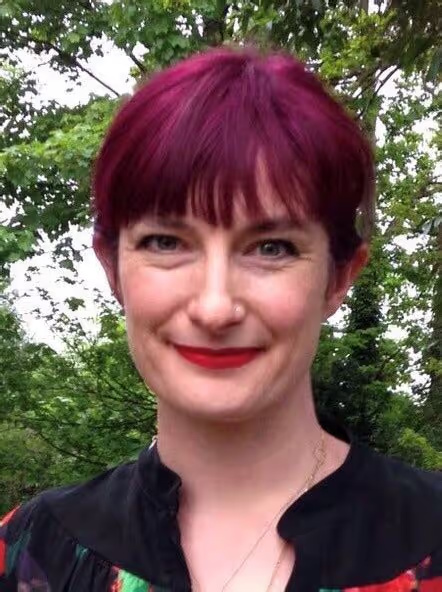
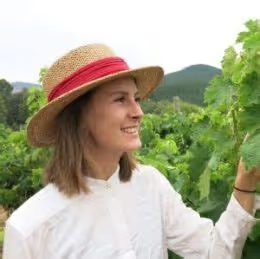
Abby Rose
Episode Summary
Q1: Place
If we could do a flypast on any part of the world that is significant to you, which place, city or country would it be and why?
Chile
Q2: Life
Give us a glimpse into your life story so far with an emphasis on what you are doing currently?
Studied particle physics, moved to Chile to work on her parent's farm, developed apps (soil mentor) now used by farmers around the world. Abby co-founded an award-winning podcast called Farmerama which enabled the sharing of learning and information and has become an advocate for healthy soil.
Q3: Reset
Where on earth is your place or reset or re-charge?
The Ocean
Q4: Wonder
What wonder of the natural world excites you the most?
The Soil. 'An amazing world below our feet'.
Q5: Hopefulness
What is your story of hopefulness (not your own) about a person, business or non-profit who are doing amazing things for the world?
Three stories: River (revitalising indigenous values for earth's regeneration) in New Zealand. Jennifer Armburst and the 12 principles for prototyping a feminist business and finally Leah Penniman from Soul Fire Farm in Albany, New York who is the author of Farming While Black.
Q6: Insight
As we prepare to re-enter, what insight, wisdom or question would you like to share with us?
Tell the truth. 'The more I tell the truth about what I'm doing or why, the more real life gets'.

Transcript
Steve (host):
Welcome to episode 44 of Wonderspace. It's great to have you on board. My name is Steve Cole and over the past year I have been asking the same 6 questions to amazing people from around the world. The questions orbit around wonder and hopefulness and the setting for each journey is a shared window on the space station from where we see everything from a different perspective. Before we introduce our guest our friends at AskNature.org are going to help us to rewonder.
Ask Nature:
How do plants turn to face the sun without eyes, muscles or bones? Chemistry. A hormone called auxin flees from the sunny side of the plant. This concentrates it on the shaded side, where it causes the cells to take in more water and elongate, tilting the top of the plant toward the sun. As the sun moves, so does the auxin, and so does the water, allowing adjustments as easy as the day is long.
Steve (host):
Our orbit this week will take us from North America to South America and to experience these views with us in this ultimate window seat we welcome Abbey Rose. Abbey is a farmer and soil health advocate who was named 1 of the 50 new radicals by the Guardian for her work developing apps that help build ecology, beauty and profitability on farms around the world. She also co-founded an award-winning podcast called PharmaArma Radio which shares the voices behind regenerative farming. Abby was nominated by our seventh guest on Wonderspace, Kathy Runciman from Atlas of the Future. Here is Kathy telling us why she nominated Abby.
Cathy:
I nominated Abby because she has inspired and educated me and expanded my thinking from the day I met her. She really helps me to see and feel the world differently, from the soil under our feet to the need for land justice and she helps me to imagine a thriving planet of healthy, regenerative, profitable and beautiful farms around the world.
Steve (host):
With a panoramic view of Earth, I start by asking Abby, If we could do a flypast on any part of the world that is significant to you, which place, city or country would it be and why?
Abby Rose:
It's a difficult question because my family has lived on 3 different continents in my lifetime so far. So I feel a little bit placeless. But today when I first thought about that, the first place that occurred to me was Chile, which is where my family had most recently ended up. And I think the reason I want to do the fly pass there is because for people who've never been to Chile, it's a country of insane extremes. Like we have a farm there and from the hill on the farm you look 1 way and you see the Andes and these amazing mountain tops, you know, extinct volcanoes where the top of the mountain is totally flat because it was blown off at some point, covered in snow.
Abby Rose:
And then you look the other way and it's out to the sea. And then you go south and you end up in these quite wild forests that are all made of monkey trees. It's just like this exotic other world is all I could say about Chile. In the far north is the desert, in the far south it's glaciers and freezing places in the world. It really is an amazing, amazing place.
Abby Rose:
And certainly since spending more time there, I've had some of the most extreme experiences of my life, whether that's earthquakes or fires or insane thunderstorms. It just... Yeah. It's quite a place is all I could say.
Steve (host):
Abbie, give us a glimpse into your life story so far with an emphasis on what you are doing currently.
Abby Rose:
A good place to start is that I did study physics at university and with a focus on particle physics. And by the end of that experience, it was too abstract for me. Although I love thinking through physics and the amazingness of it all and the patterns and symmetries. I felt disconnected from the earth in the end because the scales are so outside of our range of what we can imagine. And so then after finishing university, I spent some time.
Abby Rose:
My parents had moved to start farming in Chile whilst I was at university. And so I spent some time on the farm for the first time, like 4 or 5 months. And that was when I really started to connect with what this farming thing was all about because before that I thought it was completely ludicrous. I thought farming was really boring. I grew up in Cheshire and I just watched cows and sheep move in and out of fields and it just seemed like irrelevant to our futures for me, which is awful thing to say now.
Abby Rose:
So being on the farm, I guess the thing that really occurred to me was everyday decisions on the farm are actually something that affect far beyond the farm gate. So whether that's, you know, you decide, oh, well, actually, you know, we're going to cut down those trees now because farm is a business, you know, maybe that's how you're going to pay for your kids to go to university or whatever it is. But actually that decision to cut down those trees can contribute to flooding in a nearby town later in the year because suddenly the soil isn't taking up so much water. Or the way you choose to graze your animals, that will impact how much carbon is sequestered in the soil. So again, you know, we're talking about a global condition of how much carbon there is in the atmosphere, but that is impacted at the level of how I graze my animals.
Abby Rose:
And then also, you know, the nutrition density of our food or how healthy the food we are eating is, again, that's very much impacted by the farm and, you know, how good the soil is, what nutrients are going into those plants, etc. So really, farmers are like some of the key decision makers of all of our futures. And it just hadn't even occurred to me before. And no 1 had ever framed it like that for me. So when that dawned on me, that was really the beginning of my journey to support farmers to be able to be empowered to make decisions that support all of us, basically.
Abby Rose:
I also quickly realized that farming is really quite challenging and the system is not really set up to support farmers to make decisions that are environmentally aligned. And so it really, I was very clear, it really wasn't farmers' fault that it was like this, or that they were making bad decisions. It's much more about the whole system around it that is creating a format that means farmers make their decisions. So out of that I developed some apps. So VitaCycleTech is our company and we make apps to support small to medium scale farms like our farm in Chile.
Abby Rose:
So on the farm in Chile we have olive trees, almond trees, pistachios and then we graze sheep between them and we also have vines and then our vegetable gardens for ourselves. And so we make a natural wine and we're starting to make olive oil and have almonds. So you know at that the scale we're talking 10 to 15 hectares here at that scale like what are the tools that will support mainly observation driven farming And so that's what our apps do. We have 2 main apps, Soil Mentor and Sector Mentor, and they support farmers all over the world. It helps them monitor biodiversity, things like that.
Abby Rose:
And then also I co-create a podcast called Farmerama Radio. And that's very much about, early on in the journey, it was like, okay, got it. So, you know, we want to farm as regeneratively as possible, essentially. And we were clear on that from the very beginning. We didn't want to be applying synthetics.
Abby Rose:
But where do you go to learn about that? And it wasn't that easy. This was 6 or 7 years ago. And so I was already making some podcasts about Tech for Good with a guy called Joe Barrett. And so we came together and started to make podcasts about farming.
Abby Rose:
In particular, it was like, who are the people out there already working in regenerative ways or experimenting in this and how can we like go and ask them some questions to help me out but also share that knowledge as widely as possible so that all of us can collectively learn together and therefore you know the whole system is kind of being reflected back at itself and we can learn and iterate more quickly. Where
Steve (host):
on earth is your place of reset or recharge?
Abby Rose:
It's changed recently so that's why I'm a little slow on it but my dad died recently and he on his death he wanted his ashes to be put back into the sea or into the ocean. And so suddenly I have a completely different connection with the ocean. And so my place of recharge isn't actually on the earth right now, which is unusual for me because I'm quite an earth dweller but it's actually starting to be the sea and in particular for now anyway the Mediterranean Sea because there's not too many waves. It's just like an unbelievably, it's an overwhelmingly calming experience to just lie floating on the sea and when your ears just go under the top of the water and you suddenly are immersed into this other world and you can hear your breathing and you're connected to all these things through water rather than air and I've just found that to be Amazing. I think previously I always found it a bit overwhelming and a little bit discombobulating or scary but as I said since my dad's ashes have been returned to the sea I feel a new level of oneness or connection.
Steve (host):
What wonder of the natural world excites you the most?
Abby Rose:
Yes, so the most exciting part of our natural world for me is the soil. And I think to most people, you look at soil and it's just this kind of brown black substance and not very interesting. Maybe you even call it dirt. But It's actually this amazing world below our feet. And so I think the place to start is that in 1 handful of soil, healthy soil we're talking about here, you have more microbes than there are people on the planet.
Abby Rose:
So you have over 7000000000 microbes in a handful of healthy soil. So just imagine how alive that soil is, and then extend that to thinking about, below your feet, there's all this soil. And we have something called the Internet of Fungi. So not only are these, there are these millions, billions of microbes, but they're all connected through this kind of these channels of fungal hyphae that can extend for miles and they're all sending little signals between them between each other and like communicating and saying like, oh, you know, there's extra water over here or, oh, we've detected a pest over here, you know, get ready. And so they're sending these signals and it's just like there's this insane underworld that you can't even imagine.
Abby Rose:
And once I started to connect with soil like that, that it's a living web, it's unbelievably exciting place. And I think 1 of the ways a lot of people get excited about soil is because of its carbon sequestration possibilities. Because if you have a plant growing in soil, then that plant, it's photosynthesizing, it's building up some carbohydrates, it sends those carbohydrates down to its roots, maybe it wants to have some phosphate, for example. And the exciting bit is the root is like the plant soil interaction layer. And so the root will exude a little bit of sugar with a communication that says, hey microbes, we need some phosphate, can you bring me some?
Abby Rose:
And then the microbes will go away, they'll probably like connect with some fungal pathways, they'll go get the phosphate, dissolve it from some of the bedrock, bring it back, and give the plant the phosphate in return for the sugar. And then the microbes will digest that sugar essentially and turn it into a more stable form of carbon and then the plant is super happy and super healthy because it has all the nutrients it needs when it needs it. And so you can see that healthy soil, when it's really working, it's actually also the root of healthy plants, because it is the way that plants are able to get exactly what they need when they need it. And again, this is something that, you know, any gardener anywhere in the world, once you start to understand that, when you see your plant not doing well, you don't worry about the plant, you worry about the soil and you're like, oh gosh, I better build my fungal web. And so it's completely transformed even, you know, in my back garden, how I grow things.
Abby Rose:
I'm so focused on this soil. And for other contexts, the structure of soil is also really important. So I just described that mechanism that microbes have for getting the carbohydrates and then turning it into stable carbon. But as they do that, they are also building healthy soil structure. The carbon is sort of a glue and it creates this structure that's almost like popcorn you could imagine below our feet and it has a huge surface area.
Abby Rose:
It's able to retain insane amounts of water so it prevents flooding And also it then means that during drought periods, you know, plants have access to water for way longer, or if there's a heavy rain, the water is able to infiltrate in and be captured. So the thing about soil is it's just like on so many levels it's a wonder web. I don't want to say substance because it's not really a substance it's a web it's a life form and yeah so it gives me a lot of hope and it really is the most amazing wonder of the world I would say.
Steve (host):
Abbey what is your story of hopefulness that's not your own about a person, business or non-profit who are doing amazing things for the world?
Abby Rose:
My stories of hopefulness are, because I can't stick to 1, so I've got 3. So 1 of the ones that I've been really excited about recently is something called RIVER. RIVER stands for Revitalizing Indigenous Values for Earth's Regeneration. And a lady called Erin Matariki Carr is 1 of the people who is helping to nourish it as an entity. But part of what gives me hope about what they're doing is there's already some context for amazing steps forward in New Zealand with respect to the relationship between the colonizers and the indigenous people there, often referred to as the Māori people, in that they've had written into law a river and an area of forest have both been given like legal personhood, which is much more aligned with the Maori kind of way of understanding the world.
Abby Rose:
And so it's almost like the Western law has some, or this colonizer law has somehow been able to be molded so that it actually really honors and respects the Maori laws and ways of being. And I think for me that was a moment of insane hope because in so many places and ways those, you know, indigenous ways of being and thinking and colonizer ways of being and thinking are at loggerheads. And it just doesn't seem like there's any way they're ever going to come together. And for me it's hopeful because it's actually, it's very inviting and welcoming. And it comes from a place of healing justice rather than an aggressive place or a place of confrontation.
Abby Rose:
So yeah I'm really excited by the work they're doing. Definitely recommend checking them out. Their weareriver.earth is their website and they are offering courses for people who are non-indigenous to kind of learn about these ways. And then the second 1 is it's actually a set of principles that I'm most excited about. So they're called the 12 principles for prototyping a feminist business.
Abby Rose:
And anyone who knows me knows I'm obsessed with them. But they really are principles that have completely transformed my life and they allow me to continue to be me against all the grains of what the world is pushing back with, I would say. And so there's a lady called Jennifer Ambrost in LA. She has a company called Sister.is. Sister is.
Abby Rose:
And if you go to the website, you can see the feminist business principles there. Her creating those has been an insane gift to many, many people. And then finally, it's a lady called Leah Penniman. You may have heard of her. She wrote a book called Farming While Black.
Abby Rose:
It's an excellent read, and I highly recommend it for anyone, particularly if you're interested in farming or land in any way. And so Leah set up a farm in Albany, New York called Soulfire Farm. And I mean, I'd say she's just an amazing communicator. Like when you hear her speak, she particularly talks from a Black perspective in terms of relationship to land and farming in the United States. But again, she does it with this elegance and clarity and force that it just knocks you off your feet.
Abby Rose:
I mean, It's unbelievable. And I feel like no 1 could not be moved by what she says and what she shares. And some of the things she talks about are extremely challenging for many people, including myself. When I first read the book, You should have seen my notes on the first 1. I was like, what?
Abby Rose:
But I think, you know, that's okay. And, and, and there has to be space for that. But I feel like Leah, through writing that book and through the work she does at Soulfire, which is about empowering young black indigenous leaders and particularly teaching them how to farm and return to the land-based activities and seeing that as a form of healing, it's just created a whole momentum shift around this in the United States and globally. Like she's had impacts in many other countries as well, through people who've been through that program at Soulfire. So I just think she brings me a lot of hope.
Steve (host):
Finally, as we prepare to reenter, What insight, wisdom or question would you like to share with us?
Abby Rose:
Wisdom I would like to share is 1 of the permanent business principles. And it's just tell the truth. And I think as, you know, those 3 words, the more I go through life, the more I think that if we really, really were to embed those in us and really, really tell ourselves the truth about why we're doing things or who we are, what we're doing, that would be incredibly revelatory for the world. And there's an amazing amount of not telling the truth that goes on. And it's not an accusatory thing, it's just a recognition that it is a really powerful place to be and the more I tell the truth about what I'm doing or why, the more real life gets.
Steve (host):
To find out more and listen to the award-winning podcast Pharma Rama go to pharma Rama dot co Information about the family farm in Chile and the apps that Abby created can be found at VidaCycle.com. Links to the people and organisations that Abby spoke about in her stories of hopefulness can be found on our website, OurWonder.space, where you can also hear the previous 43 episodes. I want to thank Abby for joining us on this Wonderspace and I hope you can join us next week for more wonders and stories of hopefulness.