Episode #
42
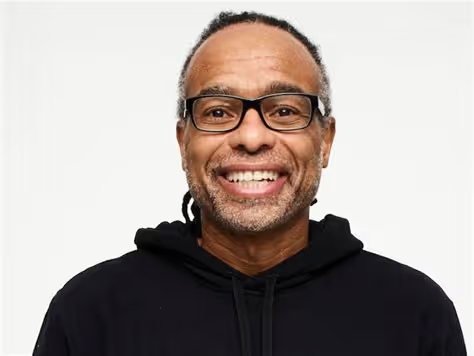
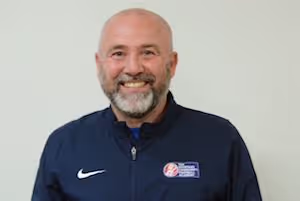
Douglas Samuel
Episode Summary
Q1: Place
If we could do a flypast on any part of the world that is significant to you, which place, city or country would it be and why?
Leith in Edinburgh
Q2: Life
Give us a glimpse into your life story so far with an emphasis on what you are doing currently?
Head of the national apprenticeship programme for Standard Life with an aspiration to become an elite football coach. Approached to join Spartans to turn the model of a football club on its head focusing on tackling social issues through a 4 million pounds sports centre and an enterprise model.
Q3: Reset
Where on earth is your place or reset or re-charge?
Santa Ponsa in Majorca
Q4: Wonder
What wonder of the natural world excites you the most?
Northern lights in Iceland
Q5: Hopefulness
What is your story of hopefulness (not your own) about a person, business or non-profit who are doing amazing things for the world?
Connecting Jamie from Coaches across Continents with Shukla Balls from the Parikrma foundation in India
Q6: Insight
As we prepare to re-enter, what insight, wisdom or question would you like to share with us?
What steps can you take in your part of the world that can create positive ripples in other parts of the world? Are your intentions serving a greater good or serving yourself?

Transcript
Steve (host):
Welcome to our 42nd Wonderspace journey, it's great to have you on board. My name is Steve Cole and since September 2020 I have been asking the same 6 questions to people from around the world. The questions revolve around life and wonder, places of reset and stories of hopefulness. The setting for all of our interviews is a virtual window seat on the space station, 250 miles above Earth, where we see everything from a different perspective. Before we introduce our guest our friends at asknature.org are going to help us to rewonder.
Ask Nature:
The key to the sinuous movements of an elephant's trunk is not in bending or twisting but in constricting. Muscles that radiate out from the center line flex at any point along the trunk to form a temporary joint giving dexterous control over the other motions and allowing elephants to lift and maneuver anything from a blade of grass to the trunk of a tree.
Steve (host):
This week our orbit will give us a stunning view of Spain and the Balearic Islands and to experience these views with us in this ultimate window seat we welcome Douglas Samuel. Douglas is the Chief Executive at the Spartans Community Football Academy in Edinburgh and was nominated by our fourth guest on Wonderspace Nathan Atkinson from Rethink Food. Here is Nathan telling us why he nominated Douglas.
Nathan:
I've nominated Dougie because the outcomes that he's achieved in founding and developing the Spartans Community Football Academy are truly incredible. Dougie is somebody who makes things happen, he's selfless and driven and I am truly in awe of his commitment and his passion in improving outcomes for the local community and I'm sure you'll enjoy his journey.
Steve (host):
A shorter version of this episode together with footage of this journey over Spain and the Balearic Islands can be found at ourwonder.space I start by asking Douglas from this window seat 250 miles above earth which place city or country would you want us to fly over and why?
Douglas:
It's probably a bit of a boring answer but without question it would be Edinburgh, my home. I'm extremely proud to come from Edinburgh. I'm obviously biased, but it's a stunning city, a beautiful city. But in particular, a part of the city called Leith, which is a port within the city where I grew up. And within that area, a specific block of council housing or social housing called the Banana Flats, a block of flats made famous by the film Trainspotting.
Douglas:
You may remember the character Sickboy lived in the Banana Flats. I often get asked why they're called the banana flats and it's because the building is in the shape of a curve. If you imagine a large block, your flats in the shape of a curve, sorry, on 10 floors, you'll get a sense of the scale. If you imagine a typical tenement house of 6 or 8 families, this block of what I would call concrete heaven was home to over 200 families so it was a really interesting place to grow up a place that was fully honest hard-working what you would call working-class families fully characters fully personalities and certainly where I learned my values.
Steve (host):
Douglas give us a glimpse into your life story so far, with an emphasis on what you are doing currently.
Douglas:
My life is really a combination of 3 things, I guess. I worked in Standard Life for 21 years. So I joined Standard Life straight from school, worked in different parts of the business. So I worked in customer service division before I then worked in major projects, worked in a call center for a while. And then I found my sort of, I guess, my destiny if you like in HR.
Douglas:
I ended up being responsible for the modern apprenticeship programme for the whole of the UK for standard life, which was a wonderful job and a job I really enjoyed. But as part of that job I was sent on lots of different personal development courses. So I would go on courses where I would get to walk over hot coals and break blocks of wood with karate chops and break arrows with my throat and all this type of thing. And of course every time I went on 1 of these courses I was invited to think about what my life's purpose was, what my values were, what drove me, so on and so forth. And the more I reflected, the more I thought about the fact that perhaps I was in the wrong place and I wanted to help people, I wanted to work in the third sector.
Douglas:
But I also had an aspiration to be an elite football coach. So I took a plunge, I took voluntary redundancy and I left standard life after 21 years to become a house husband, to spend more time with my 2 daughters and my wife and to coach the University of Edinburgh. So whilst I was spending time as a house husband and coach in the University of Edinburgh, the chairman invited me to do a piece of work in relation to that project and in simple terms it was a bit needs analysis. It was to liaise with the local schools to ask them if they would use the new facility, the new facility he dreamed of creating at the home of Spartans. But what actually happened was, to cut a long story short, Spartans ended up selling their ground and creating a brand new home, literally 2 bike kicks away over the road.
Douglas:
So I was fortunate enough to get involved in that project from the very beginning, and I'm still here. And that project in simple terms was to build a new 4000000 pound sports facility that could be the home for the football club, but also could be a social home for the community. So a place where people could feel a real sense of belonging, where our doors would be open and welcome to everybody from all walks of life. And we would provide services for people from all walks of life, from all different backgrounds. Really turning the model of a football club on its head, whereby the football club almost borrows the facility back from the community as opposed to the football club giving the community a loan of the facility.
Douglas:
So really sort of like tipping things on its head. The interesting thing is that I only ended up at Spartans on the back of being rejected elsewhere and this is probably 1 of my great life lessons is that often when we think something that's happening to us is the worst possible thing that could happen and it's devastating news, it actually leads to great things. And it reminds me of Steve Jobs' quote which is, we can only join the dots looking back. It's not until several years later that when I look back, I think, gosh, if I hadn't been rejected there, that wouldn't have led me to Spartans. And if I hadn't ended up at Spartans as a player, I wouldn't have ended up being the chief executive of the Charitable Armoury Football Club.
Douglas:
So I work for today the Spartans Community Football Academy, which as I alluded to is the Charitable Armoury Football Club. We're a registered charity. We're also a social enterprise. So we run and manage this 4000000 pounds sports facility as a social enterprise and we take the profits from trading, the money that's raised from our charity fund raising efforts, and we deliver services across 3 or 4 thematic areas for the benefit of our community. So again, you've heard me say this already, I'll try and keep it simple.
Douglas:
We're trying to make a difference in our wee patch of the world. How can we improve the quality of people's lives living in North Edinburgh? And for some people living in this community life's tough, it's difficult, it's home to areas of multiple deprivation, but it's also home to some amazing people and to some amazing organisation doing some great things. So we work across 3 or 4 thematic areas, those being education, youth work, health and wellbeing, physical activity, and we also try and play an active part in trying to create community cohesion that leads to tackling social needs, social issues in a meaningful, dignified and compassionate way. So trying to work with partners who are like-minded.
Steve (host):
Where on earth is your place of reset or recharge?
Douglas:
My place of reset is actually my imagination. It's somewhere I sit on holiday in a bay in Majorca in the Bay of Santa Ponza and my favorite reading spot in the whole world. For whatever reason this spot just calms me down. It just allows me to be present. I wouldn't be as grand as to suggest that I do like a formal meditation there, but I do a crude form of relaxation and meditation there.
Douglas:
And it's just my calming spot. It's my calm, I think, my place of calm. Although a close second would be a bay in the southeast Scotland in a place called Orkinlaire, which is a bay that has no sand. It's purely pebbles, but stunning, gorgeous pebbles that you, the light you wouldn't see anywhere else in the world. So I close my eyes and I go to 1 of those 2 places because I like being near water, especially in the Bay of Majorca where the colors, the blue aqua colors of the sea is just absolutely stunning.
Douglas:
That in itself I find quite calming and allows me to like reset. But it's probably more than just reset, it recharges me, it fills my well. I'm a great believer that we can only help others if we take care of ourselves. And by that I mean filling our own well. So it's important we make time for quality recovery time.
Douglas:
And that can be a real challenge for busy people. Busy people who are motivated to help others typically go at 100 miles an hour. And they're always spotting opportunities to take care of other people. But it's making time to actually slow down and do a bit of self-reflection and do a little bit of, as you call it, resetting and recharging, I think that's key. It's really important that we make and find time to just slow down.
Douglas:
And the other curious thing I think, which is fascinating from my perspective, is that the number 1 faculty, the right side of our brain is our imagination. And it's most effective at the point just before deep sleep. So actually slowing down and being relaxed is more conducive to coming up with creative solutions and ideas than running about 100 miles an hour. But imagine seeing a senior executive or a leader of a major corporate, the thing you need to do is just actually lie down. Just lie down for half an hour and just trust your subconscious and see what it delivers, see what it throws to the front of your mind and then grab your wee pad and write it down so you don't lose it.
Douglas:
But can you imagine somebody walking into like the chief exec's office and he's lying on the sofa? But if that's the technique to access the right side of the brain, then that's what it should be proactively doing.
Steve (host):
What wonder of the natural world excites you the most?
Douglas:
I've not seen it in full bloom yet and it's on my bucket list. But it's the Northern Lights. I'm desperate to go to Iceland, swimming in volcanic waters and enjoy the Northern Lights from the front row. Now every now and then we're blessed in Scotland, we got a glimpse of them. I'm obviously in the central belt, I'm not in the north, in the highlands.
Douglas:
We get to see this quite often so every now and then we get a wee teaser, a wee taster but it's most definitely on my bucket list to go to Iceland and swim in the volcanic waters and enjoy and just soak up the Northern Lights.
Steve (host):
Douglas, what is your story of hopefulness that's not your own? About a person, business or non-profit, who are doing amazing things for the world.
Douglas:
My story of hopefulness is born out of human connection. We had a young lad who worked here, who grew up in Loch End in quite a tough part of Edinburgh, was kicked out of school at 15, didn't leave with any qualifications, came to work for us and did a fantastic job. And through connections that we have, i.e. A former employee being based elsewhere, this young lad, Phil O'Kane, got the chance to go on the inaugural Michael Johnson Global Leadership Programme. Imagine being 1 of the first 12 young people to be chosen for a leadership program being designed and developed by Michael Johnson.
Douglas:
This led to him becoming an ambassador for a global organization called Coaches Across Continents. Where the connection comes in is that at the same time, I was connected to a woman called Dr. Shukla Bolz in India who runs a foundation called the Parikama Foundation, which in simple terms, a foundation set up to provide education for kids who are living in the slums. An incredible project, an incredible project. Fast forward a couple of years and we were able to connect Jamie to Shukla and Jamie spends time at Parikama teaching and training some of the teachers how to use sport for development activities to educate these kids who've come from the slums about things like United Nations sustainable development goals and the like.
Douglas:
A wee boy for lock end who left school with no qualifications helping to make a difference in India purely through the power of human connection. Amazing.
Steve (host):
Finally as we prepare to re-enter what insight, wisdom or question would you like to share with us?
Douglas:
What a fantastic question to end. I would invite people to think about What steps can they take within their own wee patch of the world that can create positive ripples in other parts of the world, but ripples that they might never see? So think about the intention behind their actions and think about if those intentions are serving a greater good or they're serving themselves.
Steve (host):
To find out more about the remarkable work of Spartans go to spartancfa.com In his story of hopefulness Douglas talked about connecting Jimmy from Coaches Across Continents and Shukla at the Parikama Foundation in India. You can find out more at coachesacrosscontinents.org and pericamafoundation.org
Douglas:
For
Steve (host):
our second year of Wonderspace we have redesigned the website to make it easier to engage with all the previous 41 episodes, go to ourwonder.space. I want to thank Douglas for joining us on this Wonderspace and I hope you can Join us next week for more wonders and stories of hopefulness.