Episode #
39
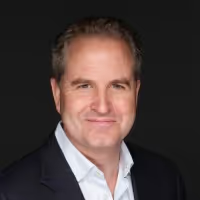
Jonathan Baillie
Episode Summary
Q1: Place
If we could do a flypast on any part of the world that is significant to you, which place, city or country would it be and why?
A small island in Northern Ontario
Q2: Life
Give us a glimpse into your life story so far with an emphasis on what you are doing currently?
The World Conservation Union, Red List, Gorillas in Gabon, Zoological society of London, Chief Scientist at National Geographic, 30 by 30 campaign, Media company for nature.
Q3: Reset
Where on earth is your place or reset or re-charge?
Northern Ontario in Canada
Q4: Wonder
What wonder of the natural world excites you the most?
The diversity of life
Q5: Hopefulness
What is your story of hopefulness (not your own) about a person, business or non-profit who are doing amazing things for the world?
Kris Tompkins was the CEO of Patagonia and is responsible for creating some of the biggest protected areas in the world.
Q6: Insight
As we prepare to re-enter, what insight, wisdom or question would you like to share with us?
The development of our children and our mental health is all dependent on a good relationship with nature. Who are we without nature?

Transcript
Steve (host):
Welcome to the 39th Wonderspace journey. It's great to have you on board. My name is Steve Cole and since September 2020 I have been asking the same 6 questions to people from around the world. The questions revolve around life and wonder, places of reset and stories of hopefulness. The setting for all of our interviews is a virtual window seat on the space station 250 miles above Earth where we see everything from a different perspective.
Steve (host):
This week our orbit will take us from Mexico to Canada and to experience these views with us in this ultimate window seat we welcome Jonathan Bailey. Jonathan is a global leader in conservation biology and has authored some of the most influential reports on the status and trends of the world's species and ecosystems. Jonathan is the CEO of a media and technology company called On The Edge Conservation and previously was the Chief Scientist of National Geographic where he initiated a campaign to protect 30% of the planet by 2030, which as you will hear in his story has now been adopted by countries around the world. A shorter version of this episode together with footage of this journey from Mexico to Canada can be found at ourwonder.space. I start by asking Jonathan, from this seat 250 miles above earth, which place, city or country would you want us to fly over and why?
Jonathan :
I'm really lucky because I've had a career that's allowed me to travel much of the world. But in doing that you often realise that the places that you experience first are some of the most magical. And so I would have to say, if I were to make a deep dive and a closer visit, it would be the place I'm sitting right now, which is in Northern Ontario on a small island where I've come every year of my life. So if we came in from space, we would likely see some of the large city areas, but quickly you come into complete forest and you hit the Canadian shield where it becomes very rocky. And It's just ancient, ancient rock all around and trees just sort of clinging on on top of the thin soil and lake after lake after lake and there's a lot of cottages at the beginning and still humanity near the cities but as you get further and further north it's just complete solitude and it's true wilderness.
Jonathan :
It's an unbelievable part of the world.
Steve (host):
Jonathan, give us a glimpse into your life story so far with an emphasis on what you're doing currently.
Jonathan :
I guess I'd start really where I believe my career started was going to work for IUCN. I was doing a master's at the School of Forestry and Environmental Studies and had the amazing opportunity to work at the World Conservation Union in Switzerland. And I arrived there and I found out my job was to edit this book called The Red List. And it's a list of the world's threatened species. It tells you which species on the planet we believe to be threatened with extinction.
Jonathan :
And my job was to really apply a new system of categorizing threat using quantitative criteria. And email was just starting and most people were still writing letters. So I wrote and emailed a network of about 9, 000 people And together we assessed thousands and thousands of species using this new system. And we assessed all the mammals for the first time ever. And for me that was just an introduction to a completely new exciting world.
Jonathan :
And having that base throughout my career has been tremendously helpful and I'd never give up that opportunity in a million years. Then I went on to do a PhD with Georgina Mase at Imperial College, which was based at the Zoological Society of London and studied island endemic birds and what makes certain species more prone to extinction than others, and did my PhD field research in the Gulf of Guinea on an island which is basically, well, a series of islands, like the Galapagos, but sort of unheard of. Some of the, well, the highest level of endemism for birds per area in the world. And then from there, I was keen to get into the forest, so I went to live in the rainforest for 2 years in Gabon, studying gorillas and starting an ecotourism and research camp to help basically fund the whole protected area. And I was working with Emmanuel Demerode, who was there at the time.
Jonathan :
And that was a phenomenal experience and made me realize the challenges of conservation projects on the ground that people face day to day. But as I walked through the forest, I had an opportunity to think about, you know, we'd walk for about 20 kilometers a day, I'd think about, you know, what would I do with my life if I wanted to have the greatest impact and help move us more towards a sustainable path. And I came to the conclusion that I wanted to define the status and trends of the world's species and ecosystems because I felt if people knew that, that they would make the right decisions. And really we just needed to understand. And so when I left the rainforest, I went back to London and worked with Georgina Mase again.
Jonathan :
We did a few more, edited a few more RedList and then we developed the indicators and assessments unit. And there we helped develop the living planet index, red list index, sample red list index, wildlife picture index. These are all indices of how animals and ecosystems are changing through time. And we get massive press each time we put out a report. But then like 3 days later, we would just sort of die away.
Jonathan :
So I realized that we really just needed more action on the ground. So I fortunately got the job of running all the conservation programs for the Zoological Society of London. I built that out into, we know we're in 50 different countries around the world doing innovative projects. But again at the end I realized if our relationship with nature doesn't fundamentally change, if we don't value nature more, we could have all the amazing projects in the world, but they're just not going to get to the scale needed. And then there was the opportunity to be chief scientist at National Geographic Society.
Jonathan :
And there I could do the science, the conservation, and really the communication component, which I felt was fundamental. And that was an amazing experience. And I guess, we did tons of things, but The project I had the most fun with was launching the 30 by 30 campaign And that was to convince the world's governments to protect 30% of the planet by 2030 And now basically most of the world's governments have bought into it and it's established and currently we're protecting about 15 percent. The target was 17 percent for 2020. But the big question is how you get there.
Jonathan :
That's a big lift by 2030. And so I realized that we're never going to get there unless we can better unlock private sector capital. We can't do it with just government funding and philanthropic funding alone, at least in the current state. And I also felt that we needed to focus a lot more on how we redefine our relationship with nature. So that led to my phase now where I'm doing the 2 things that if I think, you know, what are the 2 things I would do till I pop off basically, if I could?
Jonathan :
And 1 is helping us redefine our relationship with nature. And that's a project I'm doing or running a company called OTEC, which is on the edge of conservation, which is basically a media and marketing company for nature. And currently there isn't 1. And then the second thing is a massive, we're focusing on massive scale restoration projects and developing the impact monitoring technology to make that feasible and unlock the billions of dollars that are available for nature-based solutions. So that's the journey.
Jonathan :
And so this phase now is to drive those 2 areas forward. 1 is how do we redefine our relationship with nature and the other is how do we secure the Earth's species and ecosystems at scale. My place of reset is this small island I'm sitting on right now in Northern Ontario. I'm on day 12 of my 14 days of quarantine all on my own and it's absolute bliss. It's a place I've come every year of my life.
Jonathan :
It's a place that my journey really started in terms of exploring nature. And it's from here really all discoveries began. And so it's a true place to reset. It's a true place to kind of get the factory settings back to the beginning. But also it's a place you come and you can reflect on how you've changed because you know who you were when you were there last time and you can see how that creature is changing through time and you can have that discussion with yourself and see if you want to go in that direction or not.
Jonathan :
It's just the most beautiful place to spend time, reset, and when I come out of here, I'm invigorated and sort of ready to take on some of the big challenges we all face.
Steve (host):
What wonder of the natural world excites you the most?
Jonathan :
I think I'm just going to have to say diversity. It's the diversity of life that leaves me in constant wonder and in a constant quest to learn more and explore it. And it's an amazing discovery. And often when you think you know something really well, it even shocks you. I was swimming around near this island and I saw a loon and I swam up to it and I got within about 10 meters and I dove down and I looked around and thought it was gone and then it popped up about a meter away from me and I looked out and it looked me right in the eyes.
Jonathan :
And they're quite a big bird when they're a meter away from you, they have a big black bill. Looked very powerful at the time. And we kind of looked at each other. And I looked at its neck and I'd always thought that loons are, you know, let me say dichromatic, black and white. And I looked at his neck and it was iridescent green, the most iridescent green I'd ever seen.
Jonathan :
And so it's wonderful to have this diversity of life and think you know some of it intimately, but then discover that there's something completely new and different. And that's kind of, I think, the excitement of life, is just exploring the known and finding things you don't know, but then also stepping into the world and opening yourself to a whole world of new experiences. And that's what's special about our planet. The diversity of life that we arrive on this planet is special, magical, part of what makes us human and we have a responsibility to live with it and make sure that it exists when we depart.
Steve (host):
Jonathan, what is your story of hopefulness that's not your own? About a person, business or non-profit who are doing amazing things for the world.
Jonathan :
My story of hopefulness is a story about a woman who's really committed her life to helping us better understand the natural world but ensure that much of it is secured for future generations. Chris Tompkins was CEO of Patagonia. And for the last 25 years, her and her husband, who's now unfortunately passed away, started really focusing on how to secure large tracts of land. And together, they started creating some of the biggest protected areas in the world. Of course it isn't somebody who's come from sort of a traditional conservation career that has sort of led the way and people have followed.
Jonathan :
It's an individual who started their career in the private sector and built up, but always had a great reverence and respect for the natural world. And then went on to work with local communities and governments and helped set up 13 national parks in Chile and Argentina and protect almost 15 million acres. That alone gets my full respect, but really it's her ability to communicate the importance of the natural world and our relationship with other forms of life and the need to get to know our neighbors and understand nature so that we truly respect value and ultimately want to protect it. What I'm always so impressed with is just the courage and the constant, you know, waking up in the morning, taking on these massive challenges and just continuing. And it's not easy.
Jonathan :
I mean, these challenges are immense, and there's so many interests against securing the natural world. But when you have an example like this, who's just got up and done it and climbed 1 mountain and then finished taking a breath and climbed the next. For me, that's a story of hope and respect, but also 1 which I hope we have many other people emulating in the future. And that's also she showed us that it's possible and you see what 1 person can do.
Steve (host):
Finally, as we prepare to reenter, what insight, wisdom or question would you like to share with us?
Jonathan :
I guess when you say re-enter there's re-entering the earthly world but there's also re-entering in terms of COVID coming to an end or not an end but more bearable and it's interesting because it's I hope really helped us think about our relationship with the natural world and made us think about our values and what's really important. And that a world based on just money, making money and having money drive all decision-making probably leads us to some unfortunate places. And I really want to just ask, you know, having spent time here and thought about our relationship with nature through time, it's just like, what are we without nature? Who are we as humans without nature? Are we humans without nature?
Jonathan :
Nature made us. Nature grew us. It looked after us. It's a part of us. And for so long, we've tried to push nature away.
Jonathan :
But in truth, we're coming to realize, and I think the COVID situation helped us understand that when we're removed from nature, it leads to stress and anxiety. And it's led to all sorts of complications across the earth. And I think for the first time, we're beginning to realize that the development of our children, our mental health, is all dependent on a good relationship and time in nature. And then in fact it is a part of us and that without us we're not whole. And so my question just is really, who are we?
Jonathan :
Who are we without nature?
Steve (host):
To find out more about Jonathan's work, go to ontheedge.org. Jonathan also spoke about the 30x30 campaign, which you can join at campaignfornature.org.
Jonathan :
In
Steve (host):
his story of hopefulness Jonathan spoke about the extraordinary work of Chris Tomkins and you can find out more at tomkinsconservation.org. To listen to the previous 38 Wonderspace interviews the website is ourwonder.space. I want to thank Jonathan for joining us on this Wonderspace and I hope
Jonathan :
you