Episode #
36
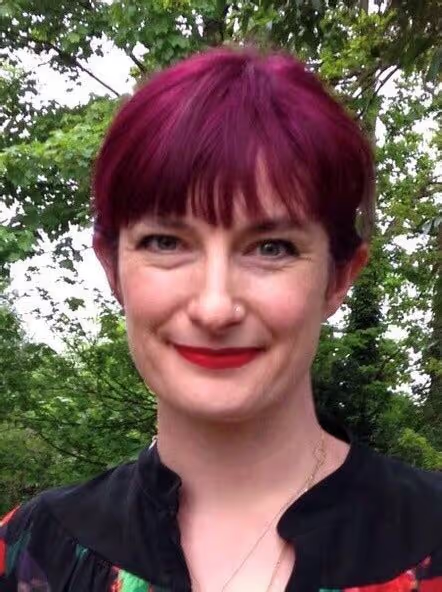
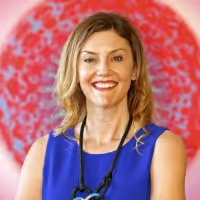
Tamsin Jones
Episode Summary
Q1: Place
If we could do a flypast on any part of the world that is significant to you, which place, city or country would it be and why?
The Centre for Gross National Happiness in Bhutan
Q2: Life
Give us a glimpse into your life story so far with an emphasis on what you are doing currently?
Australia, London Olympic regeneration, Tech hub in Cape Town, Boardroom Africa, Climate collective leadership models, Rallying Cry
Q3: Reset
Where on earth is your place or reset or re-charge?
Cape Town watching pods of dolphins and whales.
Q4: Wonder
What wonder of the natural world excites you the most?
Giant Manta Rays
Q5: Hopefulness
What is your story of hopefulness (not your own) about a person, business or non-profit who are doing amazing things for the world?
The Flipi Floppi initiative in Kenya. A Dhow boat made of plastic that has been collected from the oceans and clad in 30.000 flip flops. The boat is an icon in East Africa to advocate the end of single use plastic.
Q6: Insight
As we prepare to re-enter, what insight, wisdom or question would you like to share with us?
You can trust your body, your senses and your instincts. To be human is to be connected to self, to others and nature and so build the muscles of your senses as they are informing our decision making.

Transcript
Steve (host):
Welcome to the 36th Wonderspace Journey. It's great to have you on board. My name is Steve Cole and since September 2020 I have been asking the same 6 questions to people from around the world. The questions revolve around life and wonder, places of reset and stories of hopefulness. The setting for all of our interviews is a virtual window seat on the space station 250 miles above earth where we see everything from a different perspective.
Steve (host):
This week our orbit will take us from Ghana to Turkey and to experience these views with us in this ultimate window seat We welcome Tamsin Jones who is a venture builder and an advocate for collaborative leadership. Tamsin is the co-founder of workshop 17 which is a co-working environment in Cape Town that accelerates innovation and entrepreneurship. She is also the co-founder of the boardroom Africa, which promotes exceptional female talent to boards across the continent. Tamsin also advises governments, CEO Leadership Communities, Impact Investors, Women in Leadership and is a trustee of the Flip Floppy initiative in Kenya with a mission to eradicate single-use plastic. A shorter version of this episode together with footage of this journey from Ghana to Turkey can be found at ourwonder.space.
Steve (host):
I start by asking Tamsin from this seat to 150 miles above earth which place city or country would you want us to fly over and why?
Tamsin:
2 years ago, almost kind of today-ish, I was sitting on a very small airplane flying right, very close to the Himalayas, perhaps dangerously close. My knuckles were kind of white. I was hanging onto the side of my chair and we were about to land in a place called Tim Pu in Bhutan. And I was traveling to Bhutan on around my 40th birthday. I decided that instead of having a birthday party, I wanted to use the opportunity to reflect in a place that was different to walk in someone else's shoes.
Tamsin:
And So we were landing, it wasn't just me, it was a bunch of activists and filmmakers and impact investors and we were coming to Bhutan to the Centre for Gross National Happiness and we were going to be talking about issues of what is happiness, what is your personal happiness? What is happiness of a country? What is happiness in a system? And for me, this wasn't academic. At the time, I was completely burned out and I was operating on empty and I lost the ability to answer this question for myself.
Tamsin:
So when we landed, we all sat in a big circle of strangers and were asked by our kind of guide from the center, Julia, to grab a rose petal and to put the rose petal into this bowl in the centre of the group and to say what our intention was for this week together. And I said inspiration and direction for the next 20 years of my life, you know, no small thing. But what I did relearn there and why it's my touch point is I learned something that was instinctive but I'd lost which is what it is to be human and what it is to value and practice connection with self and other people and nature and so it was kind of like hitting the reset button on my computer and it's a very special place for me, a very important touchstone.
Steve (host):
Tamsin, give us a glimpse into your life story so far with an emphasis on what you are doing currently?
Tamsin:
I grew up in South Australia, started out in a country town. My dad was a reverend, he was a kind of reverend that wore flip-flops and a t-shirt and shorts and he had churches in pubs and skateboard churches and our house was full of activists. And when I was 10, 1 of my heroes was a particular activist called Max who had kind of long black hair and she had tassels on her clothes and she'd give me the most extraordinary giant hugs and she used to be a prostitute and was helping other women who were in a similar situation to what she was in and to come out of prostitution and her life wasn't an easy life you know it was a life focused on so tenaciously focused on social justice and you know my dad would tell me that you know good things don't always happen to good people, but you do good anyway. This idea of tenacity and social justice has taken me really all over the world. It's not uncommon for people to look at my story of my career and kind of get slightly puzzled I think at the various things I've done, but the thread is tenacity and social justice.
Tamsin:
So it's taken me to working on the London Olympic regeneration with companies from the city in Canary Wharf, to Cape Town working on programs to prevent HIV transmission to babies, and to set up a couple of ventures and organizations that I've co-founded. I'm really proud of a technology and innovation hub in Cape Town called Workshop 17, which has 250 entrepreneurs, a coding academy for young people who can't afford to pay for that training themselves. And it's really about inclusive innovation and following on from that, set up another company with a business partner called The Boardroom Africa, which is really the leading solution for getting more women on boards across the continent. And we set it up because people were saying there were no women for board roles and we knew them. And I think this idea of tenacity and social justice means that kind of wherever I was with whatever I saw, there was always an opportunity to do something, you know, do something good, do something that would have a real impact.
Tamsin:
And my passion has always been on building these things. And then when they're built, handing them over to someone that is better at operationally running them because this kind of connection to what next and what could be done is so strong in me. But there was a moment 1 day when I realized I couldn't, I'd achieved a lot but I couldn't feel my emotions anymore. And I wasn't really setting these healthy boundaries in my personal and professional life. And I didn't know it at the time, but these were signs of burnout, you know?
Tamsin:
And from talking to the thousands of women across our board network. I wasn't the only 1 experiencing this. I'm not the only leader. I'm sure I'm not the only person here experiencing this. But I became really curious about why, Why this tenacity and focus on social justice was burning me out?
Tamsin:
How could I have an impact differently? So I started kind of voraciously and slightly obsessively reading about this based on an experience I had of being with the Center for Gross National Happiness in Bhutan, but also reading the Harvard Business School book on leadership theory and practice, kind of cover to cover, doing a coaching course focused on the body. And I started to sort of see that the tenacity that's got us here, you know, got the world to this point, that had got me to this point of building a number of successful initiatives is what was burning us out and, you know, and was being systematically supported and not just burning us out but burning out our planet because we were kind of using an old operating model. And so I've become very, very interested in the last 2 years on focusing on new models for the way we lead that aren't just more regenerative or healthier, you know, but better. Because to find new solutions, you know, if I'm interested in this emerging new solution space, we've got to get really comfortable with listening and not knowing the answer.
Tamsin:
And how can we listen if we can't hear our own sense of the world anymore because we're so busy doing. And so, you know, sometimes when people think about that, they're like, well, that's kind of all well and good. I get that it's healthy for you, but are people kind of in boardrooms really taking this seriously? You know this idea of sensing seriously and and connecting with nature and our bodies and these new models and ways of working and I can honestly say, you know yes, I'm hearing more and more these conversations about consciousness in the boardroom, sort of this ability to be able to hold multiple truths and to listen. And these concepts like stakeholder capitalism, where the stakeholders are more important to business than the shareholders, because it's about the long-term interests of the planet, these are critical.
Tamsin:
And so, at the moment, I'm very focused on creating a new training focused on leading with the body and the mind. So how do we combine and understand our sense of the world and our sense of who we are, which is something we do to make decisions all the time, but isn't acknowledged. And also more climate collective leadership models. So I'm working very hard on an initiative, a collaborative initiative called the Rallying Cry, which is bringing women who are climate leaders running businesses into conversations about what policy shifts need to happen, not just from a data standpoint, but from their personal experience of soil quality and the need to sustain their communities, not just for 1 or 2 generations, but for many. So it's an emerging space for me because I think that's where the world is right now but with all of that there are lots and lots of opportunities for leaders to get together and get more involved and so I'll be developing a lot more of support for leaders that are wanting to do that over the next 6 to 12 months.
Steve (host):
Where on earth is your place of reset or recharge?
Tamsin:
My place of reset is always in nature and I was lucky enough to live in a place that was really all about nature and that was Cape Town in South Africa. I would sit on the deck of my house watching pods of hundreds of dolphins and whales swimming by and driving and seeing Table Mountain every morning. And it was the best thing you could possibly imagine into the world every day with this connection to nature that wasn't just a holiday or a moment in time that was just always there. You know, they call it the mother city because of Table Mountain. It sits in the center and it grounds you.
Tamsin:
And from Workshop 17, which is an innovation hub that I co-founded in Cape Town, you could sit and work and watch what they call the tablecloth, which is this cloud cover that would come over Table Mountain every day, just slowly coming across the mountain and sliding down the other side. And every time that happened, it was a reminder of how connected we are to each other and to nature.
Steve (host):
What wonder of the natural world excites you the most?
Tamsin:
A wonder of the natural world that excites me is giant manta rays. I am obsessed, obsessed with them. They're like angels to me. I love scuba diving and I've been to see manta rays in Mozambique many times and in the Maldives. And when I go to Mozambique to a place called Tofu Bay, you go out on this little dinghy boat and you have, it's a double dive, so you take 2 dive tanks with you and it's super rough and I get very seasick.
Tamsin:
So the whole way out to the reef I am seasick the whole time and I don't even care because I know that when I put my reg in my mouth and I dive into that, you know, cold water and start going down, I'm going to see devil rays and manta rays and the current is just pumping and you just drop onto this this beautiful reef and and lock into the reef so you're attached and there's a lot of currents so you're kind of floating and then these giant mantas just come and hover right near you over the reef to be cleaned And so it's the most extraordinary thing and I never ever want to come up when I'm down there with them.
Steve (host):
Tamsin, what is your story of hopefulness that's not your own? About a person, business or non-profit who are doing amazing things for the world.
Tamsin:
My story of hopefulness is a boat and it's not just any boat it's a dow boat which is a traditional boat and it's not just any dow boat although it's made by 1 of the most skilled dow boat builders in East Africa It's a boat made of plastic that's been collected from the oceans and clad in 30, 000 flip-flops, which is the footwear of 3000000 people. And the most common item found on our beach cleanups in Kenya, and this boat is called the flip floppy, and it's 9 meters long and weighs 7 tons, and it's the first time this has ever been done. The flip floppy is an icon really in East Africa to advocate for ending single use plastic and also for reusing the plastic that's being collected. For every 1 piece of plastic collected in Kenya, there are 5 more pieces that will wash in. And so we realized that this is something that needs to be changing both on a local level in Kenya in terms of collecting the plastic and reusing, but also on a global level in terms of stemming that flow.
Tamsin:
And so the flip floppy was created by Ben and Depeche and a group of people, and Alexander, who's a boat builder on an island called Lamu. And they've taken this boat to various places across East Africa and most recently that has been Lake Victoria, but previous to that it traveled over 500 kilometers from Lamu to Kenya, to Zanzibar to Tanzania. Every time it travels, it stops at communities along the way and attracts hundreds of millions of people to engage with it. Because I think some of the challenges with advocacy for ocean health, which we all know is important and Indian single use plastics, which we all know is important, is that sometimes it can feel, you know, like a stick, you know? And the flip floppy is 1 of the most vibrant, optimistic icons.
Tamsin:
If you see it visually, you smile. And so all of a sudden, the efforts to create this change come with music and this boat and this sense of hopefulness and this sense of what can be done as you can see through this boat which is a world first but it won't be the only world first you know the organization is creating an innovation hub and a series of innovation hubs along the coastline of East Africa which are focused on using the plastics that are being collected which have already been piled up and are ready to go and we're looking for supporters you know if anyone would like to help with looking at ways of turning this plastic into products, the usable products where we're looking for partnerships, but the idea is to create local ways of creating products that can be used in the local market until we can end single-use plastic. Sadly we heard just a few weeks ago that Ali Skander, the boat builder, his workshop where the flip floppy was built and where future flip floppies will be built and where a lot of other boat building takes place as well has just been burnt down.
Tamsin:
So we're really always hopeful and raising money for that. So if people are keen to support this initiative they can go to the Flip Floppy website and lend some support to this grassroots movement across East Africa.
Steve (host):
Finally, as we prepare to re-enter, what insight, wisdom or question would you like to share with us?
Tamsin:
As we prepare to re-enter, The wisdom and insight that I'd like to share is to let you know that you can trust your body, your senses, your instincts. I think so often in the world we live in, and certainly historically, we've operated from the basis of knowing of data, of our mind being the most prominent decision-making part of our anatomy. And actually that's not correct. We know now through neuroscience that quite often our senses tell our body what to do. Our hand might tell our mind what to do.
Tamsin:
Our stomach might tell our mind what to do. Our senses are quite often much more attuned to our historic experiences than our mind. Our mind can only access a tiny portion of what we've experienced in our life. Top leaders around the world, they know this and making intuitive decisions all the time but we don't have a great language for it and sometimes we forget to sense into it and what I would what I would what I think is the most important skill of the current century is our ability to not know the answer. And to do this, we need to get comfortable and skilled with sensation.
Tamsin:
You know, when we're uncomfortable, we need to be able to sit with that and go, what is that telling me? Because maybe it's telling you that it's the wrong answer, or maybe it's telling you that historically something has been challenging for you, or maybe it's telling you that historically something has been challenging for you, or maybe it's telling you that you're tired, but it's important to understand those things because whether we do or not, they're informing our decision making. And actually, if we're going to change the way that policymakers and business leaders and financiers and executives actually think and look at the world around them. We need to move from a tunnel vision to a lateral vision, you know, from data to understanding and connection. And so this is something that maybe we can just do a little brief exercise in.
Tamsin:
So if you think about a moment when you're in nature, or if you are in nature, maybe take a moment to soak it in through all of your senses. Or think about a moment in your life when connection to nature has been greatest for you and just take a deep breath. Pretend you're there. Think about it. Smell the air and hear the sounds of that place and remember what it feels like on your skin.
Tamsin:
Is it hot or cold? Is it windy? This is as simple as it is to feel and understand sensation and it's highly, highly good for us to understand how we're feeling and how we're understanding our environment and when we can do that we became much more able to be present with other people and to listen. And this connection to nature and each other is actually how change happens in healthy ways. And it's, as I say, it's how we remain present during hard and complex conversations.
Tamsin:
And in truth, like what it is to be human is to be connected to ourselves and to others and to nature and so this is the muscle I think you know that we need to be practicing and take your time to build that because these sensing muscles may maybe telling you something really important. More information about Tamsin can be
Steve (host):
found at TamsinJones.com. In her story of hopefulness, Tamsin talks about Flip Floppy and more information can be found at theflipfloppy.com. To listen to the previous 35 Wonderspace interviews the website is ourwonder.space. I want to thank Tamsin for joining us on this Wonderspace and I hope
Tamsin:
you