Episode #
35
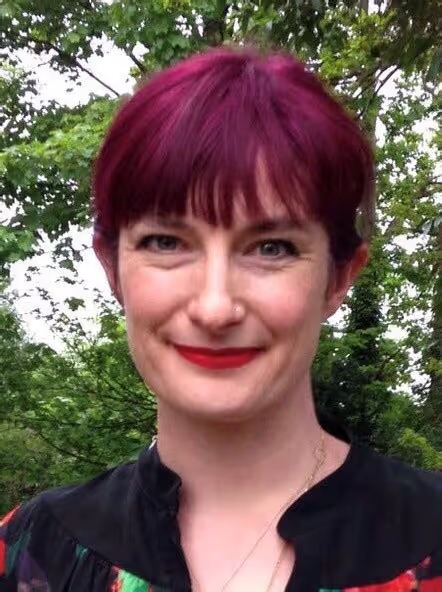
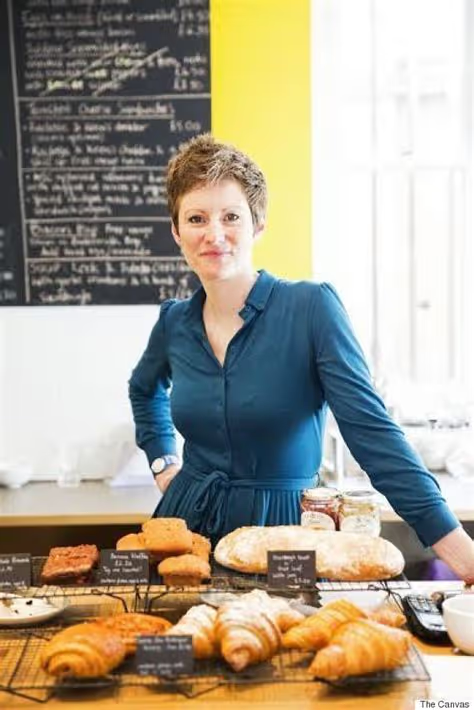
Ruth Rogers
Episode Summary
Q1: Place
If we could do a flypast on any part of the world that is significant to you, which place, city or country would it be and why?
New York
Q2: Life
Give us a glimpse into your life story so far with an emphasis on what you are doing currently?
New York, Body Gossip campaign, Sell out shows, The Canvas, 15.000 meals during lockdown, Gilbert and George and two advertising agencies
Q3: Reset
Where on earth is your place or reset or re-charge?
A walk or swim on my own. “I have a one year old and a two year old”
Q4: Wonder
What wonder of the natural world excites you the most?
The Sky “During lockdown, I have gone so long without noticing it”
Q5: Hopefulness
What is your story of hopefulness (not your own) about a person, business or non-profit who are doing amazing things for the world?
Lost Stock is an impactful retail business, set up in the wake of COVID-19 and using a fashion box model to connect consumers with the billions of pounds worth of cancelled stock orders while supporting garment workers and their families.
Q6: Insight
As we prepare to re-enter, what insight, wisdom or question would you like to share with us?
What could you do? whether that's buying a lost stock box, or find your local food bank and volunteer, we can all do something to make a positive impact in the world.

Transcript
Steve (host):
Welcome to the 35th Wonderspace Journey. It's great to have you on board. My name is Steve Cole and since September 2020 I have been asking the same 6 questions to people from around the world. The questions revolve around life and wonder, places of reset and stories of hopefulness. The setting for all of our interviews is a virtual window seat on the space station 250 miles above Earth where we see everything from a different perspective.
Steve (host):
This week our orbit will take us from Minneapolis to the city lights on the East Coast of America and to Experience these views with us in this ultimate window seat. We welcome Ruth Rogers. Ruth is an actress, creative producer, and social entrepreneur and campaigner who 6 years ago founded a vegan cafe and event space called Canvas just off Brick Lane in East London. During lockdown Canvas has cooked over 6, 000 home cooked meals for vulnerable residents in Tower Hamlets, 8, 000 meals to a homeless project and 700 meals for children at risk of hunger during school holidays. This all came about through a partnership with 2 local advertising agencies and 2 world famous creative neighbors which you will hear about in Ruth's story.
Steve (host):
A shorter version of this episode together with footage of this journey from Minneapolis to New York can be found at ourwonder.space. I start by asking Ruth from this seat 250 miles above earth, which place, city or country would you want us to fly over and why?
Ruth:
I first visited New York City in 2005 when I was 24 and I'm choosing that because when I look back at all the places I visited that is the most significant. I mean this don't forget this was me aged 24 very different to me aged 40 but I felt most Ruth Rogers in New York City than I had ever felt in my life. And I visited there as a tourist in 2005 and then I went back, I engineered myself a summer of feeling like I lived there because I enrolled onto the New York Film Academy. I used to be an actress so I did a film acting course when I was 25 And it was during that course that I had the idea for a campaign and project that absolutely has led me to where I am now. I learnt by talking to the actors and actresses that I was studying with that body image for them was a huge problem and it was causing them sort of debilitating social anxiety and it made me really cross, don't forget this was 2005 where actually body image wasn't as talked about as it is now you know it was a long while ago and social media wasn't really around like it is now and I got really mad at how awful people felt about how they looked and that gave me the idea for Body Gossip which is the first sort of bit of entrepreneurial campaigning that I did.
Steve (host):
Ruth give us a glimpse into your life story so far with an emphasis on what you are doing currently.
Ruth:
Well my life story so far would need to start with body gossip. So here we are 25 year old me in New York very cross at how people's thoughts about their appearance is making them so sad. I came up with an idea I felt that it was a powerful idea to make people feel better. The idea was that if you invited people to write down their story about their body and then share it with an anonymous ear, then if you turn some of those stories into live theatre shows or short films or publish them in books then you could celebrate those stories you could celebrate the thousands of ways that that people are beautiful moving away from this very narrow spectrum of beauty that exists in the media. And I had this idea that I would turn it into a West End show performed by A-list celebrities.
Ruth:
And that didn't happen. But what did happen with Body Gossip was that we registered it as a charity. We have published a book. We have created 9 sellout shows in London and Edinburgh. We have performed to Prince William and Kate.
Ruth:
We also had a YouTube channel which was viewed by thousands and thousands of people. Some people would write to me to say that they watched these videos every single day to help get over their eating disorders. So that all started in New York when I was 25. But funnily enough, The body image part of body gossip was never my thing. I found people wanted to talk to me about being a body image expert but the thing I was really excited by was this idea of humans sharing their stories, humans opening up little parts of themselves to share to anonymous ears, that got me really going.
Ruth:
And I created this sort of side art project in order to promote body gossip which was very, very sort of budget. I had a white living room sofa, you know, the Ikea ones, the clip-hand sofas with the removable covers. And in order to sort of get people talking about body gossip, I put my living room sofa on the roof rack of my car and I would drive it to different places like the Edinburgh Fringe Festival, the the clothes show live, to schools, to loads of places and I would invite passers-by to write 1 sentence about their body on the sofa And what started as a sort of PR gimmick basically, it was so incredible. People were more honest with the sofa than they were to their friends and families. Now this is, I think, summed up beautifully when 2 women, probably in their mid-30s, were writing on the sofa and 1 of them wrote, fingers crossed.
Ruth:
And her friend looked at her and said, what do you mean? And I'll never forget this. Her friend said, well, I was going to tell you later but I'm pregnant. And it turned out that this woman had suffered a series of miscarriages. And now I'm a mum to 2 beautiful kids, I know just how awful that would have felt.
Ruth:
And she said, I was going to tell you later but I thought now would be a better time. She told the sofa first. She told the sofa. And that blew me away that you give someone an unusual canvas and they are more honest, more open than they actually are with their friends and family. So that really stuck to me as an idea.
Ruth:
And I thought, wouldn't it be amazing to create a space that is the canvas, where there are loads of questions, not just about body image, but about other things around community and humanity and happiness and memories. And so I created it. It's called the Canvas. It is a vegan cafe and event space just off Brick Lane in East London. And every wall has a question on it and people are invited to answer the questions on the walls.
Ruth:
And what that's done is just created this space where there are no barriers, there are no walls around, you know, oh, this is me in my space and this is that person in their space. It's everyone's space. And you see people walking in and they take it all in and you just see them smile and go, oh, this place is mine and it's theirs and it's everyone's. And we have a community hub which we gift free for the launch of new ideas that will improve other people's lives and we have a creative space that hosts live theatre and music and talks and debates and meet ups. And our vegan cafe is open 7 days a week.
Ruth:
So I set up the canvas in 2014. So we are 6 and a half years old. That feels like such an achievement and we are gearing up to reopen after the lockdowns in the next month or so. And the pandemic has been incredible really because what I've been trying to do with the canvas ever since I opened it is to set routes sort of moving through the borough of Tower Hamlets so that the canvas becomes absolutely a place that is rooted in its local community and it serves its local community. The problem, when you open somewhere, when you've been an actress for 12 years with no hospitality experience whatsoever, The problem is that you actually spend the first 4 or so years working at how to keep a cafe open.
Ruth:
But in the last couple of years, we've really managed to sort of push our roots out. And the biggest project that we have created is called Double Helpings. And it's a gorgeous project because it's run by our neighbours. There's a local advertising agency called Wyden and Kennedy and another 1 called McCann and both of them have created this project with us completely for free, completely pro bono. And they were the ones who dared me to knock on the door of Gilbert and George, the globally famous artists who just happened to be our neighbours and I did, I knocked on their door, I was terrified and they agreed to gift us 6 original pieces of art which we print onto dinner plates and the sale of each dinner plate provides the canvas cafe to make 14 meals for people in need in Tower Hamlets And that project launched just a few months before the pandemic hit.
Ruth:
And we have now launched 4 of those designs and we have created thousands of free meals for our local residents. We partner with organizations who are supporting those residents on a daily basis and we deliver the meals to them weekly. And I love how, I love how neighbors got together and created a really stylish product. I mean, they're gorgeous, these plates. And people can buy them all over the world.
Ruth:
We ship them all over the world and yet it's the canvas with its roots into the local Tower Helmets community that is creating that direct impact which is what we've been doing over this pandemic.
Steve (host):
Where on earth is your place of reset or recharge?
Ruth:
My place of recharge is currently anywhere alone. I have a one-year-old and a two-year-old, and oh my gosh, a walk on my own or a swim on my own are heaven to anyone who is juggling whatever they're juggling it's so tiring wearing different hats all the time and having to sort of be in a responsible role for lots of different things and different people. So the ability to go for a walk or a swim and just breathe and be with my own thoughts is so important and I try and do that at least twice a week.
Steve (host):
What wonder of the natural world excites you the most?
Ruth:
I thought long and hard about this and I was trying to come up with a really intelligent answer but I couldn't come up with 1 because I don't know how other people feel but after this pandemic everything feels very very local and very small. I am yet to go out beyond my sort of my 5 mile radius really. So I'm going to save the sky. I go so long without noticing it and recently we had some really great news about a partnership with the business that was going to unlock a huge project that we want to run. And I remember waking up and seeing the sky for the first time in months.
Ruth:
And it felt so good to see the sky and notice it and I just realized how long I had had my head down and it's so so much better when you look up.
Steve (host):
Ruth what is your story of hopefulness that's not your own, about a person, business or non-profit who are doing amazing things for the world?
Ruth:
My story of hopefulness is an organisation called Lost Stock. They were formed at the beginning of the pandemic. Because when the pandemic was growing across the world, 2000000000 dollars worth of clothes were canceled across the world. And they had been made already in countries like Bangladesh, China and India, but the fashion labels just cancelled those orders and that meant that the people, mainly women who had made those clothes, They all lost their jobs and they weren't going to get paid for the work that they'd done. And Lost Stock was created to try and help that situation.
Ruth:
What I love about this was it's it's just people with an idea and they go hang on could we do something and what they did was created boxes of up to 3 garments and then they made a website and you could go onto the website and you could tell this website whether you were into neutral colors or dark colors or bright colors you you put in your size and also whether you like to wear baggy clothes or tight clothes and I think it was 35 pounds for a box and then you got 3 tops in the post. Now I bought a box, I sent the lost stock link to all my friends and everyone bought a box and the really interesting thing was our box took months to arrive but no 1 cared. We didn't really want the tops, we just wanted to help these women, we wanted to get these women to be paid and we wanted to avoid these tops going into landfill. So that's the brilliant thing about Lost Stock. I remember the day when everyone got their boxes because we were messaging each other, me and my mates going, oh me, 2 out of 3.
Ruth:
Some people were lucky they got 3 out of 3 that they liked. Some people were like, no, not out of 3. But it didn't matter because those tops were then going to be, you know, lent on to other people or given to charity shops but the most important thing was the women got paid and the clothes didn't go into landfill and the Lost Dock work with a foundation called the Sagida Foundation based in Dakar and Bangladesh. And they have supported nearly 114, 000 people through the pandemic. And every lost stock box supports a worker and their family for 1 week.
Ruth:
And I highly recommend you go and check them out. They're amazing.
Steve (host):
Finally, as we prepare to re-enter, what insight, wisdom or question would you like to share with us?
Ruth:
The question I'd like to share with you all is what can you do? What can you do? Just like the people who created Lost Stock, just like me with an idea to create a space and just like all the people who use our community hub to launch ideas that improve other people's lives, what could you do? Whether that's buy a lost stock box, go on, do it. Or find your local food bank and volunteer, or just, we can all do something to make a positive impact in the world so that's my question.
Steve (host):
More information about the Canvas Cafe can be found at thecanvascafe.org. In her story of hopefulness Ruth talked about Lost Stock and you can find out more and order your box at loststock.com To listen to the previous 34 Wonderspace interviews, the website is ourwonder.space I want to thank Ruth for joining us on this Wonderspace and I hope you can join us next week for more wonders and stories of hopefulness.