Episode #
30
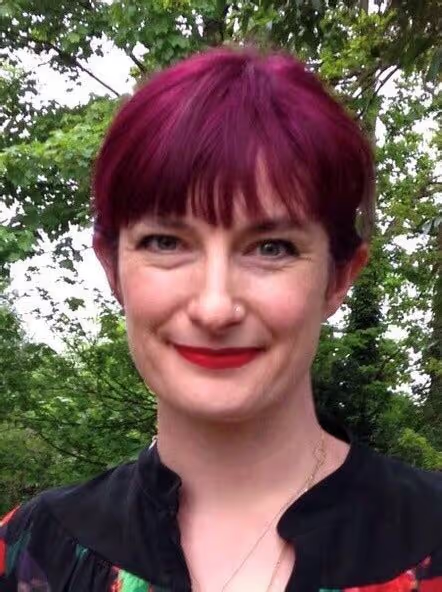
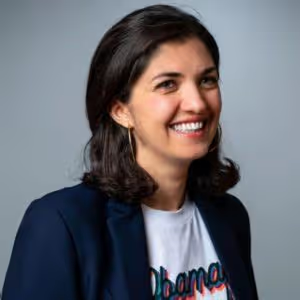
Zarlasht Halaimzai
Episode Summary
Q1: Place
If we could do a flypast on any part of the world that is significant to you, which place, city or country would it be and why?
Kabul in Afghanistan
Q2: Life
Give us a glimpse into your life story so far with an emphasis on what you are doing currently?
Eldest of five children, hospitality in Afghanistan, daily bombings, Uzbekistan, refugee status, academia, RTI, Greece. Obama.
Q3: Reset
Where on earth is your place or reset or re-charge?
My family and friends in London
Q4: Wonder
What wonder of the natural world excites you the most?
The expansiveness of the universe
Q5: Hopefulness
What is your story of hopefulness (not your own) about a person, business or non-profit who are doing amazing things for the world?
Mediator Gabrielle Rifkind specialises in conflict resolution with Oxford Process.
Q6: Insight
As we prepare to re-enter, what insight, wisdom or question would you like to share with us?
Can we come together as a collective as an ecosystem that is interdependent?

Transcript
Steve (host):
Welcome to the 30th Wonderspace journey. It's great to have you on board. My name is Steve Cole and since September 2020 I have been asking the same 6 questions to people from around the world. The questions revolve around life and wonder, places of reset and stories of hopefulness. The setting for all of our interviews is a virtual window seat on the space station, 250 miles above Earth, where we see everything from a different perspective.
Steve (host):
This week we are on a night time orbit over Europe and to experience these views with us In this ultimate window seat we welcome Zalasht Halamzee who is the founder of the refugee trauma initiative. A shorter version of this episode together with footage of this journey across Europe can be found at ourwonder.space. I start by asking Zalasht from this window seat 250 miles above earth which place city or country Would you want us to fly over and why?
Zarlasht:
So I think if I could fly over anywhere right now it would be over Kabul and Afghanistan where I was born and I'd like to fly not just geographically but I'd love to go back in time. I'm assuming this spaceship also doubles up as a time machine. And the time would be sometime in the 50s before the war started in Afghanistan in the 70s. The country was poor but 1 that was incredibly diverse and it has some of the most beautiful nature in the world, some of the most awesome mountain ranges in the world and it's an incredibly diverse country. So if you line up 20 people from Afghanistan you probably won't know that they all come from the same place.
Zarlasht:
Sometimes you can line up 20 people from the same family and you might not know that they're related because Afghan society is made up of Pashtuns, Uzbeks, Tajiks, Greeks. There's just such an array of diversity in the country. And before the international intervention, It really was a kind of a magical place where travelers from all over the world would go on the Silk Road and stop in Afghanistan as 1 of these countries where time had preserved these remote villages with their own very distinct culture and art traditions, oral history. And I would just love to have been around them to experience that side of Afghanistan, because when I was born, the war had already started. And so I was told these stories by my grandmother and my family of how amazing some of the traveling that they had done Afghanistan had been, but I was never able to do that because of what was going on.
Steve (host):
Zalast, give us a glimpse into your life story so far with an emphasis on what you're doing currently.
Zarlasht:
A glimpse into my life story so far would have to start in Afghanistan because it's everything that I do and who I am now and the way that I interact with the world. That foundation was very much set in a country where there is a very old ancient history that informs the identity of Afghan people. There is a very strong value system, a lot of which is based on generosity and hospitality, which is very much part of my ethos. And I was born at a time where these things were being threatened from external forces. So I remember growing up in a household where people lived in this very collective, caring way and in a place where you don't have social security.
Zarlasht:
So the protection and what you rely on is your community around you. And so you spend a lot of time nurturing that community and getting through really difficult things as a community and then healing together as a community. And so I grew up in those circumstances and from when I was born till I left at age 11, I saw the deterioration of the situation I want to start. But coupled with that, I also saw how communities every time tried their best to rise up and to meet some incredibly difficult circumstances. You know, anything from daily bombings to lack of, you know, food wasn't available for days or we couldn't have access to drinking water.
Zarlasht:
And every time something like that happened to families like mine. You know, I'm the eldest of 5 kids. So it's an average family. We're living in a house with our grandparents and, you know, my parents are trying their best to bring up their children under these circumstances. Every time something like that happens, communities kind of just came together and tried to work out a way of surviving as a collective.
Zarlasht:
And that left a huge impression on me, experiencing disaster in 1 way, but also seeing how you could respond to that and how you could actually respond to that with a lot of integrity and a lot of dignity. When the situation in Afghanistan for my family became completely unsustainable and we had to make a choice between staying there and possibly dying or leaving and trying to survive and this was an incredibly difficult decision that my parents made, and haste, and it wasn't sort of a deliberated decision over a period of time, it was something, it was a reaction to what was happening outside of our front door. So we decided to leave Kabul and make our way north first to Mazar Sharif and then we crossed the border into Uzbekistan and because there was really not a plan for what to do other than to kind of walk out whether it was a good idea to wait around the border for violence to stop so we could go back home or to try and find somewhere else to settle in. And this period of trying to work this out took 4 years because the violence in Afghanistan kept getting worse and worse and worse.
Zarlasht:
And In 1996, 4 years after my family left Afghanistan, the Taliban took over the country and the situation became exponentially worse. You know, they essentially made women invisible. They brought in some incredibly inhumane punishments and tried to really erase society in the country and rule it in this very brutal, tyrannical way. And so when that happened, my mom, who was a teacher and who had spent her entire life trying to keep children in school and particularly focusing on girls and making sure that they got an education, this was a nightmare for her. So we decided not to go back because we couldn't see that being a home for us and we couldn't see that we would be safe under those circumstances.
Zarlasht:
So my family emigrated to the UK where we became refugees And that was an incredibly difficult experience because all of a sudden you're plonked into a country, you don't speak the language, you don't understand what people say, you have no idea what people mean when they say it's raining cats and dogs. You're like, is it? So there's all these kind of weird things that you have to navigate. And it takes a really long time to figure all those cultural references, all the kind of social cues of, you know, how to create social capital for yourself in a country like this. So I went to school and then I went to university.
Zarlasht:
But the whole time I knew that I wanted to do something that was about helping people who through no fault of their own, were put in circumstances that they couldn't control. That was something that had made a really big impression on me when I was a child. Because suddenly, you know, on a click of a finger, everything kind of flips upside down, and you really, really don't have any control over it. And people find this experience, I think the vast majority of people find this experience incredibly destabilizing because you have to remake all your stories, your references, the things that, you know, you kind of have to remake your past in some ways, especially for countries that have gone through a war, but you also have to imagine a completely different future. And that's a really hard thing for people to do.
Zarlasht:
So that was something that I lived with in my teens and twenties and after you know working for different things and spending some time in Jordan and in Pakistan and in Turkey working in different emergency responses, I decided to set up a refugee trauma initiative, an organization that focuses specifically on the emotional fallout of experiencing violence and experiencing displacement as a result of violence. And we've been working in Greece now for 5 years. This month is our fifth birthday. Happy birthday, RTI. And you know, it's been an incredibly inspiring, difficult, painful experience to support people and have that privilege of seeing people find their resilience and really take care of themselves, but also be witness to the brutalization that is going on in our world today and how gratuitous that is and how much it impacts people and how long it takes for people to recover and to reconcile themselves.
Zarlasht:
In the time that we've been operational with RTI, we've supported thousands of refugees and forms of collective healing, therapy groups, counseling for families, early childhood support. And the work that we've done is very much informed by the identities and the histories of people that we work with. So it's not, you know, sort of parachuting a Eurocentric psychological model on communities, it's very much a way of co-creating what collective healing spaces are for people and then using the wisdom and the resilience and the skills that exist in the community to make those places really work for those who attended. And This work has received quite a lot of attention from different organizations. The World Health Organization has cited us as an example of best practice.
Zarlasht:
We've been covered by various international organizations, but the 1 that I feel very proud of is being awarded an Obama Fellowship for the work that RTI has done. And this was totally unexpected and completely blew my mind, especially because 20, 000 people from 190 countries had applied to become an Obama fellow and they selected 20, which was, you know, an extraordinary achievement for the organization and for me, but also I was so happy that a topic like trauma that refugees are experiencing will have that sort of a platform where I can talk to people that have much, much bigger microphones than I do about a subject that people need to listen to.
Steve (host):
Where on earth is your place of reset or recharge?
Zarlasht:
One of the challenges of having led a very nomadic life is that you really find it difficult to put your feet on the ground in a specific place and kind of put a flag there and said, this is where I recharge and this is where I recuperate. And to be really honest, I really haven't found that place yet. I think the closest place after Afghanistan to home is London. And this is where my family is and my friends are.
Zarlasht:
And so I think that is somewhere that I come back to, to connect to my community, to restore what's been lost through the work as someone who's working on something that has affected me. This is a big thing that you live with for the rest of your life. That sort of dislocation stays within you for a really long time. And the more I kind of do this sort of walk with myself, I sort of realized that I need to find a place of home within myself and within the community that is around me right now, rather than a specific geographical place. Because dislocation kind of takes that away from you.
Zarlasht:
And you need to find a different way. You need to reimagine what that is for you. And I think it's different for every person. For me it is, you know, it's friends and family. It's people that you can go to and just ask for a cup of tea and be your was self and they're there and they can just hold you for that moment.
Zarlasht:
I think that's the thing that for most people, if you have that, I think that's very lucky thing to have.
Steve (host):
What wonder of the natural world excites you the most?
Zarlasht:
I'm looking out of the window and I'm seeing the earth. And this is perfect because it's exactly this side of the natural world that really excites me. And having experienced the world and its most tumultuous, 1 of the things that gives me a great deal of comfort is the expansiveness of the universe and how unfathomable it is, that there is this vast universe and in the middle of it, in the corner of it, there's a tiny bowl that is kind of hanging on its own. And the reason that it gives me a great deal of comfort is that when you zoom down, when you go down on earth and when you go into a village where, some of the people that I work with have been affected by, the kind of things that they've been affected by. I find such an enormous comfort connecting that back to the universe because I think, you know, we could do our absolute worst and the universe would be intact.
Zarlasht:
And that gives me a real comfort. I'm actually really interested in astronomy and you know our solar system and you know what lies beyond it and the galaxies and how you know these forces move and clash and explode and create new things. That to me is very comforting.
Steve (host):
Zalast, what is your story of hopefulness that's not your own about a person, business or nonprofit who are doing amazing things for the world?
Zarlasht:
My story of hopefulness concerns someone called Gabrielle Rivkind, who is a psychotherapist by training, but she has spent the last 25 years working on conflict resolution. And her idea is that, you know, to make peace, to end conflict, you really need to bring the differences of the people into a room and you need to have a way of resolving those with empathy and allowance of people to grieve, to kind of express anger, all the kind of things that we do in a therapy room is necessary when you bring 2 warring factions together and that the only way to reconcile is to really try and understand the other person's perspective just as a human being, not as someone that's attacking you or, you know, as a geopolitical rival, but as someone who on the other side is trying to raise a family and has aspirations for the future. And she's done this work in lots of different countries like in Israel and Palestine, she's worked in, you know, the Middle East and she's worked in Spain with the Catalan separatists. So and I think it's exactly what we need when we're thinking about conflict resolutions and peacemaking.
Zarlasht:
We need to understand the psychology of the people and why they get stuck in positions that perpetuate violence. And what can we do aside from these you know rooms where lots of men sit together with lots of egos to try and negotiate deal How can we move away from that model of peacemaking to actually creating a space where people can express their vulnerability? And I don't mean that in a sort of kumbaya type of way, but express that I am afraid for my child, you know, and that's why I'm taking this position and I'm afraid for this or I think that's... I don't think without that you can make peace and part of that type of peacemaking also involves bringing other people in the room. So you know you have women in the room, you have people who are young people in the room whose future is at stake.
Zarlasht:
And then I think that can shift the paradigm to something that could actually work in terms of making peace between different warring factions and I think if we can't do that, if we aren't able to come up with some sort of a framework for resolving conflict without violence, I think we're just going to continue seeing more and more and more misery and desperation in the world. So my story of hopefulness is Gabrielle Rifkindt who is the founder of Oxford Process that works to help people stuck in conflict and manage their radical differences.
Steve (host):
Finally as we prepare to re-enter What insight, wisdom or question would you like to share with us?
Zarlasht:
The insight I'd like to share is to do with my wonderment of the natural world or the natural universe. And I said that 1 thing that gives me a great deal of comfort is realizing how incredibly vast the universe is, and that the earth, you know, with all its folly, can't really change the destiny of the universe. And that gives me quite a lot of comfort given what I do. But I would love and am doing everything that I can to get this beautiful planet of ours on the right track and to help it heal and to help it be what it has been for us, you know, just an incredibly nurturing, beautiful habitat that has sustained and produced so much life and wonder. And I think that as human beings, we're in this crossroads.
Zarlasht:
And I really feel it every day when I wake up. I think there is an Islamic tradition, human beings are tested against different things. You're tested to see what you're made of. And I really feel like we're in 1 of those poignant moments of history where we are being tested. And the test is actually, it's a very simple 1 in some ways and very, very hard in others.
Zarlasht:
The test is whether we can come together, whether we can find a way to each other and recognize our species and other species in the world as a collective, as an ecosystem that's depend and interdepend on each other and live in a way that honors that dependency or carry on the way that we are carrying on and just live as individuals.
Steve (host):
To find out more about the Refugee Trauma Initiative, go to RefugeeTrauma.org. In her story of hopefulness, Zalash spoke about Gabrielle Rifkin from Oxford Process. They can be found at OxfordProcess.com. To listen to the previous 29 Wonderspace interviews, the website is ourwonder.space. I want to thank Zarlasht for joining us on this Wonderspace and I hope you can join us next week for more wonders and stories of hopefulness.