Episode #
29
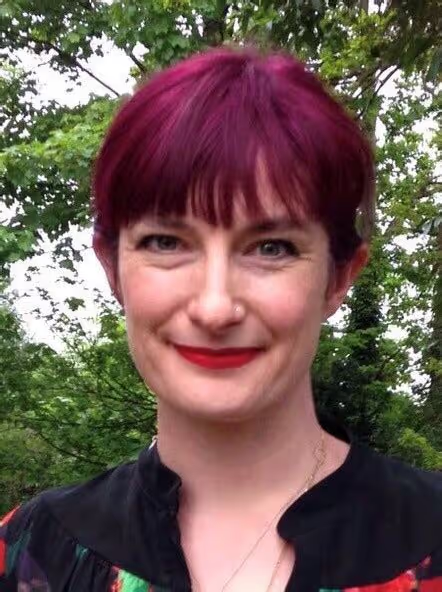
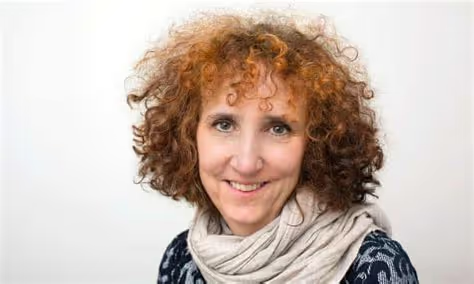
Marina Cantacuzino
Episode Summary
Q1: Place
If we could do a flypast on any part of the world that is significant to you, which place, city or country would it be and why?
Romania
Q2: Life
Give us a glimpse into your life story so far with an emphasis on what you are doing currently?
Journalism, Red Cross and Oxfam, counter-narrative after Iraq War, collating stories about forgiveness and reconciliation.
Q3: Reset
Where on earth is your place or reset or re-charge?
Wild swimming in the Hampstead ponds in London
Q4: Wonder
What wonder of the natural world excites you the most?
The Heron
Q5: Hopefulness
What is your story of hopefulness (not your own) about a person, business or non-profit who are doing amazing things for the world?
Mina Smallman, the mother of two teenagers who were murdered in a random attack. With courage, dignity and clarity Mina drew attention to the fact that their deaths were not taken seriously because of the colour of their skin.
Q6: Insight
As we prepare to re-enter, what insight, wisdom or question would you like to share with us?
I’m so much happier embracing uncertainty, acknowledging that I don’t have everything figured out.

Transcript
Steve (host):
Welcome to the 29th Wonderspace Journey. It's great to have you on board. My name is Steve Cole and since September 2020 I have been asking the same 6 questions to people from around the world. The questions revolve around life and wonder, places of reset and stories of hopefulness. The setting for all of our interviews is a virtual window seat on the space station 250 miles above Earth where we see everything from a different perspective.
Steve (host):
This week our orbit will take us from Algeria to Romania and to experience these views with us in this ultimate window seat we welcome Marina Cantacazino. Marina is an award-winning journalist who founded the Forgiveness Project that works around the world building a climate of tolerance, resilience, hope and empathy. A shorter version of this episode together with footage of this journey from Algeria to Romania can be found at ourwonder.space. I start by asking Marina, from this window seat 250 miles above earth, which place, city or country would you want us to fly over and why?
Maria:
Well, I think I'd have to choose somewhere in Romania, because my father, he was Romanian, came to this country when he was 12, just before the Second World War. And I've been several times, and I've always felt a connection with the place, even though, you know, I was born here and I'm very British. It's a place in the north of Romania called, the area is called Maramureș and the actual place is a village called Breb. It's on the Ukraine border and it's a stunningly beautiful, mystical, magical place. It's got traditional ancient timber, houses, it's got 16th century church, horses pulling carts, very, very few cars, very isolated, medieval in a sense, and it's a place you completely lose yourself and you're in another almost another era and almost in another realm.
Maria:
I just loved it. I've been twice only but that is where I would gravitate towards. And I think it's particularly because I live in a quite central London, in a very residential street, and I was interested to read recently that in the last 10 years there's been a 70% increase of traffic on our streets in London, in residential streets. And so when I think of a place that's restorative for where I want to go, it's where there's very few cars and that is Breb in Maramures, in northern Romania.
Steve (host):
Marina, give us a glimpse into your life story so far with an emphasis on what you are doing currently.
Maria:
Much of my life was spent as a freelance journalist and then more latterly the last 18 years I've been the founder and for many years the director of a charity called the Forgiveness Project. But I put it all back to my childhood actually, I've often thought this. I grew up in a very happy family but I had a terminally ill brother who I always knew was going to die and who I was very close with. And he did die at 17 when I was 21. And I think that experience actually really made me the person I am and the person who felt sort of strangely comfortable around pain and difficulty and difference and otherness.
Maria:
And the very first article I ever wrote, and it was in the day's pre-email, when you just sent things in the post to editors, I sent it to the Guardian Women's Editor and it was an article about being the sibling of a terminally ill brother and how that impacted on me. And the article was published and I was very surprised. And basically it gave me the confidence to think, oh, I could be a journalist. That's what did it, that article. And I then had many years as the main breadwinner, 3 children, I was doing some amazing work for Oxfam, Red Cross, all sorts of articles that were just so interesting, very much human stories based on people overcoming difficulties, a lot around illness and conflict.
Maria:
And I think it was that. I also wrote a book called Till Break of Day about London Lighthouse, which was a centre for HIV and AIDS. So I did a lot of work around AIDS. All this, I think, led to me starting the Forgiveness Project, which I found in 2004. It was really a response to the Iraq war in 2003.
Maria:
I felt quite incensed by that, this if you're not with us, you're against us attitude. I just didn't get it. And I wanted to find counter narratives. I wanted to find stories where people had been hurt or traumatized or suffered atrocity, but not sought revenge. And so as a very private project that I did with a friend who was a photographer, we were doing this work as journalists at the time, working for Oxfam, Red cross, etc.
Maria:
I said to him, why don't we just see what sort of stories we can find about forgiveness and reconciliation and where people had demonstrated empathy and compassion as opposed to wanting revenge and retaliation. And he agreed. And so for a year we spent collecting the stories and then we're lucky to meet Anita Roddick, who was the sadly dead now, but was the founder of the body shop. And she saw the raw material of his photographs and my stories that I've written up of all these people I've met. And I should say there were victims and survivors and former perpetrators, people who'd transformed their aggression into a force of peace.
Maria:
And she was so moved, Anita Roddick was just so moved by these stories. She funded it as an exhibition, which became the F Word exhibition, which was launched in 2004. And I thought my life would go back to journalism. I had absolutely no idea that this subject of forgiveness, which we approached in a very real and sort of gritty way. There was no way was anyone saying you must forgive and if you don't forgive, your life will be depleted in some way.
Maria:
It was really people's difficult, complicated experiences around just being determined to draw a line under the dogma of revenge. And people were overwhelmed, well rather the interest was overwhelming and I founded the charity as a result. We called it the Forgiveness Project because By then I knew that forgiveness was a difficult subject, that people were inspired or affronted by it in equal measure. But I also knew it was potentially transformative. And some of the people I met along the way from South Africa, from Northern Ireland, from America, from Europe, they were so inspiring and their stories were so hopeful in a time of such despair really, which hasn't changed.
Maria:
And I saw it as, you know, stories that heal, rehumanize and offer hope as opposed to, as an antidote to all the stories that we hear all the time, which are about division and antipathy and retaliation and insularity. So the Forgiveness Project, which is a charity, which is amazing that it still continues 18 years on, we work with real stories. Everything we do is around narrative. We work in prisons, we work in schools. I have developed a podcast called the F Word podcast.
Maria:
We have exhibitions all around the world. We put on online events now mainly of course. And I have really tried to comment about aspects of political and personal life where people are quick to judge, quick to retaliate, quick to seek revenge, quick to cut people off because they don't meet your expectations. We like to change the discourse around that and offer tools through stories. Because we're not saying this is what you need to do.
Maria:
We're saying consider this, read this story, watch this story, think how this might relate to your life and what seems to happen is that people are inspired to act and think differently as a result.
Steve (host):
Where on earth is your place of reset or recharge?
Maria:
Most definitely Hampstead ponds in London. I have been doing what they call wild swimming now for about 10 years That means you swim at all weathers, winter, summer. And I go there at least twice a week and there's the women's pond, there's the men's pond which obviously I don't go into, and there's the mixed pond. And I'm also a member of the Winter Swimmers Club. And it is just an incredible place to get to.
Maria:
I also have taken up cycling since lockdown and I actually love that. So it takes me about 20 minutes to cycle up there and then I get very cold at the moment and go into the very very cold water and just feel so energized and alive and with the trees, sky, quiet of the heath, It is absolutely wonderful. I often go by myself, I also go with my husband a lot and that is the place that I probably love most in London anyway.
Steve (host):
What wonder of the natural world excites you the most?
Maria:
The wonder of the natural world that excites me the most is possibly a strange 1 and I have to think long and hard about this because I'm a city person. I was born in the city and raised in the city and live in the city and will I'm sure die in the city. But the thing that I'm most excited to be is the heron, the bird, and this is because I discovered the heron at Hampstead Ponds And I often talk about the heron. So if I've been, I'll come back and say, oh, I saw the heron today. And of course, there's more than 1 heron.
Maria:
But in my mind's eye, there is there's a single heron in hamster teeth. And sometimes I'm lucky enough to see it. And I'm very short sighted. So when I'm swimming around and I just do sort of very leisurely swimming with my head above water I sometimes see this sort of grey thing in the distance and I think is it the Heron? Often it's a rock but sometimes it's the Heron and what I love about them they're very sort of prehistoric in look and of course there are many many types of herons and I don't know what type of heron this is but it's very large and it's very lugubrious and it and and it sort of pecks away at things in this sort of dark light manner So it's slightly sinister but I feel very safe around it and actually it's the Heron in Greek mythology is represented as a messenger to the gods and some Native American tribes focused on its inquisitiveness and curiosity and determination which is why it's viewed as a symbol of wisdom.
Maria:
So I think my natural sort of love of the heron just, you know, just comes from being in such close proximity to it really. Sometimes I'm just inches away. It's remarkable.
Steve (host):
Marina, what is your story of hopefulness that's not your own about a person, business or nonprofit who are doing amazing things for the world.
Maria:
So my story of hopefulness is a person and her name is Minna Spallman. And actually, you know, I wondered about choosing her because it's actually a story, a tragic story of despair. But she gives me great hope. Many people won't know who she is. She came to prominence really last year when her 2 daughters were both murdered in an unprovoked and random attack in a park in Wembley.
Maria:
And she's only given 2 interviews, both to the BBC. She said very, very little about it. She's a former archdeacon. But both times, she's been unbelievably composed and articulate, drawing attention to the fact that their deaths were not taken seriously by the police because of the color of their skin, her daughter's skin and hers. And she said recently, she said, you know, she said, I think the notion that all lives matter is absolutely right, but it's not true.
Maria:
There was no urgency about looking for 2 black women who went missing. And she said very little, but everything she says really pierces my heart in a way that I want to, in a way that opens my heart. You know, it's a response that I can't fully explain. And it could be something to do with this park. It's not too far from where I live.
Maria:
So there's an immediate connection. I have 2 daughters myself. And yes, of course she's angry, but she has such dignity and such clarity and she's not emotional. I find her utterly inspiring. As a mother, She's completely broken, but she's also an activist.
Maria:
And what gives her purpose, I think, is hoping some good will come out of this and that if her daughter's lives can make a change as to how women like them are viewed, and black women in particular, that then it won't all be in vain, you know, that is her kind of message as an activist. And yeah, I think she's extraordinary. And so Minna Spallman is my chosen woman.
Steve (host):
Finally, as we prepare to re-enter, what insight, wisdom or question would you like to share with us?
Maria:
The insight I'd like to share, it's quite a personal insight, but I don't know, it might resonate with some people. It's around spirituality and faith. So I've been a Buddhist for 30 years. It's a form of Japanese Buddhism, Nichiren Buddhism, and it has a lay organization called Sakagakkai, and I've been a member for years. But during lockdown I relinquished my membership.
Maria:
That is not to say, in my mind I relinquished it. It's not to say that I'm not still a Buddhist and I still meditate and I still believe in the philosophy, but I don't consider myself a member of an organization anymore because this particular Buddhism is very goal-orientated And it's very set and very certain about this is the way to enlightenment. This is the way to change your karma. If you do these certain things, then this will happen. Very prescriptive.
Maria:
And then I got this book by Richard Raw called Falling Upward. And he talks very much about the first and second half of your life, about what might be a container for the first half isn't necessarily right for the second half. And it really kind of spoke to me and I just realized that I wanted to break free and be... That I didn't know that everything I was told this is how it is and this is how you will do that. I was just questioning everything and I realized it wasn't working for me anymore to be contained in this organization within this particular religion because I think spiritual Reality is all about change and growth and I felt very stuck and very fixed in the way of viewing the world And I understand that the rhetoric of certainty is safe because certain rules Easy to follow if they promise a bright future, but when those rules don't work for you anymore.
Maria:
And I suddenly realized I was so much happy embracing uncertainty and about acknowledging that I don't have everything figured out. And that that in a way was fueling my curiosity and fostering, I think, a more open mind. So I'm just really drawn to this idea of questioning as exploration and as a relief from certainty and I have felt this kind of thrilling liberation as a result.
Steve (host):
To find out more about The Forgiveness Project, go to theforgivenessproject.com. To join the Wonderspace community and share your own wonders and stories of hopefulness or to listen to the previous 28 interviews the website is ourwonder.space I want to thank Marina for joining us on this Wonderspace and I hope
Maria:
you