Episode #
21
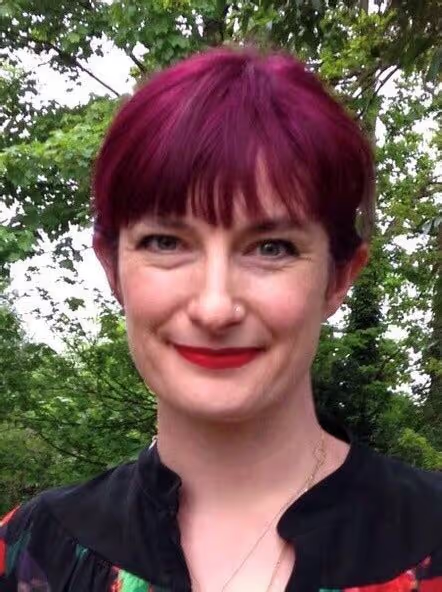
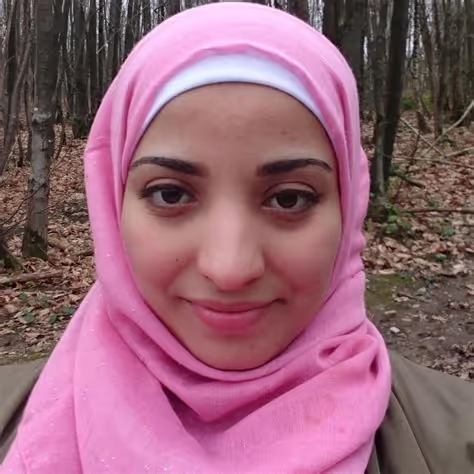
Reem Alsayyah
Episode Summary
Q1: Place
If we could do a flypast on any part of the world that is significant to you, which place, city or country would it be and why?
Damascus in Syria
Q2: Life
Give us a glimpse into your life story so far with an emphasis on what you are doing currently?
One of eight children, studied in Damascus and became refugees in Jordan. Had the opportunity to be part of a drama project called the Syrian Trojan Women which enabled women to speak about their stories about the war on the theatre stage. This play became Queens of Syria that eventually toured the UK.
Q3: Reset
Where on earth is your place or reset or re-charge?
I don't have a certain place. I believe that it's all related to the state of mind and soul that you have. There will be people who have everything and they won't be able to reset or recharge because they are lost from inside.
Q4: Wonder
What wonder of the natural world excites you the most?
Big open spaces that brings perspective
Q5: Hopefulness
What is your story of hopefulness (not your own) about a person, business or non-profit who are doing amazing things for the world?
All refugees, the hope seekers who despite facing terrible things, never gave up and were able to start their lives from square one.
Q6: Insight
As we prepare to re-enter, what insight, wisdom or question would you like to share with us?
The world is bad, not because it's filled with bad people but because it's filled with good people who know nothing.

Transcript
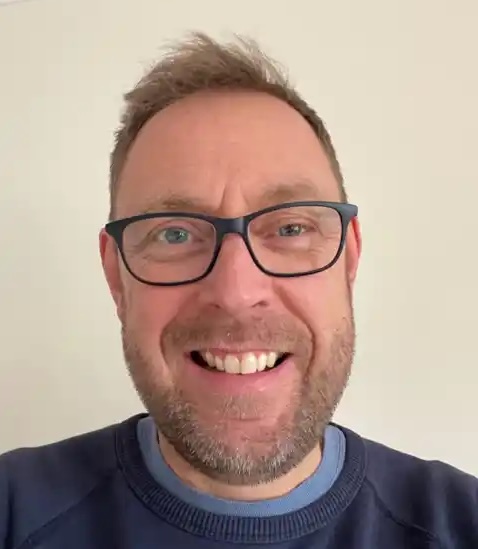
Steve (host):
Welcome to the 21st edition of Wonderspace. It's great to have you on board. My name is Steve Cole and since September 2020 I have been asking the same 6 questions to people from around the world. The questions revolve around life and wonder, places of reset and stories of hopefulness which I think we need more than ever. The settings for all of our interviews is a virtual window seat on the space station 250 miles above Earth where we see everything from a different perspective.
Steve (host):
This week our orbit will pass over the coastlines of Oman and Yemen and to experience these views with us in this ultimate window seat we welcome the amazing Reem Al Sayyar from Damascus in Syria. Reem has acted in various theatre productions in Jordan and in the UK and recently finished her degree in computer network engineering with Damascus University. A shorter version of this episode together with footage of this journey over the coast lines of Oman and Yemen can be found at ourwonder.space. I start by asking Reem, from this seat 250 miles above earth, which city or country would you like us to fly over and why?
Reem:
This city is going to be Damascus. I was born in Damascus. There are 2 significant places in Damascus that I'm so attached to. The first 1 is the Umayyad mosque. I remember, I still remember when I first entered there, when I was like maybe 4, 3 years old, I had the feeling that I'm entering the heaven.
Reem:
The other place which is also so attached to me and to my soul is the very big olive tree field in Damascus support near my grandparents house. And you just look around and all you can see is just olive trees, very big olive trees. Everything above you is green, everything under is green and these 2 places are kind of the dream that I try to go back to whenever I feel sad or I feel nostalgic.
Steve (host):
Reem, give us a glimpse into your life story so far.
Reem:
I was born in Damascus. I'm 1 of 8. My family is a very normal middle-class family. My father was a lawyer. My mother is like the greatest mother ever.
Reem:
I went to Damascus University. I was studying networking engineering and then when the war started we had to flee to Jordan And all of our life has been just turned upside down. We become refugees and difficult life in Jordan was waiting for us. In Jordan, I had many jobs just to be able to support my family like a secretary in a law firm and a receptionist in a dental clinic. Then I got the opportunity to be part of a drama project called the Syrian Trojan Women, which enable women to speak about their stories with the war on the theatre stage.
Reem:
After that I was involved with another project called Oliver in Arabic which is the same Oliver Twist musical in English but it's the Arabic Virgin. And after that I had the opportunity to come here to the UK with my mom and my 2 sisters and my 2 aunts to do a new version of the Syrian Trojan women called Queens of Syria and we were able to do a tour all around the UK. We've been to many cities and that was 1 of the most amazing experiences I ever had in my life and we were able to speak about the voices of the Syrian women. After the tour was over, we decided to stay here and seek asylum. So we sought asylum and we were able to bring our families from Jordan to the UK under the family unification scheme.
Reem:
UK for me is my home now. I don't feel that I'm a stranger. I always felt that I'm welcomed, I'm loved, and I'm in my place. My family is also happy here. Although I had to really take care of them, I've been able to be involved in many other projects here in the UK.
Reem:
1 of them is called Desperate Journeys and it's a simulation that lets the people walk in the refugees shoes and It's actually been done to raise empathy towards refugees. I was also involved with other projects like the welcoming party and I was trying to do my own project about documenting the stories of Syrian refugees, mainly women. I've been an activist when it comes to refugee rights and women rights in general. I'm actually now trying to get a job that enables me to do the things that I feel that I'm the most motivated to do. I also want to raise awareness regarding the situation of refugees and Syria both inside and outside Syria.
Reem:
What lots of people don't know is that the situation is still very bad. It's very difficult there. The economy is wrecked. People are unable to afford to put a meal on their tables. They are not able to afford medical care, bread, gas, electricity, all of these very basic things are very hard to get in Syria.
Reem:
There is no electricity, there is no internet and even if there was internet it's gonna be like very limited because of the limited electricity. I feel that I have the responsibility to speak up and tell the world that there are still people who are suffering in and out Syria.
Steve (host):
Where on earth is your place of reset or recharge?
Reem:
I don't have a certain place. I believe that it's all related to the state of mind and soul that you have. There will be people who have everything and they won't be able to reset or recharge because they are lost from inside. But I believe that you can reset or recharge even if you were in the worst places ever. Just if you had the right set of mind.
Reem:
Try to meditate, try to let go, try to fill my heart with good thoughts, with love, and only then I'll be able to reset and recharge. For me as a religious person, praying as well is 1 of the key things that I do to reset and recharge, regardless of where you are. It's more about how do you feel, what's inside your mind, what's inside your heart, what's inside your soul.
Steve (host):
What wonder of the natural world excites you the most?
Reem:
Any open landscape, mountains, deserts, forests. And the reason why is because it reminds you how small you are comparing with the world that you live in and it's kind of reconnected you to your nature as a human being because we are a very very small tiny part of this big thing.
Steve (host):
Reem, what is your story of hopefulness about a person, business or non-profit who are doing amazing things for the world?
Reem:
My story of hopefulness is the story of all refugees, mainly Syrian refugees because I'm a Syrian. I believe what refugees have done is amazing because they tried to restart their lives from square 1. They were able to learn new languages, they were able to work and to study. They were trying to go and find better places, They were trying to cross the seas, cross the borders, try to get better life for their children. And they were able to face horrible things like death and sometimes all the world would be against them but they didn't give up.
Reem:
They were the hope seekers. They were able to learn new languages. They were able to work and be affected and mixed with other communities. We now see Syrian food in countries like Germany, like the United Kingdom, like America, like Canada. We now see Syrian culture all around the world being celebrated.
Reem:
I have seen refugees who have done a great job, who have been great in sport, who have been great in science, who have been great in medical field. All of these people have been through so, so much, but they didn't give up. And I believe that my family and I are 1 of these refugees. And none of the things that we've been through was easy. It was all difficult, but we kept on going.
Reem:
And all the refugees are trying to tell the people about how beautiful Syria is. It has like a great heritage, it has a great history. It is 1 of the most beautiful places in the whole entire world and I hope to be the 1 who speaks about these refugees and about the country that they came from. Syria is a wonderful place. It has a wonderful culture.
Reem:
We have the greatest food ever. We had the greatest celebrations. And we still have the hope to rebuild this country from scratch. And we still have the hope to rebuild this country from scratch and we still have the hope to be free and to be able to decide our own destiny. We still have hope to be a democratic country where we can elect our president.
Reem:
We still have hope that the next generations in Syria are going to live happy and freely. And it's still a dream, but again it's all about hope. And sometimes everything you need to stay alive is hope.
Steve (host):
Finally Reem, as we prepare to re-enter, what insight, wisdom or question would you like to share with us?
Reem:
The wisdom I want to share with you is something that I read a long time ago. I can't remember where or when I read this, but it says that the world is bad not because it's filled with bad people, but because it's filled with good people who do nothing. And That changed the way that I look to myself. And I believe that as a good person, I shouldn't just like say, oh, I'm a good person. What's going around me is horrible.
Reem:
No, I need to do and act. And I think that all the good people need to go and act. We need more good people in politics. We need more good people in industry. We need more good people in science.
Reem:
We need more good people in all fields of the life. And that's hopefully is going to make the world a better place to live in.
Steve (host):
Reem was keen for us to promote the UK charity Empathy Action, which she spoke about in her story. You can find out more at empathyaction.org. To join the Wonderspace community and share your own wonders and stories of hopefulness or to listen to the previous 20 interviews the website is ourwonder.space. I want to thank Reem for joining us on this Wonderspace journey. Next week we will be joined by Kenene Matuni from the DRK Foundation and the Impact Investors Network Tonic.
Steve (host):
I hope you can join us then.