Episode #
20
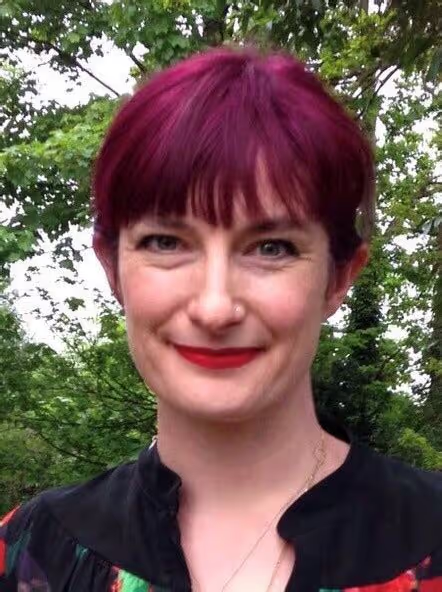
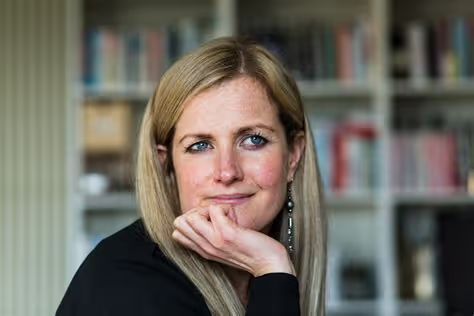
Katherine Trebeck
Episode Summary
Q1: Place
If we could do a flypast on any part of the world that is significant to you, which place, city or country would it be and why?
My adopted home of Scotland
Q2: Life
Give us a glimpse into your life story so far with an emphasis on what you are doing currently?
Australia, Indigenous communities, inequality and power structures, Oxfam, changing the economic system, The economics of arrival book with Jeremy Williams, WEAll and WEGo
Q3: Reset
Where on earth is your place or reset or re-charge?
Red Hill in Canberra, Australia
Q4: Wonder
What wonder of the natural world excites you the most?
Seeing regrowth after a bush fire
Q5: Hopefulness
What is your story of hopefulness (not your own) about a person, business or non-profit who are doing amazing things for the world?
Galgael in Glasgow provides skills, purpose and community to people coming out of prison or struggling with addiction.
Q6: Insight
As we prepare to re-enter, what insight, wisdom or question would you like to share with us?
Let's continually ask ‘but why'? Why are people needing foodbanks, medical attention for stress? Why are people turning to drugs and alcohol? Why are people feeling lonely? Why are people committing suicide? Why are we pushing the planet, beyond the brink?

Transcript
Steve (host):
Welcome to the 20th edition of Wonderspace. It's great to have you on board. My name is Steve Cole and since September 2020 I have been asking the same 6 questions to people from around the world. The questions revolve around life and wonder, places of reset and stories of hopefulness, which I think we need more than ever. The setting for all of our interviews is a virtual window seat on the space station 250 miles above Earth where we see everything from a different perspective.
Steve (host):
This week our journey will orbit over Athens and Beirut and will feature a stunning pass of the River Nile outlined by a network of city lights. To experience these views with us in this ultimate window seat we welcome Dr. Catherine Trebek who is a writer researcher and is the advocacy and influencing lead for the Wellbeing Economy Alliance or We All for short. Katherine is also the co-author of a brilliant book titled The Economics of Arrival. A shorter version of this episode together with footage of this night journey over the River Nile can be found on our website ourwonder.space where you will also find the previous 19 episodes.
Steve (host):
I start by asking Catherine, from this seat 250 miles above earth, which city or country would you want us to fly over and why?
Katherine:
Steve, It has to be this country that is my adopted home of Scotland. It's a place I've lived for 15 years now, a place I've visited many times before that and just couldn't get it out of my system. And even When I'm away from it for a short period of time, I miss Scotland. It's hills, the passionate people, the architecture, the stories, the laughter, the cheekiness, the grittiness, the energy, the passion. And so it has to be Scotland for all that's bound up.
Steve (host):
Catherine, give us a glimpse into your life story so far with an emphasis on what you are doing currently.
Katherine:
I once heard a phrase and apparently it was Ernest Hemingway who said the world is a fine place and worth the fighting for And I have been so lucky in my life to have many, many examples and personal experiences of what a fine place the world is. I've been able to experience the many gifts of the world, many gifts of community, many gifts of growing up in a fairly wealthy, safe country of Australia. But I've also through my work, whether it's with Indigenous communities in Australia or living for some time in Africa, or even in some of the most marginalized communities in Glasgow, just had so many examples of that it does need fighting for. There's not enough that goes around and not enough distribution and so often that's connected to the economy and so in hindsight I don't think I made very conscious career choices. I always thought about where do I want to be, what's interesting, never thinking about how do I get to the top of an organization or anything like that.
Katherine:
But I've always been driven by how can we really change the tide on vulnerability and power structures and blinker thinking that despite this world of plenty means there's still so much suffering and inequality. So my work is all about trying to change our conversation about the economy and change the sort of policies and power structures that do so much damage to people around the world. And so at the moment, it's through the Wellbeing and Economy Alliance in the past, it was with Oxfam in the future, who knows, but I think that's a bit of a golden thread that comes from being very conscious of how fortunate I've been, but also really getting to know and experience people who are just made vulnerable by the moving plates and the inequalities that blight the planet. So the Wellbeing Economy Alliance, which rather beautifully shortens to We All, is all about connecting the amazing work that's already being done. There are so many islands of pioneering activity, whether it's incredible businesses that are turning their attention to changing the economic system, bringing about social or environmental benefits, there are impatient radical young activists, There are scholars who are building the evidence base, there are community groups, there are cities, there are policymakers, all of them wanting to connect up more and learn from each other and collaborate.
Katherine:
And so our job is to nurture them, to link them together, to amplify them so that the world hears about them and is inspired by them. And just in the last few weeks, we've had the really exciting news that the fifth country of Finland has joined this partnership that we created a few years ago that now the Scottish government leads on, the Wellbeing and Economy Governments Partnership, WeGo. So that's Scotland, New Zealand, Iceland, Wales, and now Finland. And these are countries who really recognize that in the 21st century, development cannot be about how big's your GDP. It has to be about how much do you deliver for people and planet but they're also united by humility that none of them have all the answers so they want to learn from each other and collaborate on that change that we all know is so necessary.
Steve (host):
Where on earth is your place of reset or recharge?
Katherine:
I'm lucky in that I can recharge pretty much wherever I am with a friend or a glass of wine or being able to stare out for 5 minutes at a sunset. But I'm thinking about is there any 1 particular place that if I could choose to be anywhere. And it takes me back to my hometown of Canberra in Australia where I grew up and about 200 meters from my mum and dad's house there's a small hill called Red Hill and all through my school days I'd try to do a daily walk up this hill. And there was 1 particular tree that I sat down underneath. And it's this beautiful, beautiful gum tree.
Katherine:
And looking out from sitting down underneath that tree, I could see the valley below with the houses and the buildings. But beyond that, this beautiful mountain range called the Brindabellas. I could listen to the birds, hear the distant cars but no I was separate from that because I was surrounded by nature, sometimes see a kangaroo and watch the sun go down and that is the place that when you're doing a meditation or something and they say, go to a place where you feel peaceful, that's the place I always go to. So even though I haven't been there for about 3 years now, that's the place where I would really love to be right now and catch my breath and get some solace.
Steve (host):
What wonder of the natural world excites you the most?
Katherine:
The wonder of the natural world that excites me so much is seeing regrowth after a bushfire. Like many Australians, I've been involved or been in the midst of a bushfire. For me, it was 2003 when huge bushfires almost destroyed the outer suburbs of Canberra where I always grew up. And I remember driving along, trying to get my grandma out of her house where she had literally burning embers falling into her backyard and just remembering the devastation of the sound of the bushfire that you hear before and then also of course how dark the streets became by 4 or 5 hours before the fire front had even hit. But what's extraordinary is how the landscape can change within 10 minutes.
Katherine:
Within 10 days, you're already seeing regrowth, these tiny bright green shoots coming up through the blackened trees and through the soil. And to me, that's just such a sign of hope that mother nature could be inflicted with such carnage but very quickly start to see her open up her eyes and come out again and I just hope we never push her so far that we can't get those signs of regrowth.
Steve (host):
What is your story of hopefulness that's not your own about a person, business or non-profit who are doing amazing things for the world? My story
Katherine:
of Hopefulness comes from an incredible organization that I've known for many years and it's an organization called GalGail and they operate out of this huge warehouse just on the south of the River Clyde in the place called Govan, a former shipbuilding community and they are all about giving folks who have just come out of prison or tackling addiction or long-term unemployment, giving them not just some skills and a sense of purpose, but a sense of community, and they call it a clan, giving them a sense of clanship. They eat together over a massive soup bowl every Thursday night. And what they do in this huge warehouse is use traditional shipbuilding techniques. So there's woodwork, there's joinery, there's the sound of hammers hitting wood, there's a smell of wood being cut, lots of shouting, lots of laughter, lots of banter. And it's the most amazing space to go into.
Katherine:
It visually looks incredible, it smells extraordinary, but what they're doing, I think, is probably quite literally a suicide prevention campaign. They always recognise they're just a sticking plaster. They're very humble and very attentive to the nature of the wider economic system that is driving people to their doors. But I think they're just an extraordinary, very, very precious organisation. It's very fragile, but completely inspiring in just the consistency and the sincerity of their work.
Katherine:
So I just, I love being around them. I love visiting them. I love hearing about them. And I'm so proud to know this organisation.
Steve (host):
Finally, Catherine, as we prepare to re-enter, what insight, wisdom or question would you like to share with us?
Katherine:
So the question I'd like to share with people is always act like my little nephew when he was 4 years old. And he was in that phase. I think anyone who knows a 4 year old will recognize when they're constantly asking, but why, but why, but why, but why, And I think we need to be like our little four-year-old nieces, nephews, sons, daughters, grandkids, and not take us on face value or the harm being done to the world. We need to ask why are people needing food banks? Why are people needing medical attention for stress?
Katherine:
Why are people turning to drugs and alcohol? Why are people feeling lonely? Why are people committing suicide? Why are we pushing the planet beyond the brink? And keep asking, but why?
Katherine:
Until there is no longer about why that we can ask. And that takes us to the territory of how we've designed our economic system and take with that the ambition to be more ambitious, to raise our gaze from just treating the symptoms of an inhumane economic system. Helping people survive and cope is humanitarian work and it's wonderful and necessary. But how can we go beyond that? How can we really go upstream and we'll only do that when we be like my little four-year-old nephew and ask but why?
Steve (host):
More information about Catherine and her work can be found at KatherineTribbeck.com and WellbeingEconomy.org. In her story of hopefulness Katherine highlights an amazing work in Govan in Glasgow called Galgal which can be found at galgal.org. That's G-A-L-G-A-E-L. To join the Wonderspace community and share your own wonders and stories of hopefulness or to listen to the previous 19 interviews the website is ourwonder.space I want to thank Katherine for joining us in this Wonderspace journey. Next week we will be joined by a wonderful activist and creative from Damascus in Syria.
Steve (host):
I hope you