Episode #
16
Donnie Maclurcan
Episode Summary
Q1: Place
If we could do a flypast on any part of the world that is significant to you, which place, city or country would it be and why?
The Nullarbor Plain in Australia
Q2: Life
Give us a glimpse into your life story so far with an emphasis on what you are doing currently?
Sydney, inequality, Egypt, Kenya, Economic Growth on a finite planet, how do we see new forms of business flourishing within ecological limits?
Q3: Reset
Where on earth is your place or reset or re-charge?
8000 pinned Swedish healing mat
Q4: Wonder
What wonder of the natural world excites you the most?
The abundance of seeds
Q5: Hopefulness
What is your story of hopefulness (not your own) about a person, business or non-profit who are doing amazing things for the world?
The response to the 2020 forest fires that devastated many local communities in Oregon and the determination to build back better with equity.
Q6: Insight
As we prepare to re-enter, what insight, wisdom or question would you like to share with us?
Don’t start with what is wrong, always start with the strength.

Transcript
Steve (host):
Welcome to the 16th edition of Wonderspace which was originally released as a video orbit on the 21st of December 2020. Since then we've been asking the same 6 questions to people from around the world. Our questions revolve around life and wonder, places of reset and stories of hopefulness, which I think we need more than ever. The setting for all of our interviews is a virtual window seat on the space station, from where we see everything from a different perspective. This week our orbit takes us from the west coast to the east coast of North America and joining us in this ultimate window seat we welcome Donnie McClerkin.
Steve (host):
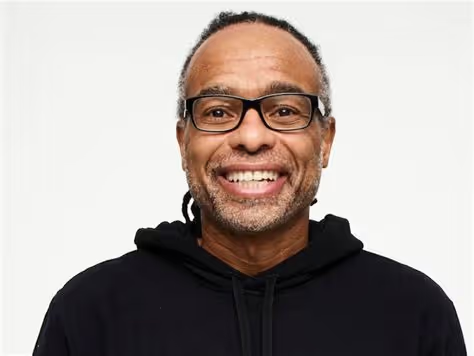
Donnie is an author, social entrepreneur and founder of the Post Growth Institute in Oregon which is an organization working to enable collective well-being within ecological limits. I start by asking Donny, from this window seat 250 miles above Earth, which place, city or country would you want us to fly over and why?
Donnie:
In 2002 I had the chance to spend a couple of months crossing Australia by foot And I would go back to the Nullarbor Plain. Nullarbor, an indigenous word for treeless. There's this expanse that runs for, gosh, almost 1, 000 kilometers with very few trees. And it's so quiet at night. But even though it's this flat open expanse of salt bush underneath every bush and within the sand and within the dirt, there's just like life that is teeming and as you traverse across this seemingly similar landscape for a thousand kilometers every 20 or 30 kilometers you just see these subtle changes in the landscape and I think it's a really really special special place.
Steve (host):
Donny give us a glimpse into your life story so far with an emphasis on what you are doing currently.
Donnie:
My life story so far begins in Sydney, Australia with sort of paradox, this birth into a family of significant privilege and wealth that at the same time had this big house in this very wealthy area, but was cash poor, with a father who is socially conservative and a mother socially progressive and this tension that was always around the dinner table was in the 2 different family lineages and every time throughout my schooling, throughout my university studies, this just constant presence of curiosity about why inequality and tension across division was so present in our society and our societies. And so all of these sort of paths steered me towards working with social projects across a range of fields. I guess I've been really lucky to have gained innovative insights from having worked in everything from defense to technology to education to human rights issues to working with the homeless to working in sports to working with young people. And I think having had a chance to work in these different fields, and I've spent time working in Egypt and Kenya and South Korea and Fiji, and most recently in the US for the last 8 years, these sort of chances to glimpse different stories have led me to a space where I'm often able to see things from different perspectives.
Donnie:
And what opened up for me about 10 years ago, I was working on a film called the Growth Busters questioning this notion of endless economic growth on a finite planet. I just finished a PhD looking at the global impacts of nanotechnology around the world with a particular emphasis on is nanotechnology going to address inequality and I kept coming to these same conclusions that our economic system has so much underneath it that is great and worth persevering with and worth building on and yet the fundamental systemic nature is 1 of accumulation of money. And that this creates problems of debt and that this is represented in the forms of business that we have operating. And what was really revealing to me about 10 years ago was to discover that there are other forms of business than our traditional for-profits that actually are significant within our economy. These not-for-profit forms of business like consumer cooperatives, government enterprises, foundation-owned businesses, non-profits that run business activities, including businesses like IKEA and the Guardian newspaper and Bosch, the engineering company, and all of the world's credit unions.
Donnie:
And discovering these organizations that I had actually been part of in Australia, these nonprofits that run business activities or these other forms of not-for-profit enterprise, opened up this whole other world for me where I could get it. I got a glimpse with my colleague, Jennifer Hinton, of a world where money circulated more freely. And as a result, power circulated. And as a result, resources circulated. And the abundance that we've been able to manufacture that serves a small portion of this world's population could actually be provisioned in service of the greater good in a way that would also allow us to live within ecological limits and in harmony with the other species on this planet.
Donnie:
So out of these findings I helped co-found the Post-Growth Institute, an organization that's looking at how we flourish within ecological limits, with that particular emphasis on the circulation of money, resources, and power. There are so many people excited about an alternative. And what's been missing is, what does that really look like? What's the fundamental operating system? And that's what the Post-Growth Institute is looking at addressing.
Donnie:
All the way through to the community level where we run these offers and needs markets and remind people there is so much richness that we each bring to the table. And it's really just a matter of how willing are we to take the time to unearth that and to, as a result, realize our potential to operate different kinds of markets, to reconnect with each other, to see the real people that are around us rather than just these consumer-based sort of avatars of each other. And that's an exciting thing to reconnect, to remember our potential as human beings and therein reimagine an economics that works for us all.
Steve (host):
Where on earth is your place of reset or recharge?
Donnie:
My place of reset and recharge is on my 8, 000 pinned Swedish healing mat. I bought this mat for $10 a number of years back. And I lie on it every day, sometimes for 5 minutes, sometimes for half an hour in my bed or on the floor. And I just chill out. These 8, 000 little pins that stick in my body.
Donnie:
And at first it's a little painful, the first few months, but after years of being on this, it's just a jump on it and it just relaxes my body. It allows me to easily drop into a meditative state. It reminds me of, I used to have the chance to spend time in float tanks. That's what actually got me through my PhD was living on 3 or 4 hours sleep a night but having an hour in a float tank every week and The Swedish healing mat is my equivalent of that these days.
Steve (host):
What wonder of the natural world excites you the most?
Donnie:
The wonder of the natural world that excites me the most is the abundance of seeds. Just think about when you open a pomegranate, the amount of seeds that are packed inside that pomegranate just blows my mind. I mean, I get so enthused just looking out my window and seeing how nature springs forth in the wake of a fire or every spring and I'm just fascinated by how abundant nature really is
Steve (host):
Donnie what is your story of hopefulness? That's not your own about a person business or nonprofit who are doing amazing things for the world?
Donnie:
My story of hopefulness is what I witnessed in response to fires that came through our communities and devastated our region in September of 2020. 3000 people were displaced along the I-5 corridor here in southern Oregon. And I put out a call on Facebook for people to join me in biking in water and supplies to the neighboring town of Tallent where access was shut off for vehicles to come in. And there were people who weren't able to evacuate, people with disability, elderly folk, who were stuck in homes without water, electricity, and even news. Some of them didn't have any mobile phones or access to information from the outside world.
Donnie:
And so what really inspired me in the wake of these fires was. 7 people joined me that afternoon, got on bikes, were in toxic smoke levels. Everyone's wearing masks. This is in the midst of COVID on top of this. Water and other things have been dropped off at this makeshift resource center that was a CrossFit gym that had been reconverted by my friend Lebo Potgieter.
Donnie:
And we've got 7 or 8 people show up. We bike in to this neighborhood. We find individuals who are really in need and haven't seen anyone for a couple of days and wondering what's happening. I put the call out, can more people join us tomorrow? And over 100 people in my small town, 100 people show up with their bikes, some of them with their kids in the front of the bikes, others with like these electric, long electric bikes, people who've already got water strapped on.
Donnie:
I'm in the midst of a meeting that I'm chairing up at my place. And LeBeau calls me and says, Donnie, you got to get here. They're like, people are ready to go. This is before the time that we'd even said we'd run off. And so I biked down and just see this place teaming with people who just want to respond.
Donnie:
It reminded me that we can do it. We can organize together. We just got to work out how we bring people together under these difficult conditions to give them a sense of hope. And what really also was hopeful was the way that it snowballed. But the last thing about this project is what came from that is a commitment to build back better because the people who were affected were largely Latinx families on the I-5 corridor who were living in mobile home parks where the fire roared through these series of mobile home parks.
Donnie:
And lots of folks there didn't own their homes or couldn't get insurance because of U.S. Legislation around mobile home parks. And a committed group of people have formed together and said we are not only going to rebuild, we're going to ensure that the future is filled with these people owning their homes and that the land be put into trust so that we stop the extractive behavior that was happening before this and we actually emerge with a more equitable, just and sustainable outcome as a result of these devastating fires.
Steve (host):
Finally, as we prepare to re-enter, what insight, wisdom or question would you like to share with us?
Donnie:
The insight I'd like to share with you is that because there is so much good happening in this world, It's really valuable to start every project, every talk we give, every article we write with what's working. Start with the strengths. That takes us into the creative neocortex as a reader, as a project participant, as a listener. When we start with the strengths, we open up the creative neocortex, which means we can respond in ways that are more creative. Rather than the standard approach in the media, in the way that we engage in projects, in the way that we give talks, which is to start with what's wrong.
Donnie:
When we start with what's wrong, and start with the problem and then try to fix it, we go into the back part of the brain, which we know is the flight, fight, freeze and fall in space. So that's my insight. Begin with what's working and it's actually a gateway to actually uncovering what's not working in a much faster, more efficient way but also in a more creative, hopeful, inspiring way as well.
Steve (host):
To find out more about the work of Post Growth Institute, go to postgrowth.org. If you want to find out more about Wonderspace, join the community or listen to the previous episodes. The website is ourwonder.space. I want to thank Donny for being with us on this Wonderspace orbit and I hope you