Episode #
11
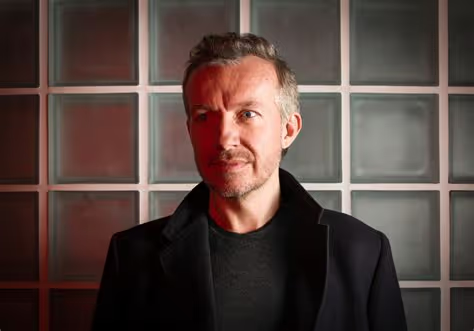
Fraser T Smith
Episode Summary
Q1: Place
If we could do a flypast on any part of the world that is significant to you, which place, city or country would it be and why?
New York
Q2: Life
Give us a glimpse into your life story so far with an emphasis on what you are doing currently?
Music scholarship, pulling pints, Guitarist, Rick Wakeman, Craig David, Producing, Kano, Stormzy, Dave, Adele, Future Utopia album around 12 questions.
Q3: Reset
Where on earth is your place or reset or re-charge?
Home in the Chilton Hills (UK)
Q4: Wonder
What wonder of the natural world excites you the most?
The Northern Lights
Q5: Hopefulness
What is your story of hopefulness (not your own) about a person, business or non-profit who are doing amazing things for the world?
The democracy of music. It's no longer being held by gatekeepers with locks on the doors who only let in a select few.
Q6: Insight
As we prepare to re-enter, what insight, wisdom or question would you like to share with us?
Freedom is available to everyone because freedom exists in your mind

Transcript
Steve (host):
Welcome to the 11th edition of Wonderspace which was originally released as a video orbit on the 15th of November 2020. Since then we've been asking the same 6 questions to people from around the world. Our questions revolve around life and wonder, places of reset and stories of hopefulness, which I think we need more than ever. The setting for all of our interviews is a virtual window seat on the space station from where we see everything from a different perspective. This week our orbit takes us up the east coast of North America and joining us In this ultimate window seat we welcome Fraser T Smith.
Steve (host):
Fraser is a Grammy award winning songwriter, producer and musician for the likes of Adele, Stormzy and Dave. Most recently Fraser released his debut collaborative album called Future Utopia which asks 12 questions to some of the sharpest creative minds in music activism and poetry. I start by asking Fraser from this window seat 250 miles above Earth, which place, city or country would you want us to fly over and why?
Fraser:
For me at this very moment, I would do a fly past New York. I think that the climate in America, I'm struggling actually to understand how intense that must be there Steve. But there must be hope and there must be unity. And I think at the moment the country must feel completely splintered and turned on its head with the lack of security of people knowing what the next chapter holds. I think it's something about New York that to me encapsulates America and I don't want to give those guys a fly-by.
Steve (host):
Fraser give us a glimpse into your life story so far with an emphasis on what you are doing currently.
Fraser:
I grew up in a small town near High Wycombe, 30 miles west of London and pretty culturally barren and I was drawn to music from a very, very young age. Didn't have musical parents but my nan was a self-taught stride piano player and used to play in the bars and clubs and I think picked up my love for music through her. And we used to go and see her in South London and I just used to marvel at her playing the piano. So I developed that love of music, not through formal training, but through listening to as much music as I could and had a small guitar when I was a kid and loved the guitar. Then going to secondary school, I developed that in the music room with Tom Rowlands from the Chemical Brothers, was a good friend of mine and we used to jam and explore different types of sounds on the guitar and drum machines and then took that love of music, started playing in bands, came out of school, didn't do particularly well, bought myself some time by doing a course in business studies, which was 1 of the last things that I really wanted to do, but just got me into London and then joined some more bands, but unfortunately joining bands wasn't part of the course syllabus for business studies so got thrown out after a year.
Fraser:
But on the side had managed to do some guitar training and actually was awarded a scholarship at the West London School of Music, which I did for 2 years and met some great musicians and then became a session guitar player. Makes it sound like I came out of music college and suddenly started doing great gigs. The bit in the middle, which was probably 5 years of lots of washing up, lots of pulling pints and doing kind of jobs I didn't really want to do, existed and then worked my way up to playing with people like Rick Wayman through playing in bars and clubs and I guess doing what my nan had done, you know, playing at, had a residency at All By 1, St. John's Word, at the Marriott in Heathrow, you know, where people really not interested in hearing your music but you're doing it because you love it and you're developing your craft. So then I had an amazing few years with Rick Waitman and Tony Hadley touring and recording loads of albums with Rick.
Fraser:
So that was an amazing apprenticeship as a musician to learn from 1 of the masters of modern music. Then got the opportunity of playing with a very young at that time Craig David who was 17 when I met him and he gave me a demo cassette of 4 songs which was Fill Me In, 7 Days, Walking Away and Rendez-vous and I just thought at that point I was starting to get into music production but I thought I can't resist playing guitar with this guy because it's just so fantastic. We ended up having an amazing 5 years together, we toured the world and then I made the decision that I really wanted to become a writer and a producer. So I started that in a timely fashion because I just met the love of my life Sarah at that point and she had introduced me to her and now our lovely daughter, Amber, who was 2 at the time. So I became a producer, a husband and a dad in very short succession, which was the most mind-blowing experience.
Fraser:
But we then, going from guitar player to producer is not as smooth a transition as you'd think. I had all the musical skills but there was a lot of technique to learn in the studio so took me a while but had the support of Sarah who stood behind me the whole way because we had some pretty lean years financially in terms of not being able to get the kind of gigs that I aspired to because I was just learning. So I turned down lots of well-paying guitar jobs, but I had to be very strong in what I wanted to do. And then started working with Kano and Plan B in the early days of UK grime and where hip-hop was coming to the fore and then wrote a song with James Morrison and An amazing writer called Nina Woodford called Broken Strings Which did really well and at the same time? Had written a song with Tinchy Strider called Take Me Back and Tire Cruise.
Fraser:
That went to number 2 and I think Broken Strings was number 3. And then had a run of number ones with artists like Adele, Set Far to the Rain, Sheila, his Ladykiller album. I think I had 3 number ones with Tinchy Strider and Dappy and went to America and started exploring all the opportunities there with artists like Britney Spears and Celine Dion and then hit a little bit of a wall because everything had happened quite quickly and thought that maybe I'd have my day in terms of production because I'd won a Grammy, I'd had loads of number ones, I'd done really well and I wondered whether that was it. So formed a publishing company called 70 Hertz with a view to signing young artists. And then I met Kano who, as I said before, I'd worked with at the beginning of his career and has been a long time collaborator.
Fraser:
And we decided to make a record called Made in the Manor where he didn't have a deal and I was doing it just for the love of it, so really regained the love of music. And it turned out that it did really, really well and it was nominated for a Mercury Prize And then in the mix of that, I met up with a young Stormzy who wanted me to work on his first record. So I was able to do something with him that I'm very proud of. And in the mix of all of that, Damon Orban approached me to work on the Gorillaz record, so it was a bit like I had a few years where I wasn't too sure what was going on and then all of a sudden all the buses arrive at once. And then Dave approached me to start working with him and again a completely different dynamic because he and I write principally on piano so we ended up doing 2 EPs together and his first album and then hit and I call them walls but I'm not afraid of the walls so I don't want it to feel as though I'm ungrateful.
Fraser:
I do definitely come to these walls or cliff faces or edge of the cliffs where I sort of feel I have to do something, reinvent myself in order to move forward because I think that for me to do another record in the vein of Made in the Manor, Gangstas and Peril Psychodrama. I'm not sure how I could reinvent myself or help any other artist, so I decided to take a break and in that time came up with The 12 Questions, which is the bedrock of my record. So it's in effect a solo record, but it's under the name of Future Utopia. And it's asking 12 questions to some of the sharpest creative minds in rap music and singing, in alternative music and activism, in poetry. And I've got some incredible answers and had a ball making the music and interviewing the artists for the record.
Steve (host):
Where on earth is your place of reset or recharge?
Fraser:
I would say the place of reset is our home. Sarah and I, my wife, have created this space in the middle of a valley in the Chiltern Hills and the studio is right in the middle of here, the house, Sarah's Sculpture Studios next door, I feel that this is utopia for me.
Steve (host):
What wonder of the natural world excites you the most?
Fraser:
I think of All the wonders the Northern Lights excite me the most. Sarah and I went to Finland and took some skidoos out in the middle of the night and were able to see that and I think the sense of awe that you feel when you're looking up at those, the sense of wonder, the sense of possibility, the sense of infinity is something that that never leaves you once you've you've seen those.
Steve (host):
Fraser what is your story of hopefulness that's not your own about a person business or nonprofit who are doing amazing things for the world.
Fraser:
What I found through my career is that now the democracy of music is really exciting in that whether you're through a council estate or a project in America or some kind of ghetto in Africa, you can make some kind of music that can be recorded in a basic way and if it's good, it can be shared. So I think that the modern culture of self-expression is 1 that's so wonderful and it's not being held by the gatekeepers really with the locks on the doors that only let a select few through. I think that democracy and that freedom is really what's inspiring me at the minute.
Steve (host):
Finally, as we prepare to re-enter, what insight, wisdom or question would you like to share with us?
Fraser:
Well it's interesting looking down on the world from this wonderful viewpoint and when I was thinking about this question I thought about my meeting with Albert Woodfox who is on the album and is a black panther that was incarcerated for 43 years in a 6 by 3 feet cell for a crime that he didn't commit for 23 hours a day. The thing that struck me most about asking him what the cost of freedom was, and I had no idea how he was going to answer that, was that he views freedom as a construct within your own mind. So whether you're sat like Tim Peake looking down at the world from wherever your point of view is, or you could be held in solitary confinement, Albert's argument is that freedom is available to everyone because freedom exists in your mind. And I think that in these days of lockdown and in these days of political insecurity and financial insecurity, it's really interesting to take away that thought from someone that has really lived on the extreme end of life and of extreme end of captivity to let us know that that you can actually be free in your mind.
Steve (host):
The Future Utopia album is extraordinary and so worth taking a listen with your best headphones. You can find out more at futureutopia.com If you want to find out more about Wonderspace, join the community or listen to the previous episodes. The website is ourwonder.space I want to thank Fraser for joining us on Wonderspace and I leave you with the last 90 seconds of a track that asks what's the cost of freedom and includes the words of Albert Woodfox who was a former Black Panther released from prison after 43 years in solitary confinement.
Fraser:
So freedom isn't about your external situation or your environment.
Speaker 2:
Well, it gives you the ability to control your environment. That's what freedom is. It's the ability, like I say, to take your philosophical views or your theoretical views or your personal views or whatever and make it real. You know, move it from within yourself to outside yourself. Like I said, I think I achieved mental, emotional, and philosophical freedom when I was around in my early 40s.
Speaker 2:
When I reeducated myself and had accumulated enough experience and wisdom where I was able to define what kind of person I've been wanting to be for the rest of my life. But at the time, also time, that I realized that there was a limitation to what I could achieve because I was physically still in prison.