Episode #
9
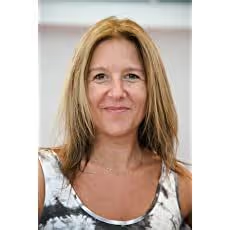
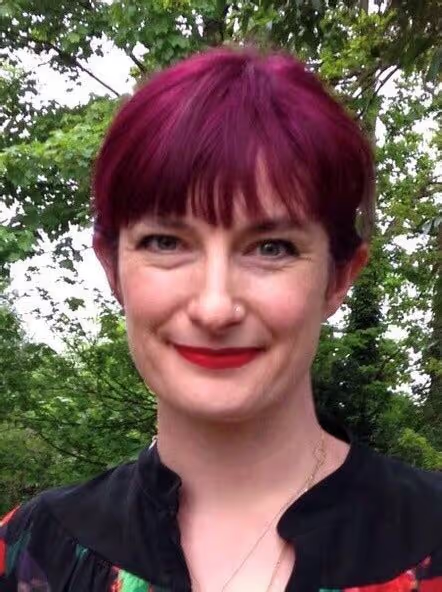
Sara Hyde
Episode Summary
Q1: Place
If we could do a flypast on any part of the world that is significant to you, which place, city or country would it be and why?
The Rangitoto Volcano in New Zealand
Q2: Life
Give us a glimpse into your life story so far with an emphasis on what you are doing currently?
Theatre, structural politics, prison reform, Tedx talk, chair of the Fabian Women's Network, pursuing a PhD in prison health.
Q3: Reset
Where on earth is your place or reset or re-charge?
The river Thames
Q4: Wonder
What wonder of the natural world excites you the most?
The human heart
Q5: Hopefulness
What is your story of hopefulness (not your own) about a person, business or non-profit who are doing amazing things for the world?
People who have lived experience of the criminal justice system and are now leading incredible work in this area. (see the organisations below)
Q6: Insight
As we prepare to re-enter, what insight, wisdom or question would you like to share with us?
I am what I am because of who we all are. Ubuntu

Transcript
Speaker 0:
Welcome to the ninth edition of Wonderspace which was originally released as a video orbit on the 2nd of November 2020, the week of the US election. Since then we have been asking the same 6 questions to people from around the world. Our questions revolve around life and wonder, places of reset and stories of hopefulness which I think we need more than ever. The setting for all of our interviews is a virtual window seat on the space station, from where we see everything from a different perspective. This week our orbit takes us from South Africa to Russia and joining us in this ultimate window seat we welcome Sarah Hyde.
Speaker 0:
Sarah has spent over a decade investing her time and energy into local politics and community activism in North London. Sarah is on the executive committee of the Fabian's Women's Network and writes and speaks on criminal justice which you will hear as part of her story. I start by asking Sarah from this window seat 250 miles above earth, which place, city or country would you want us to fly over and why?
Speaker 1:
The city I would most like to fly past in the world that is significant to me is Auckland. It's 12, 000 miles away and my mum's family live there. My cousin is there. I'm going to try and do this without crying. And I'm very close to my cousin and sometimes 12, 000 miles is a very, very long way, even in a hyper-connected world.
Speaker 1:
And I've had many significant life moments there. She has 2 beautiful children and she had cancer a few years ago, but all is well now. And there's a beautiful dormant volcano. When I go to Auckland, I like to visit called Rangitoto. And there's something about looking at that volcano and knowing just how long it's been there for that helps me check my thoughts about my own significance in the world and there's something very grounding to go back to that at different points in my life and to visit it with my cousin.
Speaker 0:
Sarah, give us a glimpse into your life story so far with an emphasis on what you're doing currently.
Speaker 1:
A glimpse into my life story so far, I've always been really passionate about other people and caring for other people and creating a better place for us all to live in really and I tried to do that initially through a career in theatre. I've been involved with the Caledonian Road area of London for about 17, 18 years now doing various community work, homelessness projects, all kinds of things like that. And then I began to volunteer in prison and ended up working in prisons. And I guess That was a bit of an awakening for me really, having been a kind of grassroots activist and finding myself in this environment where it wasn't just individuals that we were dealing with, there was just these themes of extreme poverty, addiction, childhood abuse and trauma, adverse childhood events, terrible mental health, just these kind of structural themes that kept presenting themselves to me in a way that I felt like I could no longer ignore. And there's a Martin Luther King quote about the story of the Good Samaritan.
Speaker 1:
People might be familiar with that. Somebody's attacked and several people walk on by and then eventually the Good Samaritan comes along and bandages them up and they recover. But there's a Martin Luther King quote that says, true compassion is more than flinging a coin to a beggar It comes to see that a system that produces beggars needs to be repaved We are called to be the good Samaritan, but after you lift so many people out of that ditch you start to ask maybe the whole road to Jericho needs to be repaved. And I think it's thinking like that that has changed what I've done with my life. So it's great to be involved in food banks or to work in prisons with individuals.
Speaker 1:
But for me, that was a call to get involved in party politics, in structural politics, so we could repave that Jericho road because I was spending my life triaging victims of a broken system rather than dealing with the system itself. So I went as a very kind of naive grassroots activist onto a women's mentoring scheme run by Fabian Women's Network and that just plugged me into this kind of world of structural politics, Labour Party politics and that was 7 years ago and then in that time I've gone on to be a London Assembly candidate, a Parliamentary candidate, and then I've become a local councillor and recently became the Chief Whip for the council in the area that I represent. I've also become the Chair of Fabian Women's Network and recently begun a PhD in Prison health. And when I started as chair of Fabian Women's Network I really wanted to look at our values and we did a whole exercise and we now try and run everything as an organisation out of the values of sisterhood, solidarity and service. Because actually for me it's very easy in the political world to lose sight of why you started this journey and so those values of sisterhood, solidarity and service are something that I can keep returning to in my practice and I just I get it wrong all of the time And I need something to anchor me, you know, a set of values I can look at and think, why am I doing this again?
Speaker 1:
What is the purpose? What is the reason? And the reason is to serve communities. And as Bonhoeffer said, rather than bandaging the wounds of victims beneath the wheels of injustice, to actually to drive a spoke into the wheel itself and that is something that in my very tiny way I'm trying to do with groups of people in different parts of our world.
Speaker 0:
Where on earth is your place of reset or recharge?
Speaker 1:
My place of reset is the River Thames. I was born on the Thames, obviously in some romantic teenage fantasy, literally on the banks, but no in hospital, that is on the Thames. And when I was a teenager I read this Jeanette Winsome book called Sex and the Cherry and there's a woman who lives literally on the muddy banks of the Thames and that like set my imagination totally alight as to like just the longevity of that river, the history of that river, again the sense of something just bigger than me and still living in London I just love it. Whenever I have to cross the river or go to the river I just look at it and I'm like it's okay, life is long and there are many threads and there are many people and there's a lot that is much bigger than you so are much more enduring than you and that river is like a constant in my life and a kind of thread in my life and helps me remember to not get above myself really.
Speaker 0:
What wonder of the natural world excites you the most?
Speaker 1:
The wonder of the natural world that excites me the most is actually the human heart. For about 15 years I've been trying to make a piece of theatre about the human heart because I find it endlessly fascinating as the kind of biological mechanism but also all of the kind of spiritual symbolism, its symbolism in romance, its potency, these stories of like heart transplant patients that take on the characteristics of other people, but this thing that starts before we're born and goes all of the time until we die. The way that that travels with us, the way it grows with us, just the way it makes our body functions as well as all of those other resonances. I just find that endlessly fascinating. I mean you can explain it to me in terms of the science and the biology and I can comprehend it at that level but there's another level at which it fills me with awe.
Speaker 0:
Sarah, what is your story of hopefulness that's not your own, about a person, business, or non-profit who are doing amazing things for the world?
Speaker 1:
My story of hopefulness is about all the people I know that have lived experience of the criminal justice system and are now doing something flipping phenomenal to make it better for other people. My friend Tony was 15 years in and out of prison in recovery. He has set up a charity, Hope and Vision, which is about housing people after they come out of intensive rehab. My friend Mandy, long history of a very, very difficult life, long in and out of prison, went on to become a drugs worker, again now runs housing projects for women that are intensive rehab recovery housing. My friend Paula runs Prisoner Policy Network at Prison Reform Trust, Paula Harriot, and she has gone down the more structural end of things like me and is looking at how we can get the voices of people with experience of prison and of criminal justice to change the policy and practice in our system and really honouring people's experience and wisdom from their life experiences that put them in that place in the first place and then how they moved on and move through.
Speaker 1:
And those 3 people, I just, they're some of the best people that I know because the kind of adversity that people have to overcome to get into those places and then to be able to speak, you know, truth to power from that lived experience is really profound and they are just honestly some of the bravest and best people I know and they challenge me constantly to be better, to dig deeper, to go further in the pursuit of real justice because our system is so broken and they are all just really proactively involved with a deeper level of justice, a deeper level of community, a deeper level of healing and restoration and they just always give me hope because they are phenomenal human beings.
Speaker 0:
Finally as we prepare to re-enter what insight wisdom or question would you like to share with us?
Speaker 1:
The wisdom I would like to share that has challenged me for many, many years now is Desmond Tutu's idea of Ubuntu, which is I am what I am because of what we all are, and just the profound interconnectedness of humanity. So when Black Lives Matter happens, like I need to deeply engage with that because I am what I am because of who we all are. When it's the Trans Day of Remembrance, I need to deeply engage with that. When I look at prisons, I need to deeply engage with who is in them and why it is so and what we need to do differently because I am what I am because of who we all are and I guess that's about my socialism, my values, my faith. We are profoundly interconnected, we are profoundly relational and if we're going to build a better society we need to look in every corner for the people that have not been in the narrative in the mainstream or listened to and really listen and give space to that and change off the back of it because I am what I am because of who we all are.
Speaker 0:
In her story of hopefulness, Sarah passionately talked about 3 organizations. You can find out more at hopeandvision.org.uk, find out more at hopeandvision.org.uk, treasuresfoundation.org.uk and prisonreformtrust.org.uk. Sara also spoke at a TEDx event in Exeter entitled We Need to Talk About Prisons, which you can also check out online. If you want to find out more about Wonderspace, join the community or listen to previous episodes, the website is ourwonder.space I want to thank Sarah for joining us on Wonderspace and I hope you can join us next week for more wonders and stories of hopefulness.